
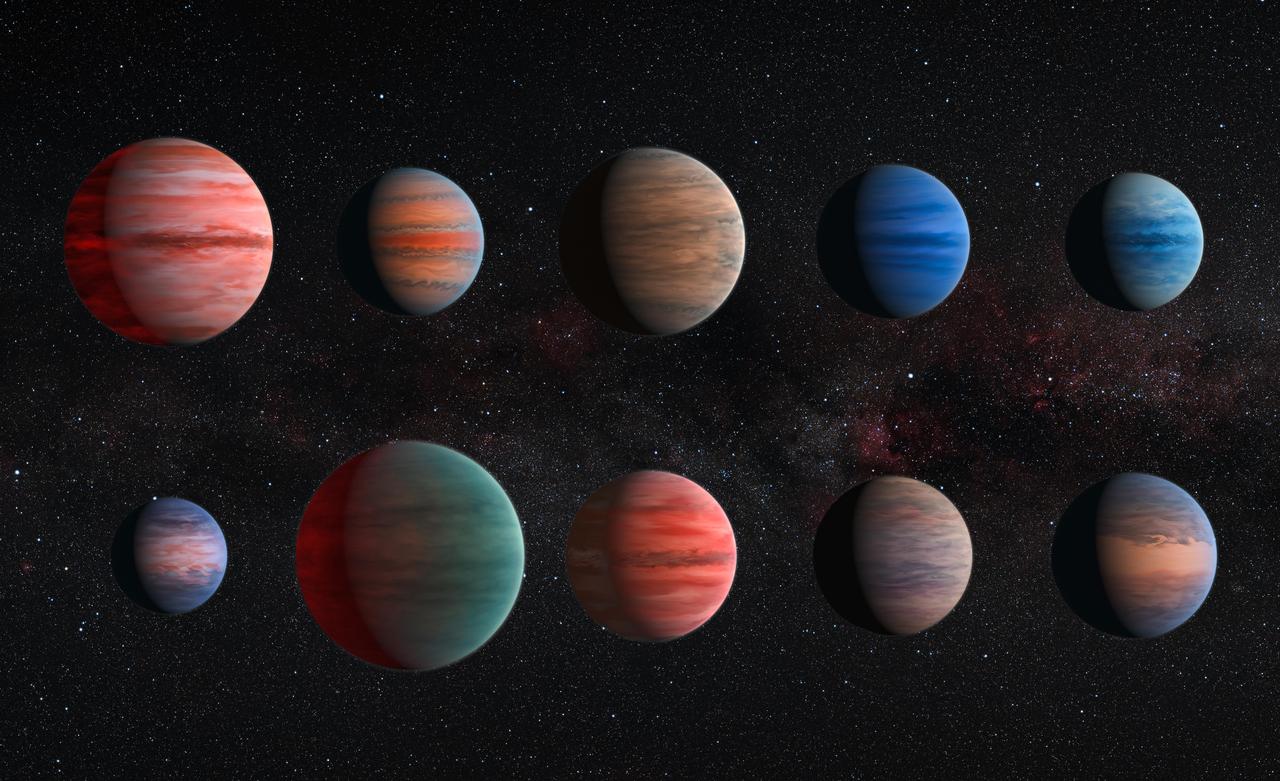
Astronomers using the James Webb Space Telescope have mapped a daily weather cycle on a planet 700 light-years away, watching mineral clouds form and evaporate over the course of its day. The world, WASP-94A b, is a "hot Jupiter" — a gas giant orbiting so close to its star that a full circuit takes days, not years.
Reading the morning and evening separately
The trick was geometry. As WASP-94A b transited its star, Webb examined the planet's leading and trailing edges separately, effectively sampling the morning and evening hemispheres on their own. The two could hardly be more different: the cooler morning side is blanketed in clouds of magnesium silicate, while the evening side, where temperatures exceed 1,000 degrees Fahrenheit, is nearly cloud-free — the minerals condensed into cloud overnight have evaporated by dusk.
Less exotic than it looked
The observation also corrected the planet's record. Earlier measurements had suggested WASP-94A b held some 500 times more oxygen and carbon than Jupiter; the new Webb data put that figure at only about five times — making the planet far more Jupiter-like in composition than once believed, and underscoring how much earlier inferences depended on incomplete data.
"We've finally pinned down what the clouds are made out of and how they're condensing and evaporating," the team reported. The study, published in Science, was first-authored by Sagnick Mukherjee, then a postdoctoral fellow at Arizona State University, with co-author David Sing of Johns Hopkins University. It is a concrete demonstration of a capability that barely existed a few years ago: resolving weather, region by region, on a planet too distant to ever image directly.
