
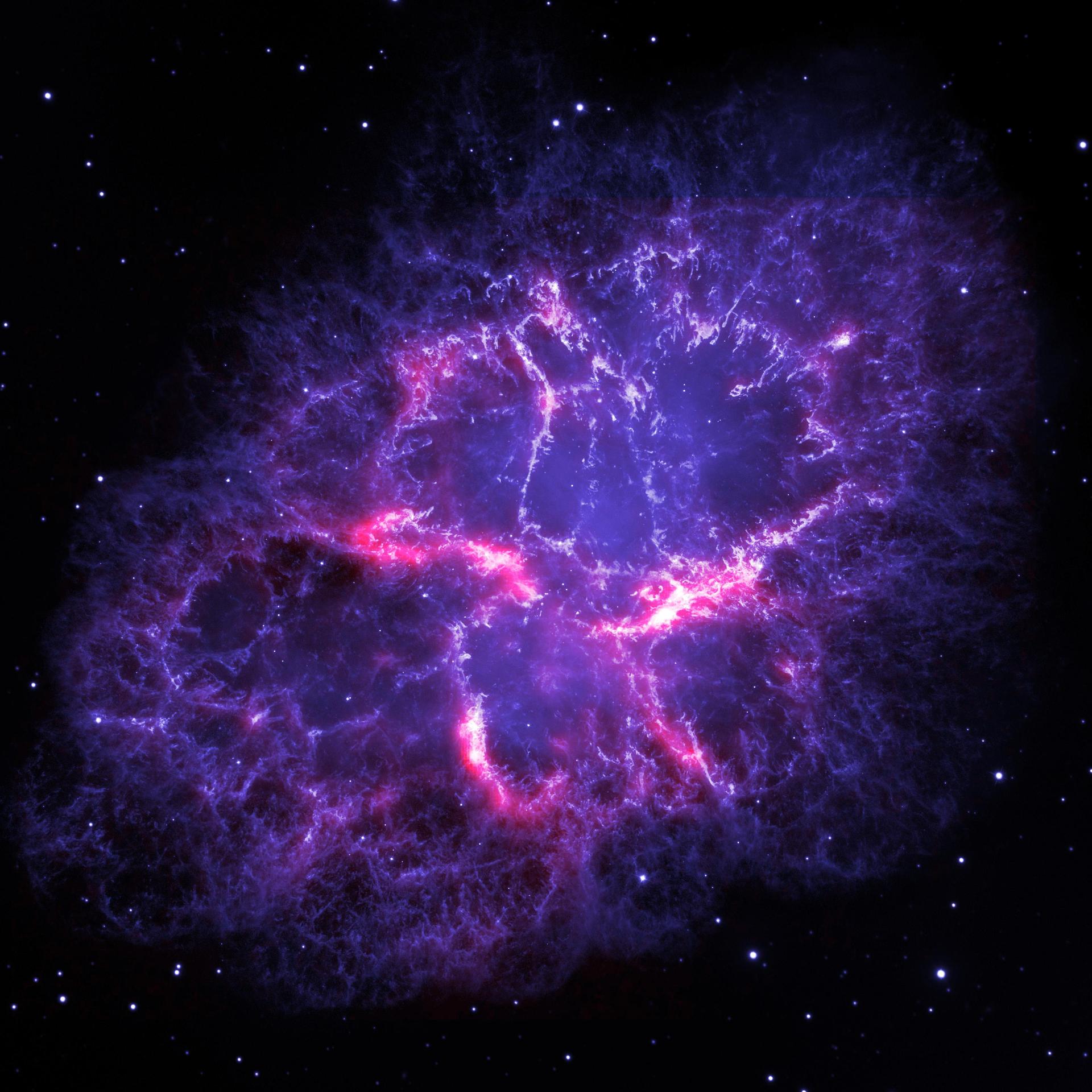
In 1181, observers in Japan, China and the Arabic-speaking world recorded a new star in the sky. For centuries afterward, its leftovers went unidentified. It was one of five supernovae recorded before the telescope whose remnants had never been pinned down. Today the leading candidate is Pa 30, a strange nebula about 7,500 light-years away in Cassiopeia. A new set of deep images from the Gemini North telescope shows that the nebula's spiky filaments are not smooth at all. Each one is a string of knots.
The work, led by Tim Cunningham of the Center for Astrophysics (CfA) and Ilaria Caiazzo of the Institute of Science and Technology Austria (ISTA), with co-authors Raymond and Kenyon, is in press at The Astrophysical Journal. A preprint is available as arXiv:2610.06424.
An unusual object to begin with
Pa 30, also catalogued as IRAS 00500+6713, is not a typical supernova remnant. According to Universe Today, it is thought to be the product of a Type Iax event, a kind of thermonuclear explosion linked here to merging white dwarfs. Unlike a standard thermonuclear supernova, this one did not destroy its star completely. ISTA's announcement describes a surviving "zombie star" at the core of the nebula.
That central object is extreme. Universe Today reports that the white dwarf may be super-Chandrasekhar, at about 1.5 solar masses. It has a temperature of roughly 200,000 °C and drives winds of about 16,000 km/s, which are record speeds. Around it lies a web of radial filaments that has drawn comparisons to a firework frozen mid-burst.
What the new images show
The team used the Gemini Multi-Object Spectrograph (GMOS) on Gemini North, part of NOIRLab, to take deep narrowband images. Narrowband filters pass only a thin slice of the spectrum, which lets astronomers isolate light from specific ions. Earlier images of Pa 30 were made in [O III], doubly ionized oxygen. The new observations focus on [S II], singly ionized sulfur. Universe Today notes that the [S II] images reveal far more detail than the earlier [O III] ones.
The results fall into a few groups:
- Many more filaments. The paper reports about an order of magnitude more detected [S II] filaments than previous studies found.
- Knots, not streaks. The filaments are, in the authors' words, cascades of knots or clumps. They look like beads on a thread, not smooth radial streaks.
- Knot sizes. The characteristic knot diameter is about 1016 cm. ISTA puts that another way: each knot is wide enough to fit ten times Neptune's orbit, with room to spare.
- Same source for two emissions. The team reports the first confirmation that the diffuse [O III] emission seen in Pa 30 comes from the same filaments that glow in [S II].
- A well-centered star. The center of the nebula is consistent with the position of the central star. That puts a 3-sigma upper limit of about 100 km/s on any "kick" the surviving star got from the explosion.
Reading the knots
Each finding carries information. The knot structure shows that the ejected material is clumped, which gives modelers a specific shape to reproduce, not just a general outline. Because the [O III] and [S II] emission come from the same filaments, astronomers do not need two separate structures to explain the two kinds of light. They can model one set of filaments that emits both.
The kick limit is a separate constraint. Universe Today quotes the authors noting that many Type Iax models involve a failed detonation or an off-center partial deflagration, so the surviving remnant can receive a substantial recoil kick. Here the nebula's center is consistent with the star's position, which the authors take to mean the remnant has not received a large transverse kick, within about 100 km/s at 3-sigma confidence. Any account of how this partial explosion unfolded has to fit inside that limit.
The paper does not settle every question about Pa 30. It does not, for example, explain in full detail how the knots formed. What it provides is a much sharper observational picture: roughly ten times as many filaments to work with, and a measured knot size to compare against simulations.
Why It Matters
Type Iax events are a rare class of stellar explosion. Pa 30 is unusual for two reasons. It is linked to the historical record of the 1181 event, and its surviving star can still be studied directly. Together, those make it a nearby test case where theory can be checked against an actual remnant. Caiazzo says its proximity makes it uniquely valuable for study.
The new Gemini North data narrow the options. Any model of the merger and partial explosion now has to produce knotted filaments with knots around 1016 cm across, put the [O III] and [S II] emission in the same structures, and leave the star with a kick below about 100 km/s. The study also connects modern instruments to observations made by sky watchers more than eight centuries ago.
