
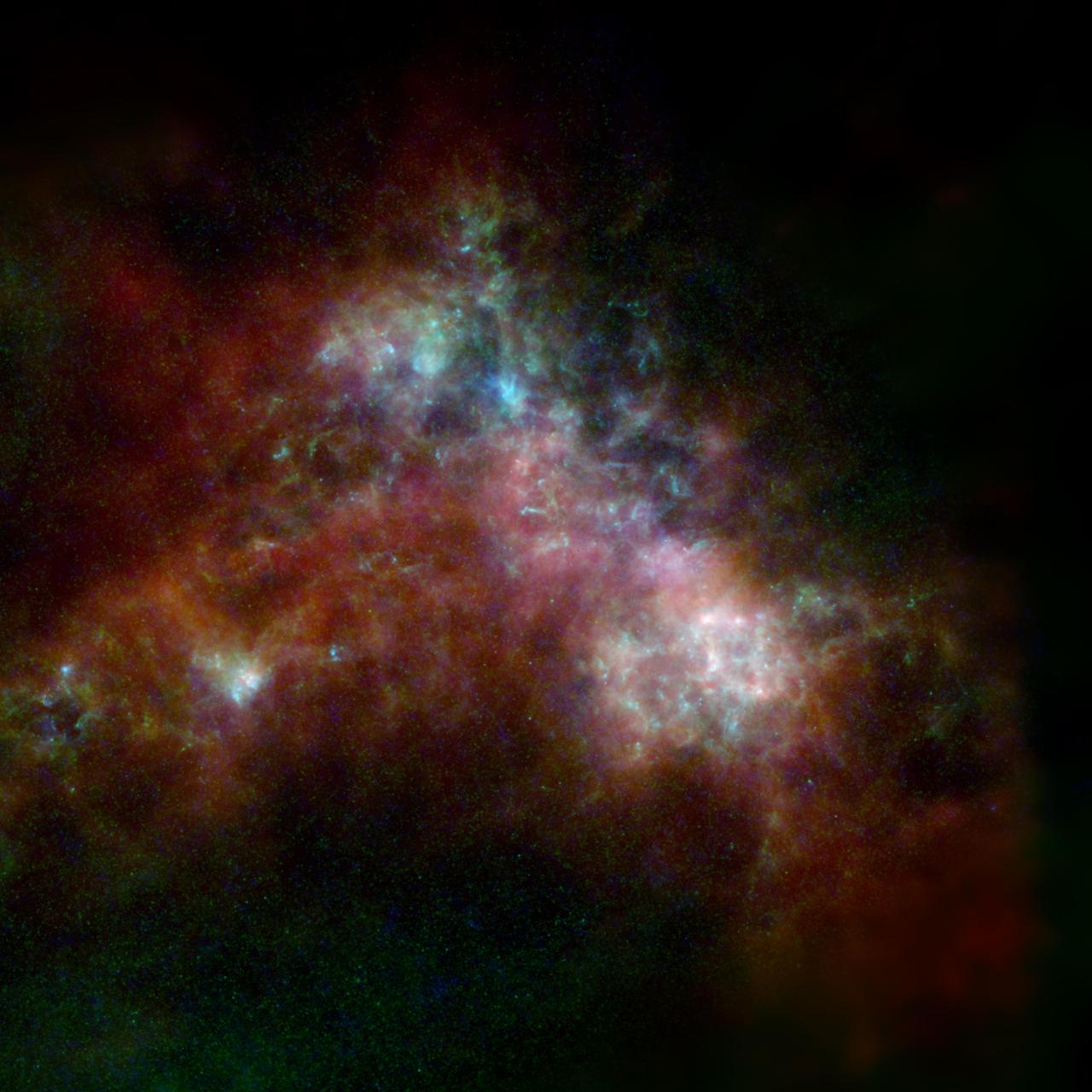
Cosmic dust is not a nuisance to astronomers so much as a building material: it seeds planets and helps cool the gas that forms stars. Where the universe's first dust came from, when galaxies had barely begun enriching themselves with heavy elements, is an open question — and the James Webb Space Telescope has found an unexpectedly good place to study it close to home.
A primitive galaxy as a time machine
Sextans A is a dwarf galaxy about four million light-years away with only 3 to 7 percent of the Sun's metal content — chemically primitive enough to serve as an analog for galaxies in the early universe. Using its mid-infrared instrument (MIRI) and near-infrared camera (NIRCam), Webb detected two kinds of dust that should be hard to make in such metal-poor conditions: metallic iron dust and silicon carbide forged by aging stars on the asymptotic giant branch, and polycyclic aromatic hydrocarbons — complex carbon molecules — concentrated in small, dense gas clumps.
Why it reframes the early universe
The significance is that stars apparently produced solid grains even without the silicon and magnesium that dominate dust today, implying more diverse formation pathways than models assumed. "Sextans A is giving us a blueprint for the first dusty galaxies," said Elizabeth Tarantino of the Space Telescope Science Institute, who led the work with colleague Martha Boyer. "Dust in the early universe may have looked very different from the silicate grains we see today," Boyer added. One study has appeared in the Astrophysical Journal; a companion paper is under review. The takeaway is that the recipe for cosmic dust was richer, and started earlier, than the standard picture allowed.
