
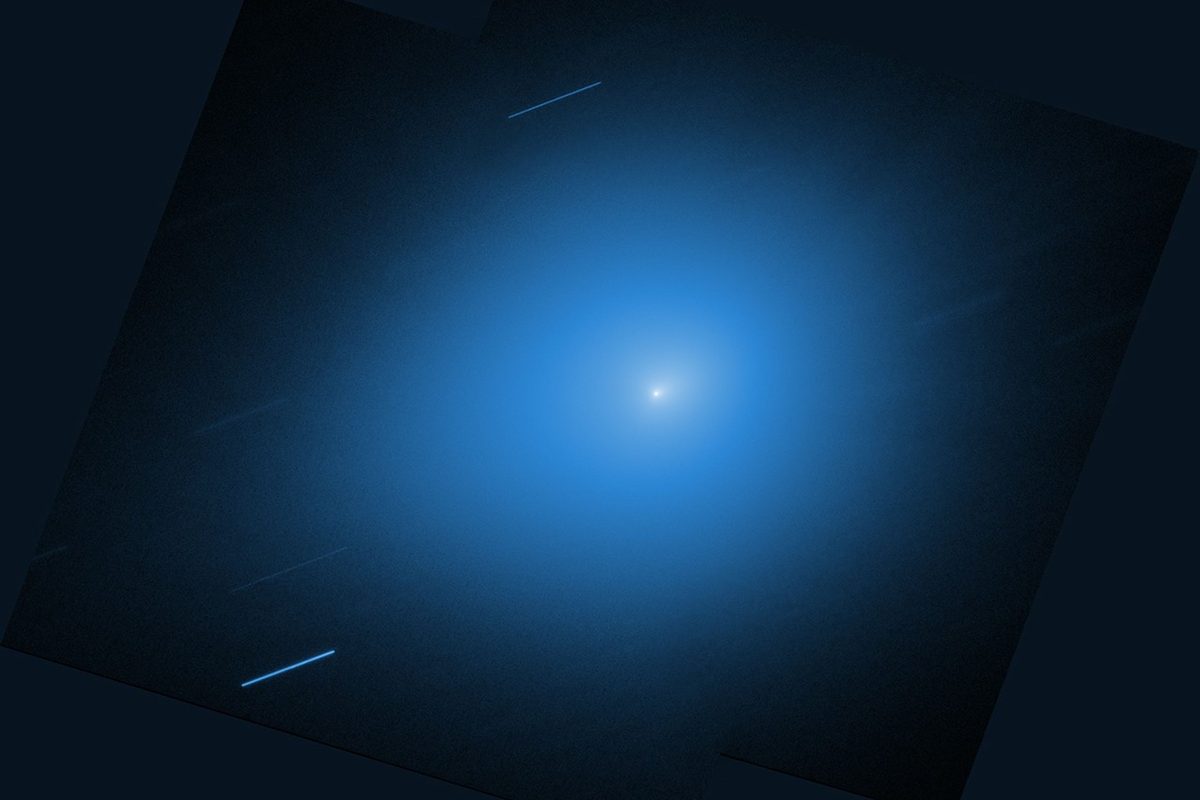
Most of what we know about how comets form comes from comets that formed here. Interstellar object 3I/ATLAS is a rare exception, and a new measurement of its chemistry shows how different another planetary system's ice can be. Using the James Webb Space Telescope, a team led by Nathan Roth of NASA Goddard measured how much heavy hydrogen is locked in the comet's methane. The result is the highest deuterium-to-hydrogen ratio ever recorded for methane, by a wide margin.
The paper, "An enriched methane D/H ratio in the interstellar object 3I/ATLAS," appeared online in Nature Astronomy on October 23. It got wider attention this week after Sci.News covered it on November 4. An earlier version is on arXiv as preprint 2603.20445.
The number
The headline figure is a methane D/H ratio of (3.18 ± 0.30) percent. In other words, a little over three of every hundred hydrogen atoms in the comet's methane are deuterium, the heavier isotope that carries a neutron as well as a proton.
According to the paper's abstract, that is higher than any other methane D/H value measured in the Solar System. It is also a factor of 13 ± 2 above the methane in comet 67P/Churyumov–Gerasimenko, which the European Space Agency's Rosetta spacecraft studied up close. Other versions give slightly different numbers. Sci.News and the arXiv abstract quote about 3.33 percent, and Sci.News gives roughly 14 times 67P. The values above come from the published Nature Astronomy abstract.
The ratio also stands out against other organic molecules. Sci.News quotes the authors saying the closest direct measurement for organic molecules in the Solar System is a D/H of 1.5 percent, for organic radicals in the Orgueil meteorite, and that the 3I/ATLAS value is at least a factor of 1.4 higher than any such measurement.
How Webb got it
The observations used the integral field unit on Webb's NIRSpec instrument. They were made on December 22 and 23, 2025, when the comet was about 2.4 astronomical units from the Sun. An integral field unit records a spectrum at every point in its field of view, so the team could look at the gas in the coma, the cloud that forms as the comet's ices warm and sublimate.
Methane was one of several molecules detected. The spectra also showed methanol, ethane, formaldehyde, water and carbon monoxide. Carbon monoxide was the most abundant of these in the coma, with a production rate roughly 3.6 times that of water, according to Sci.News. The spectra were good enough to pick out the faint deuterated form of methane, CH3D, as well.
Why deuterium is a thermometer for ice
Deuterium enrichment works as a record of where and how a molecule formed. At very low temperatures, chemical reactions on dust grains and in gas tend to favor building deuterium into molecules. The colder and more isolated the setting, the more deuterated the resulting ices can get. A high D/H ratio therefore points to a cold birthplace. The pattern across different molecules in the same body can then say something about the order and conditions in which they formed.
The paper notes one pattern the two comets share. In both 3I/ATLAS and 67P, methane is more deuterated than water. The difference is the overall level, and in 3I/ATLAS it is much higher.
The authors conclude that the value is consistent with ices that formed in a cold, low-metallicity interstellar or protostellar environment under high cosmic-ray irradiation. "Low-metallicity" means the material had fewer elements heavier than helium than our Solar System's birth cloud did. Taken together, that points to a birthplace different from the one that produced the Sun's comets.
Where the models fall short
The measurement is cleaner than the explanation. Sci.News quotes the authors saying it is uncertain whether theoretical models of either star formation or disk chemistry can reproduce the methane D/H ratio in 3I/ATLAS's ices, and that this should ideally be confirmed by new chemical models. The comet could be showing chemistry that theorists have not fully worked out.
There is some indirect support from observations elsewhere. Sci.News reports that the authors used deuteration in another hydrocarbon, cyclopropenylidene, as a proxy, and that their estimates suggest methane D/H could reach roughly 4 to 7 percent or more in some star-forming regions and cold cores. If methane in such cores reaches similar levels, 3I/ATLAS's value would be plausible for interstellar material rather than extreme. The authors describe the evidence that interstellar and protostellar D/H ratios could match 3I/ATLAS as tentative.
That is still an inference. The proxy comes from a different molecule. And the step from "possible in star-forming cores" to "what happened in 3I/ATLAS's home system" rests on assumptions about how much original ice survives the formation of planets and comets.
Why It Matters
Isotope ratios are one of the few ways to compare the chemistry of different planetary systems directly. The authors note that D/H in methane has not been constrained in extrasolar sources to date. An interstellar comet passing through our Solar System offers something better: a single body made in another system's planet-forming zone, observed up close with a telescope sensitive enough to pick out deuterated methane.
The result gives a concrete answer to a question that was speculative until recently: do ices from other stars look like ours? At least for methane in this one object, they do not. The D/H ratio exceeds any other methane value measured in the Solar System and, per the authors, any direct organic measurement there. The authors' preferred explanation is a colder, metal-poorer and more irradiated place of origin.
The finding also gives modelers a firm number to aim for. If disk and star-formation chemistry codes cannot produce methane at around 3 percent deuterium, either the codes are missing something, or 3I/ATLAS formed under conditions they do not currently cover. Either way, one comet has given the field a specific target to test against.
It is a single object and a single molecule. The same caution applies to any one data point, however unusual. But the measurement comes with stated uncertainties, it was published in a peer-reviewed journal, and it was made with an instrument suited to the job.
