
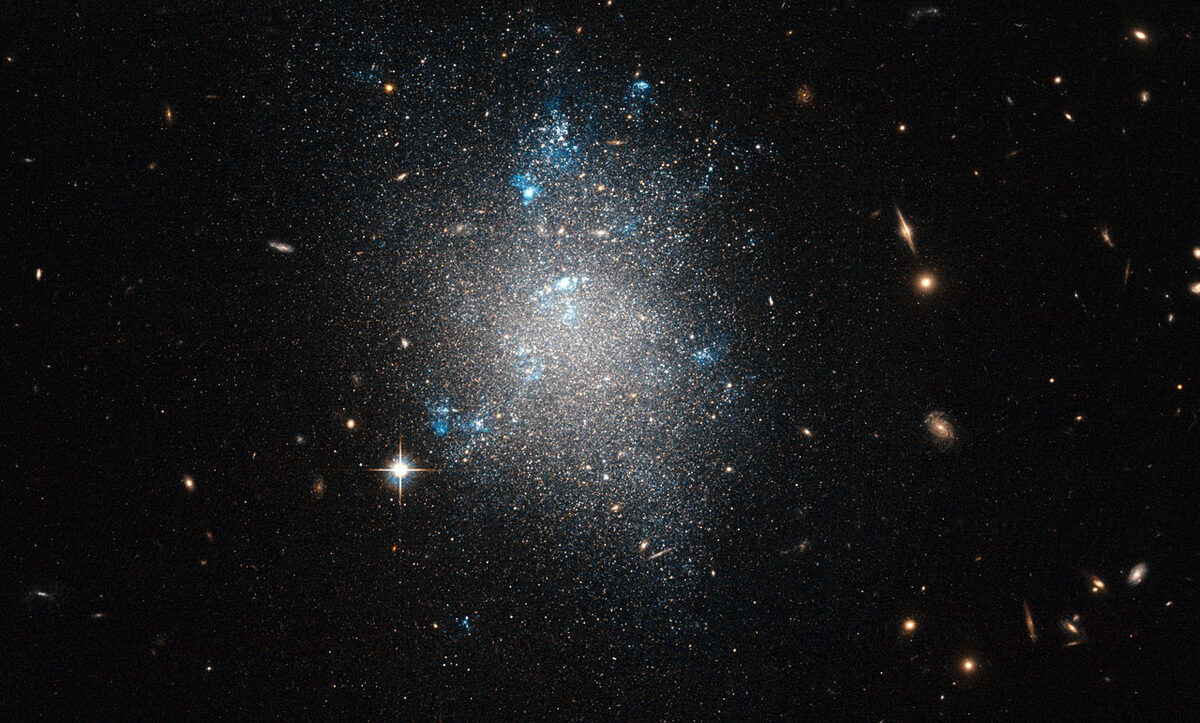
Each galaxy keeps a chemical ledger. Stars produce heavy elements, and when they die, much of that material goes back into the surrounding gas. A galaxy that held on to everything its stars made would have a ledger that balances. A new census of nearby dwarf galaxies finds that their ledgers come up far short, and the missing amount is not small.
The study was published Monday, November 2, in The Astrophysical Journal and announced by NASA the same day. It reports that 37 nearby dwarf galaxies have kept only 4 to 25 percent of the oxygen their stars produced, with a mean of about 11 percent. Put another way, a typical dwarf in the sample has lost close to nine-tenths of its oxygen output over its history.
Auditing oxygen across 37 galaxies
The project is called GLOW, short for Galaxies Losing Oxygen via Winds, and is funded by NASA and the National Science Foundation. The principal investigator is Kristen Wingfield McQuinn of the Space Telescope Science Institute and Rutgers University, who also heads the science operations center for NASA's newly launched Nancy Grace Roman Space Telescope. Grace Telford of the University of Utah is a co-investigator.
According to the team's paper, GLOW II: A Census of Oxygen in Low-Mass Galaxies, the sample consists of low-mass, gas-rich galaxies within 6 megaparsecs of the Milky Way, which Sci.News converts to roughly 19.5 million light-years. Their stellar masses run from about 106.5 to 109.5 solar masses, or roughly 3 million to 3 billion Suns. These are small systems. They are close enough, though, that Hubble can resolve their individual stars, which is not true for the vast majority of known dwarf galaxies.
Resolving individual stars is what makes the audit possible. The team worked from archival Hubble optical imaging of resolved stellar populations, which lets astronomers reconstruct each galaxy's star formation history and, from that, how much oxygen its stars should have produced. They combined the Hubble data with observations from NASA's retired Spitzer Space Telescope, the Very Large Array, and the Australia Telescope Compact Array to measure how the oxygen is distributed across stars, gas and dust today. The result is a comparison between how much oxygen each galaxy should contain and how much it actually holds.
The census also shows where the remaining oxygen is. According to the paper, nearly all of the retained oxygen is in the galaxies' gas, and Sci.News adds that very little sits in stars or dust. That means the shortfall is not explained by oxygen hiding in stars or dust inside the galaxies. The lost oxygen appears to have left.
Where did it go?
The team's leading explanation is galactic winds driven by supernovae. When massive stars explode, they can push gas out of a small galaxy and into the space between galaxies, taking the newly made oxygen with it. Telford, quoted by NASA and Sci.News, tied the ejection to energy from massive stars and supernova explosions, the same objects that make much of the oxygen to begin with.
The surprise is in how effective the winds appear to be. NASA's announcement says supernova-driven winds are more effective at removing oxygen from low-mass galaxies than current models predict. The paper adds that hydrodynamical simulations, despite reproducing the mass-metallicity relation, predict much higher oxygen retention fractions than the team measured in low-mass galaxies.
One question the data can't answer yet is where the lost oxygen ended up. It could be sitting in the circumgalactic medium, the diffuse halo of gas surrounding a galaxy. Or it could have been expelled from the galaxy's surroundings entirely. NASA and the paper both describe this as unclear: ionized oxygen has been detected in the circumgalactic medium, but it remains uncertain whether most of the missing oxygen is there. The distinction matters: oxygen parked in a halo stays near its galaxy, while oxygen sent into intergalactic space is gone for good.
The scatter tells its own story
The retention numbers are not uniform. The range from 4 to 25 percent is wide, and the paper reports more scatter toward higher retention among galaxies in denser environments and among those within 1 megaparsec of a massive galaxy. The authors say this indicates that environment likely affects the amount of oxygen a galaxy retains, recycles or accretes. A dwarf near a large neighbor may be subject to influences that an isolated dwarf avoids. The census documents the trend but doesn't settle the mechanism.
Why It Matters
Simulations of how galaxies grow and enrich themselves rely on assumptions about how much material stellar explosions remove. A direct, star-by-star measurement showing that dwarfs keep only about a tenth of their oxygen gives modelers an observational target, and because the measured retention is lower than the simulations predict, it suggests that current models do not remove enough oxygen from small galaxies.
The finding also matters for the wider universe. As McQuinn put it, tracing where oxygen ends up helps astronomers learn where and how much galaxies are enriching the intergalactic medium. If most of the heavy elements made in small galaxies leave them, those galaxies have been seeding their surroundings with processed material over cosmic time. Determining whether that oxygen sits in halos or has been expelled entirely is the next open question.
What comes next
McQuinn hopes to study even lower-mass galaxies in the nearby universe. She has an approved program to use the Roman Space Telescope to find these faint, tiny systems across a wide swath of sky, and then hopes to use Hubble and the James Webb Space Telescope for deeper observations of their stars. Telford plans to use Hubble to zoom in on individual massive stars in some nearby GLOW targets to see how they differ in these small galaxies. For now, the GLOW results suggest that dwarf galaxies have lost most of the oxygen their stars produced, more than current models had predicted.
