
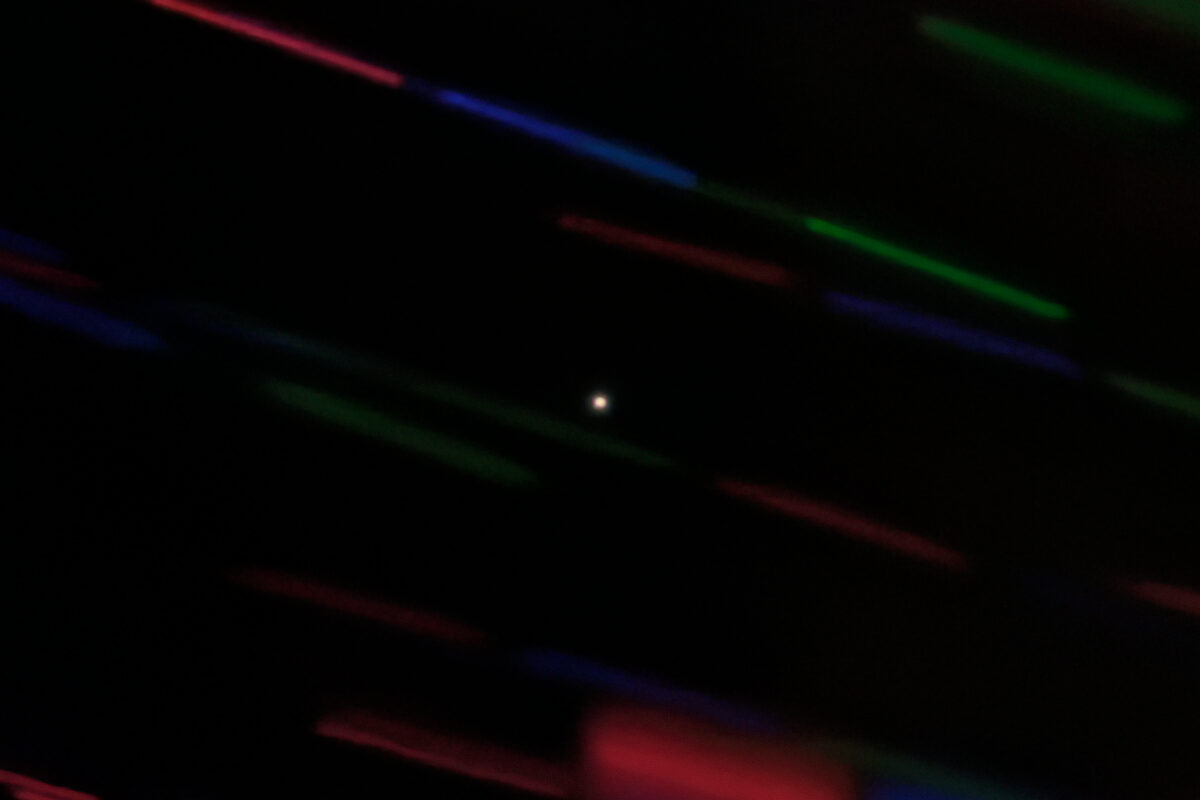
Earth has picked up a temporary companion. On Oct. 29, 2026, the IAU Minor Planet Center (MPC) reported that a tiny near-Earth asteroid called 2026 QQ8 is currently bound to our planet by gravity, which makes it the latest in a short list of known "mini-moons." It is very small, it is no threat, and it won't stay long. It is expected to remain captured through December and leave sometime in early 2027.
What makes 2026 QQ8 interesting is less its size than what it shows about the space right around Earth. Objects like this pass through our neighborhood all the time, and only recently have telescopes become sensitive enough to catch the ones that get briefly snagged.
A Faint Dot From Hungary
The object was first observed from the Piszkéstető station in Hungary (observatory code K88). The MPC's database lists the initial reported observation, by the GINOP-KHK program there, on Aug. 19, 2026. EarthSky credits Krisztián Sárneczky with the discovery and gives Aug. 20 as the date, though the MPC data put the first observation a day earlier. The MPC notes that formal discoverer credit will be assigned once the object receives a permanent number.
As of the MPC's current orbit solution, the MPC lists 36 observations of 2026 QQ8 spanning Aug. 19 to Oct. 9 (33 of them used in the fit), an arc of 51 days. The MPC gives the orbit an uncertainty parameter of 3. That is a modest arc for pinning down an orbit, and the solution should improve as more observations come in.
Rock or Rocket Stage?
Whenever a small object turns up in a loose orbit around Earth, the first question is whether it is natural at all, since spent rocket stages and old satellites can look similar at first glance. According to EarthSky, there was some debate over whether 2026 QQ8 was a natural object or a piece of junk, possibly from a rocket or old satellite.
Follow-up observations with the University of Hawaii 2.2-meter telescope and the Lowell Discovery Telescope settled it. With those observations, the MPC was able to confirm that 2026 QQ8 is not space junk. It is of natural origin, likely a small asteroid.
How Big Is It, Really?
The outlets disagree here. EarthSky describes the object as about 3 feet (1 meter) across, while Space.com puts it at about 6 feet (2 meters) in diameter. Neither source explains the gap, but for an object this small, size is normally estimated from brightness, and that estimate depends on how reflective the surface is assumed to be.
The MPC lists an absolute magnitude (H) of 31.34 for the object. That is extremely faint, consistent with an object on the order of a meter. A dark surface would make it somewhat larger, a bright one somewhat smaller. "Roughly one to two meters" is the honest answer for now.
Either way it is harmless. Space.com notes that a rock this size would likely be destroyed in the atmosphere before reaching the surface, and EarthSky says there is no need to worry about a collision.
An Orbit Almost Exactly Like Ours
The reason 2026 QQ8 got captured shows up in its orbital elements. Around the Sun, it follows a path nearly identical to Earth's. The MPC gives a semi-major axis of about 0.989 AU, an eccentricity of just 0.026, and an inclination of only about 0.53 degrees to the plane of Earth's orbit. Its orbital period is 359 days, or 0.98 years, a few days shorter than Earth's.
Because its average distance from the Sun is slightly less than 1 AU while its path still crosses Earth's orbit, it is classified as an Aten-class near-Earth object. Its perihelion sits at about 0.963 AU and its aphelion at about 1.015 AU, so it stays within a narrow band around Earth's own orbit. The minimum orbit intersection distance (MOID), the closest the two orbits come to each other, is 0.00376 AU.
An object on an orbit this closely matched to Earth's is the kind that Earth can briefly take hold of. According to EarthSky, 2026 QQ8 crossed into Earth's Hill sphere, the region where Earth's gravity dominates over the Sun's, in April 2026, months before anyone spotted it.
The Shape of the Visit
During this stay, the closest approach comes to about 0.0038 AU, which EarthSky puts at about 1.5 times the Moon's distance. Space.com gives the figure as roughly 353,000 miles (568,000 km), about 110,000 miles beyond the Moon's average distance. A mini-moon does not trace a tidy circle. Its path around Earth is a looping, irregular route shaped by both Earth and the Sun. EarthSky's coverage includes an animation by Tony Dunn that shows the trajectory.
Both outlets expect the capture to last through December. Space.com says the asteroid will break away in 2027, and that if it was captured in April 2026, modeling of typical stays implies it should move away in January 2027. After that, 2026 QQ8 goes back to orbiting the Sun on its own.
It will be back. Because its period is so close to Earth's, the asteroid returns to our vicinity about every 10 years, according to EarthSky. Not every encounter ends in capture, though. The 1965 pass did not produce one, and neither will the projected 2058 approach. EarthSky says the difference is that in those other years the rock does not cross into Earth's Hill sphere.
Why It Matters
On its own, a meter-scale rock in a temporary orbit is a curiosity. Taken together, objects like it are a census of the material moving through near-Earth space, and that census is still being filled in. 2026 QQ8 joins a short list of known temporary companions that EarthSky lists as 2020 SO, 2020 CD3 and 2024 PT5, along with the quasi-moon 2025 PN7. A quasi-moon travels near Earth around the Sun but is not actually bound to Earth.
The known examples are almost certainly a small fraction of the real population. Space.com points to research from last year suggesting that up to six mini-moons may be orbiting Earth at any given time. The modeled average mini-moon is about 75 centimeters across and stays about nine months. By those standards 2026 QQ8 is somewhat larger than average at roughly one to two meters, though its April-to-early-2027 stay is close to the modeled nine months.
Finding one takes sensitive survey telescopes, follow-up from larger instruments such as the University of Hawaii 2.2-meter and Lowell Discovery Telescope, and enough careful work to rule out space junk, as happened here.
For now, 2026 QQ8 is a quiet guest. It poses no danger, and should be gone by early 2027.
