
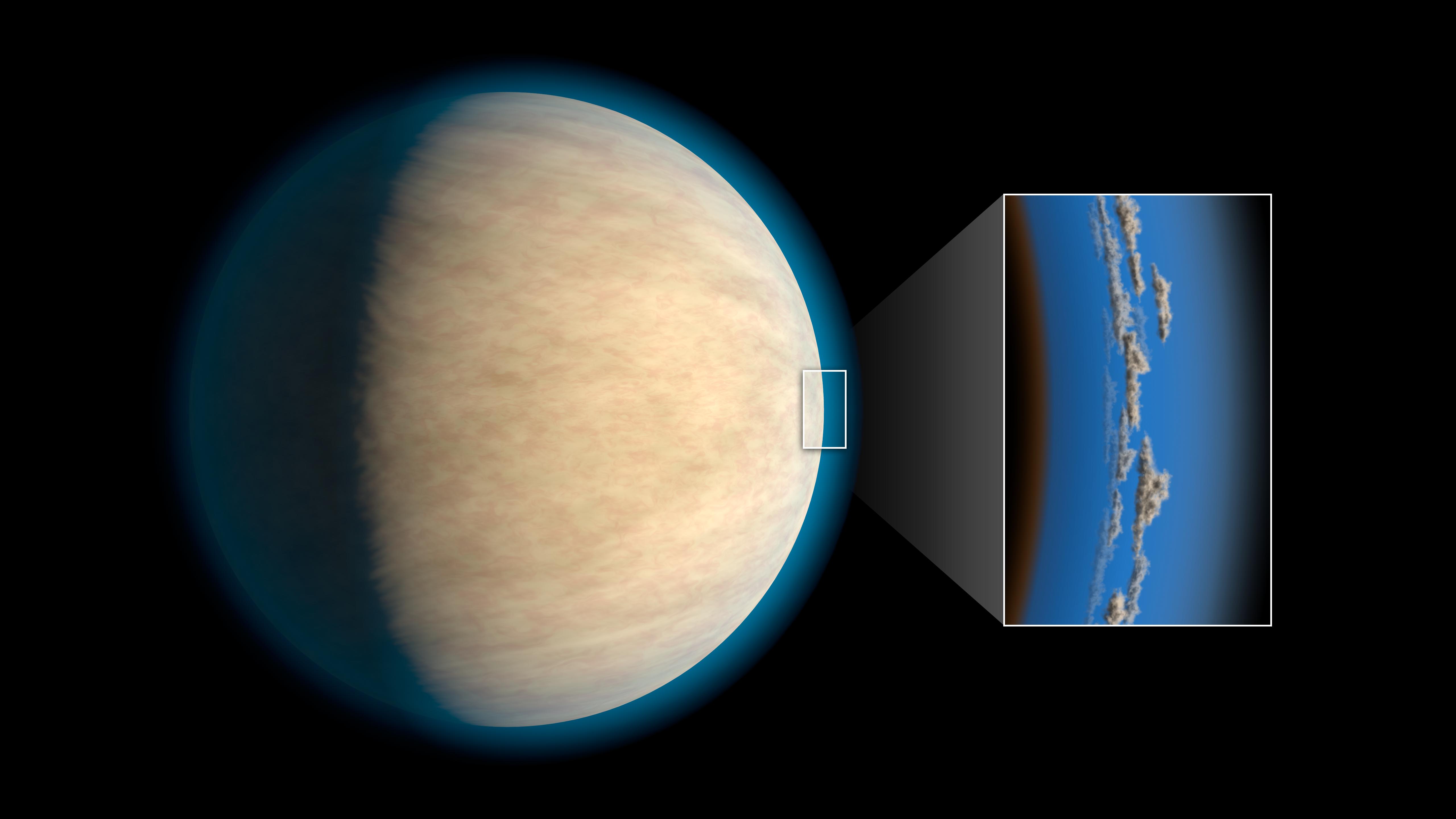
Most of the gas giants exoplanet hunters have cataloged fall into one of two tidy buckets. There are "hot Jupiters," scorched worlds whipping around their stars in a few days, so close that their atmospheres are boiling off. And there are the distant, cold giants — analogues of our own Jupiter and Saturn, parked many astronomical units out, orbiting once every decade or more. What's conspicuously sparse is the middle: giant planets on orbits of weeks to a few months, warm rather than blistering, neither fried nor frozen.
A newly confirmed exoplanet lands squarely in that gap. NGTS-39 b, described in a paper submitted July 2, 2026 by lead author Ioannis Apergis and 55 collaborators, is a Jupiter-sized world circling a Sun-like star every 58.2 days. It's not just its orbital period that stands out — its orbit is stretched into a notably eccentric ellipse, and the data suggest something unseen further out may be responsible.
An Odd Detective Story
The planet's discovery was less a single "aha" moment than a multi-year stakeout. NASA's Transiting Exoplanet Survey Satellite (TESS) first caught a single transit — one brief dimming of the host star's light as the planet passed in front of it. A single transit alone can't establish an orbital period; it's like hearing one footstep and trying to guess someone's walking pace.
The case sat unresolved for roughly three years until the Next Generation Transit Survey (NGTS), a ground-based array of robotic telescopes at ESO's Paranal Observatory in Chile, caught a second transit of the same object. That gave researchers enough of a baseline to start narrowing down possible periods. A third transit, this time captured again by TESS, and a battery of radial-velocity measurements from the HARPS and CORALIE spectrographs sealed the case, pinning down both the planet's orbit and its mass.
What emerged is a planet 1.467 times the mass of Jupiter with a radius 1.088 times Jupiter's — modestly puffed up, consistent with a planet that receives enough starlight to stay warm without being roasted. Its equilibrium temperature works out to 519 Kelvin (about 246 °C, or 475 °F) — hot compared to Jupiter's frigid -110 °C, but nowhere near the 1,000-plus-degree infernos of classic hot Jupiters.
Eccentric by a Wide Margin
The real attention-grabber is the shape of the orbit. NGTS-39 b's eccentricity is measured at 0.386, plus or minus 0.019 — a substantially elongated ellipse. For comparison, Earth's orbit is nearly circular, with an eccentricity around 0.017; even Mars, the poster child for a lopsided solar system orbit, sits at about 0.093. An eccentricity of 0.386 means NGTS-39 b's distance from its star swings dramatically over the course of each 58-day lap, alternately searing and relatively cooling the planet's dayside as it goes.
Eccentric orbits like this are a big deal for planet formation theorists, because they're a fingerprint of a planet's violent past. Gas giants are thought to form farther from their stars, in colder regions where ices and gas are abundant, then migrate inward over time. A circular orbit close to a star is easy to explain with smooth, disk-driven migration. A wildly eccentric orbit at an intermediate distance is harder — it points toward a rougher process, such as gravitational scattering by another massive body, or slow, high-eccentricity migration driven by tidal interactions that haven't yet had time to fully circularize the orbit.
That's where the paper's other finding comes in. Buried in the radial-velocity data is a long-term, linear trend of -17.75 meters per second per year — the star's velocity, as measured from Earth, is steadily drifting. That kind of steady drift, rather than a periodic wobble, is the classic signature of a second, more distant object in the system whose orbit is too long to have completed even once during the observing baseline. The authors interpret it as evidence for an outer companion, one that could plausibly have kicked NGTS-39 b onto its current stretched-out path in the first place.
Why It Matters
Exoplanet surveys have amassed thousands of confirmed worlds, but the population of "warm Jupiters" — giant planets on multi-week to multi-month orbits — remains stubbornly undersampled compared to their hot and cold cousins. That's mostly an observational bias: hot Jupiters transit frequently and are easy to catch, while cold giants need decades of monitoring to reveal themselves through radial velocity alone. Planets like NGTS-39 b, sitting right in that awkward middle distance, require exactly the kind of patient, multi-instrument, multi-year effort that produced this discovery — a single TESS transit, a three-year wait, a confirming NGTS transit, a second TESS transit, and years of spectroscopic follow-up.
Every additional warm Jupiter with a well-measured mass, radius, and eccentricity gives migration theorists a data point they didn't have before — a chance to test whether smooth disk migration, planet-planet scattering, or long-timescale tidal circularization better explains how giant planets end up where they do. A world this eccentric, with a probable outer companion still tugging at the system, is close to an ideal test case: it's caught in the act, plausibly mid-migration, rather than settled into a final, unremarkable orbit. That's the kind of system where theory meets a genuine, still-evolving mess of orbital dynamics — precisely what makes it useful.
What Comes Next
The suspected outer companion hasn't been directly detected — its presence is inferred purely from that steady drift in the star's radial velocity. Confirming it, and measuring its own orbit and mass, will likely require years more of RV monitoring, the same patient approach that nailed down NGTS-39 b itself. Given that host star's brightness, the system is also a plausible target for follow-up atmospheric characterization, though the paper focuses on establishing the planet's basic orbital and physical parameters rather than its atmosphere.
For now, NGTS-39 b stands as a reminder that the far larger population of "boring," well-behaved exoplanets can obscure just how strange individual systems get when you look closely enough — and that finding them at all often comes down to old-fashioned persistence: watching the same patch of sky, year after year, until a single transit turns into three.
