
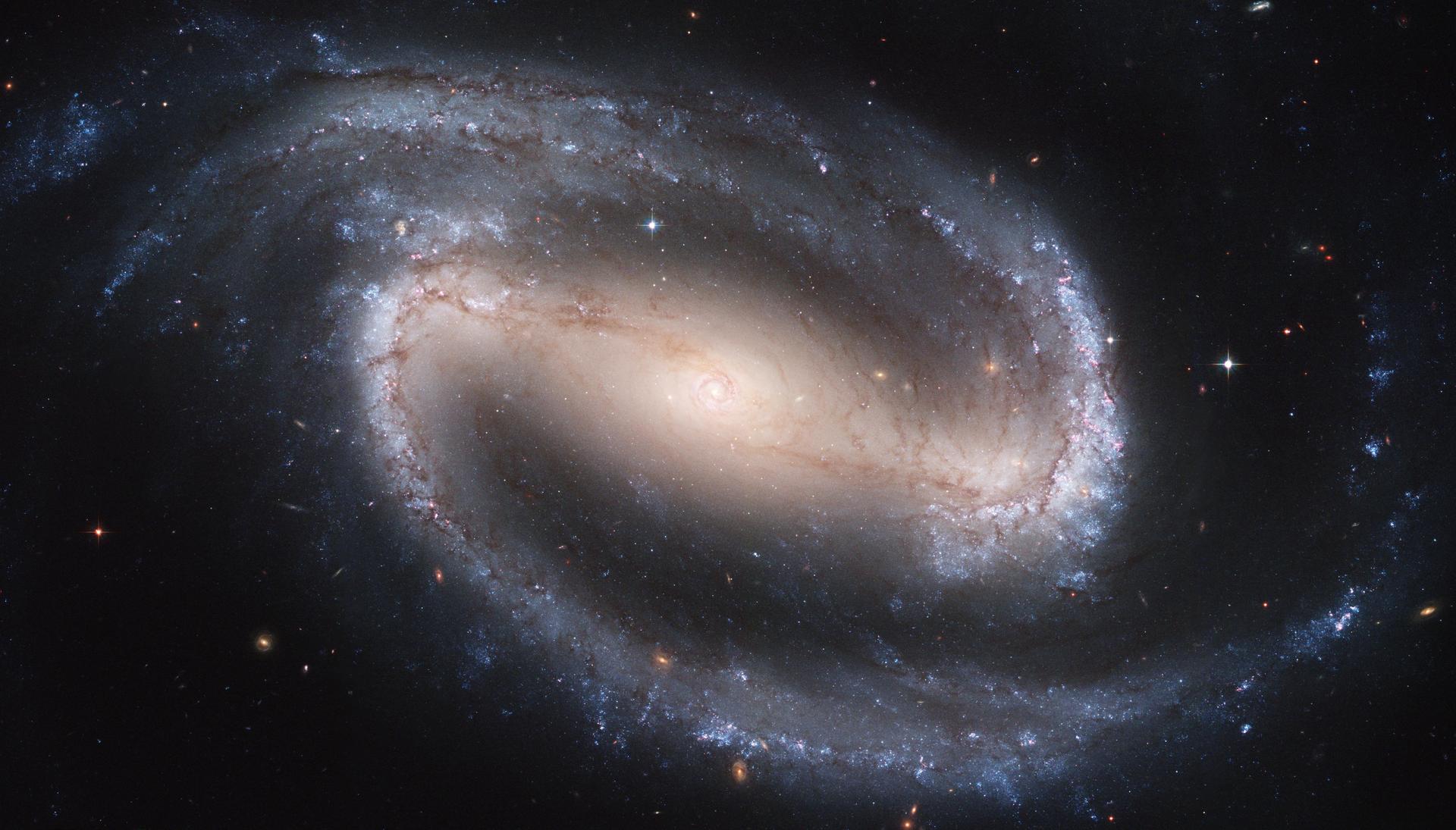
The early universe was supposed to be a mess. In the first billion-odd years after the Big Bang, galaxies were expected to look like train wrecks — clumpy, irregular, still being pieced together from mergers and inflows of gas. Grand, orderly structures like the Milky Way's central bar, the rigid stellar bridge that channels gas toward a galaxy's core, were assumed to be a late arrival, a sign of dynamical maturity that only shows up once a disk has had time to settle down.
A new discovery says that timeline needs rethinking. Using the James Webb Space Telescope's NIRISS instrument, an international team led by Xiaohan Wang of Tsinghua University has identified a massive barred spiral galaxy at redshift z = 5.102 — roughly 1.2 billion years after the Big Bang. Cataloged as M1149-BSG-z5, it is now the most distant barred galaxy candidate ever found, and its existence pushes the appearance of mature, bar-hosting disks hundreds of millions of years earlier than standard galaxy-formation models allow.
How the galaxy was found
M1149-BSG-z5 turned up not in a dedicated survey but in a parallel field — a patch of sky imaged incidentally while NIRISS observed the massive galaxy cluster MACS J1149+2223. The preprint describing the find, posted to arXiv on June 23, 2026, reports a stellar mass of about 10^10.45 solar masses (roughly 28 billion Suns) and a star-formation rate of 144 solar masses per year, a pace that would rapidly build up a substantial galaxy in a relatively short window of cosmic time.
What sets the object apart, though, isn't its mass or brightness — plenty of massive, star-forming galaxies have shown up at these distances before. It's the shape. The NIRISS imaging resolved a distinct central bar roughly 4.5 kiloparsecs long, equivalent to about 14,700 light-years, embedded in a disk with an effective radius of 2.61 kiloparsecs (about 8,500 light-years) and spiral arms reaching out to roughly 17,900 light-years from the center. That combination — bar, disk, and spiral arms all present at once — is the calling card of a dynamically settled galaxy, the kind of structure astronomers associate with billions of years of quiet, orderly evolution.
Why a bar is a big deal
Stellar bars don't form in chaos. They're gravitational instabilities that develop within a rotationally supported disk once it has enough coherence for stars to fall into a shared, elongated orbital pattern. In the modern universe, bars are common: a majority of nearby spiral galaxies, including the Milky Way, host one. But forming a bar requires a disk that isn't being constantly disrupted by mergers, torn apart by turbulence, or bombarded by inflowing gas clumps — the default expectation for galaxies assembling during the Epoch of Reionization, the period when the first generations of stars and galaxies were busy stripping electrons from the hydrogen that filled the universe.
Coverage of the find in Phys.org on July 3, 2026 adds further detail: M1149-BSG-z5 has roughly half the Sun's metal content (50% solar metallicity) and hosts an active galactic nucleus, meaning a supermassive black hole is actively feeding at its center. Neither detail is shocking on its own — AGN activity and moderate metal enrichment have both been observed in other early galaxies. What makes the full package unusual is seeing all of it arranged into the specific, ordered geometry of a barred spiral, at a point in cosmic history when such order wasn't supposed to exist yet.
Q&A: What does this actually change?
Does this break the standard model of galaxy formation?
Not on its own. One object, however striking, is a data point, not a paradigm shift. But it does put pressure on models that assume disks need long stretches of undisturbed time to organize themselves into bars. If M1149-BSG-z5 is representative of a broader population, models may need to allow disks to stabilize much faster than currently assumed.
How confident are researchers that this is really a bar, this far away?
The arXiv preprint describes it as a "candidate," reflecting the inherent difficulty of resolving fine structural detail in a galaxy this distant and faint. JWST's resolution and infrared sensitivity make the call possible in the first place — this kind of measurement was out of reach for prior space telescopes — but confirming bar morphology at z > 5 pushes the instrument close to its practical limits. Follow-up observations, and the discovery of additional examples, will be needed to move it from "candidate" to consensus.
Why did this show up in a parallel field rather than a targeted search?
Parallel imaging — pointing a secondary instrument at an adjacent patch of sky while the primary target is observed — has become one of JWST's most productive sources of serendipitous discovery. Because Webb's fields of view are precious and oversubscribed, these "bonus" observations, originally incidental to cluster studies like MACS J1149+2223, are increasingly where the most surprising early-universe finds turn up.
Why It Matters
Barred spirals are galactic infrastructure: the bar acts like a plumbing system, funneling gas inward to fuel star formation and feed central black holes, while shaping how a disk evolves over billions of years. Finding one fully formed just 1.2 billion years after the Big Bang means that whatever process builds this kind of order — settled rotation, coherent disks, gravitational instabilities strong enough to raise a bar — can happen far faster than textbook models of hierarchical galaxy assembly currently predict. If more examples like M1149-BSG-z5 turn up as astronomers comb through JWST's growing archive of early-universe imaging, it would suggest that "maturity" in galaxy structure isn't a late-arriving feature of the cosmos but something the universe was capable of producing almost from the start — forcing a rewrite of how quickly galactic order can emerge from the aftermath of the Big Bang.
