
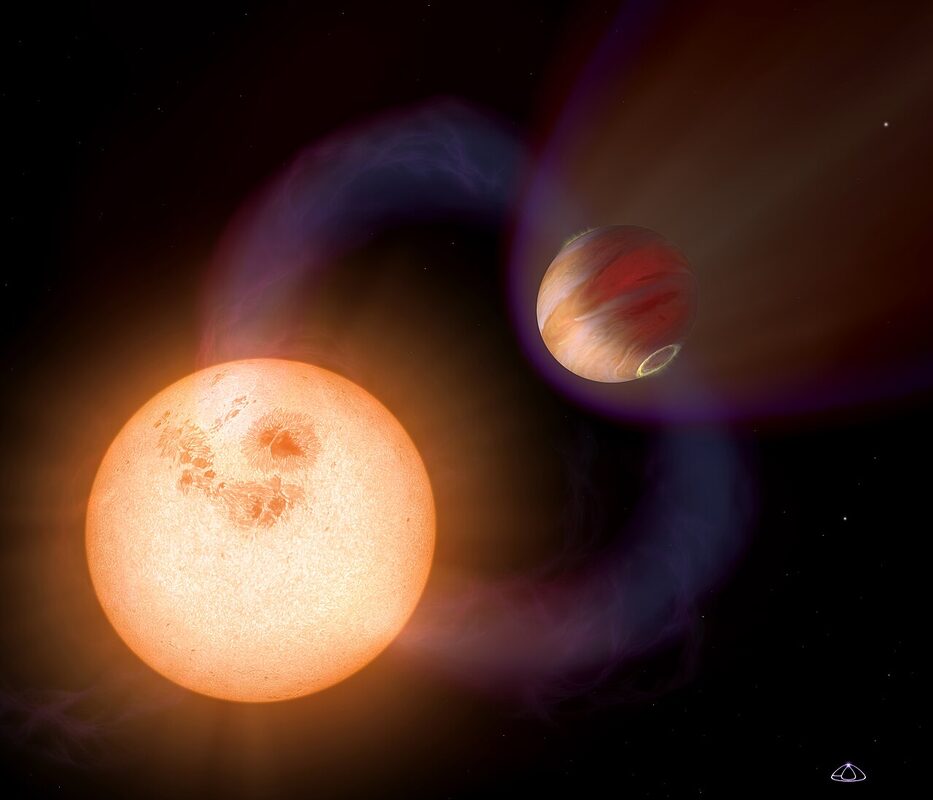
The planet is called WASP-94A b, a gas giant orbiting so close to its star that a "year" lasts only a few days and the dayside glows at well over a thousand degrees. On a world like that, clouds are not made of water. They are made of rock — magnesium silicate, the same family of minerals that forms much of Earth's mantle, condensed into a high haze. And in a result published in the journal Science, a team using the James Webb Space Telescope found that those rock clouds are not fixed. They blanket the planet's morning sky and vanish by evening, the first time a repeating weather cycle has been measured on an exoplanet at all.
How do you see weather on a planet you can't resolve?
You can't photograph WASP-94A b; from here it is an unresolved point beside a far brighter star. The trick is geometry. When the planet crosses in front of its star — a transit — starlight filters through the sliver of atmosphere at the planet's edge, and molecules and clouds imprint their signatures on that light. Crucially, the planet's leading edge enters the transit first and its trailing edge leaves last. Those two edges correspond to two different times of local day: the cooler morning side rotating into daylight, and the hotter evening side rotating out. By measuring the beginning and end of the transit separately, the team — led by Sagnick Mukherjee, a postdoctoral fellow at Arizona State University, with collaborators at Johns Hopkins — effectively read the planet's morning and evening atmospheres as two distinct columns of air.
What the asymmetry reveals
The morning limb showed thick silicate cloud; the evening limb was strikingly clear. The leading explanation is circulation. Fierce winds — common on tidally locked hot Jupiters, where one face bakes permanently — may loft cloud particles high on the planet's cooler flank and then drive them downward as the air sweeps onto the scorching dayside, burying the clouds deep enough that they no longer show. The atmosphere, in other words, is not a static shell but a churning engine, and the transit catches it mid-stride.
What makes the result more than a curiosity is that it generalises. Using the same edge-resolved technique, the team examined eight other hot gas giants and found the same morning-cloud, clear-evening pattern on two of them, WASP-39 b and WASP-17 b. That suggests asymmetric cloud cycles may be a common feature of these planets rather than a quirk of one — and it hands modellers a concrete, repeatable phenomenon to test their simulations against.
The finding also reframes how astronomers think about exoplanet "weather." A transit spectrum has usually been treated as a single snapshot of a planet's atmosphere, an average over the whole limb. WASP-94A b shows that the average can hide a planet that is meteorologically two-faced — cloudy on one terminator, clear on the other — and that the difference is not random but tied to the planet's rotation and circulation. Extending the edge-resolved method to eight more hot Jupiters and finding the same signature on two of them suggests this is a regime of atmospheric physics, not a one-off. Each such world becomes a natural laboratory for the same fluid dynamics that drive clouds and winds on Earth, run at extreme temperatures and pressures no terrestrial weather station will ever sample.
Why it matters beyond the spectacle
Clouds are the bane of exoplanet atmospheric science. They mute the chemical fingerprints astronomers most want to read, flattening the spectral features that reveal what an atmosphere is made of. A planet that is reliably clear on one limb is a planet whose chemistry can be read more cleanly. Learning where and when clouds form is therefore not a side quest; it is a prerequisite for the harder atmospheres still to come — including, eventually, the small, temperate worlds where the cloud problem will stand between us and any claim about habitability. WASP-94A b is a hellish gas giant, but the method that decoded its weather is a tool that will be aimed at gentler targets.
