
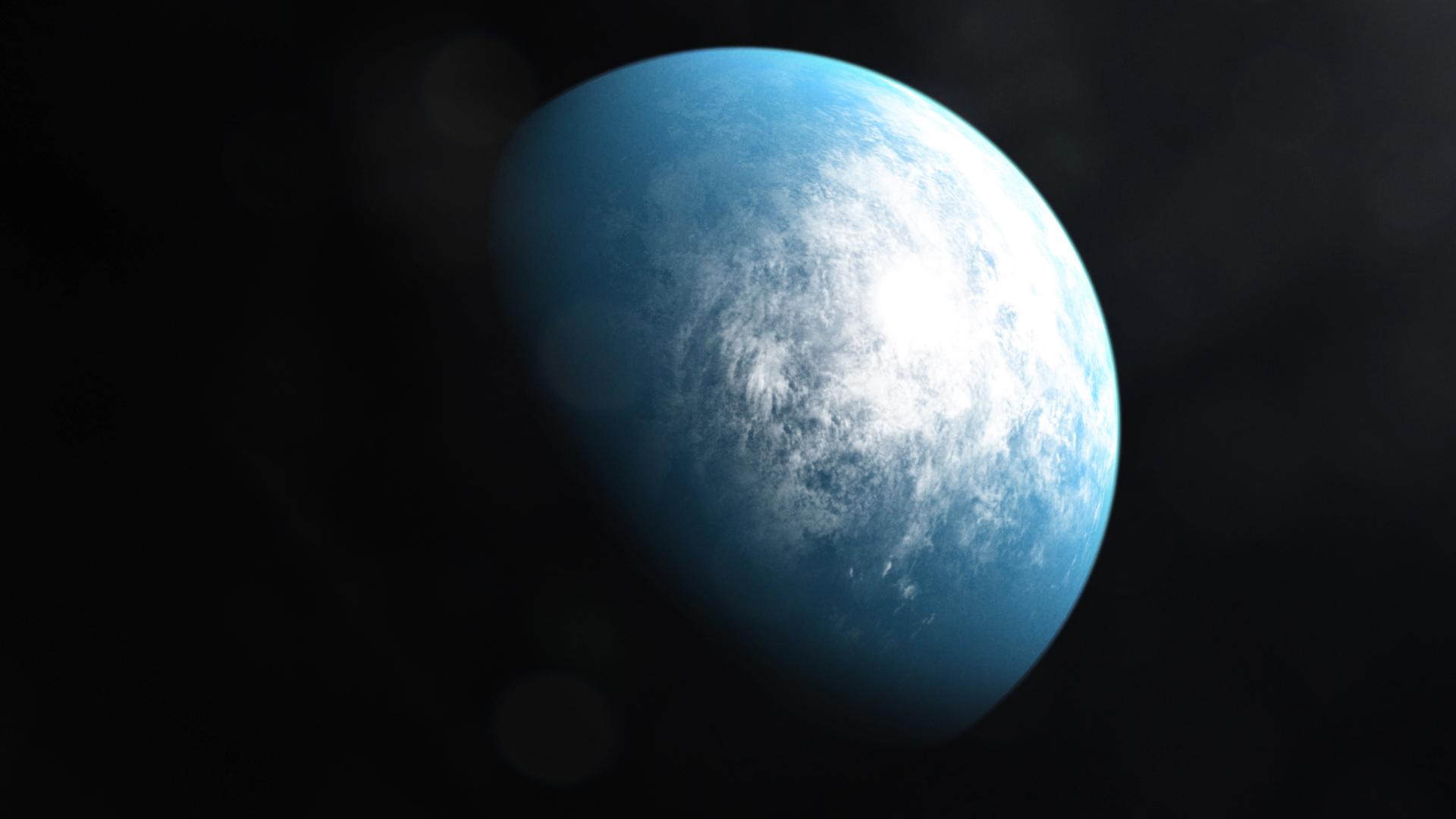
When GJ 3378b was first announced in 2024, it landed in that ambiguous middle ground that frustrates exoplanet hunters: a "super-Earth" whose mass — around five times that of our own planet — put it uncomfortably close to the threshold where rocky worlds give way to gas-and-ice mini-Neptunes. A planet in the habitable zone is only interesting for habitability if it actually has a surface. Get the mass wrong, and you might be looking at a small, choked, hydrogen-blanketed world rather than anything resembling Earth.
Now a team led by Paul Robertson, an associate professor of astronomy at UC Irvine, has gone back and done the measurement again — more carefully. The revised number: about 2.3 Earth masses, well under half the earlier estimate of roughly 5.3 Earth masses. That shift matters far more than it might sound. It moves GJ 3378b out of the ambiguous zone and into the range where planets are overwhelmingly likely to be rocky. The findings are published in The Astrophysical Journal.
How do you re-weigh a planet 25 light-years away?
You can't put an exoplanet on a scale, obviously. Astronomers infer mass from the tiny gravitational tug a planet exerts on its host star, measured as a wobble in the star's velocity — the radial-velocity method. The precision of that measurement depends entirely on the quality of your spectrometer and how much data you can stack up.
Robertson's team combined observations from two purpose-built, high-precision instruments: the Habitable-zone Planet Finder, mounted on the Hobby-Eberly Telescope at McDonald Observatory in Texas, and the NEID Spectrometer on the WIYN Telescope at Kitt Peak in Arizona. Both instruments are designed specifically to detect the minuscule stellar wobbles caused by small, rocky planets — the kind of signal that's easy to miss or overestimate with less sensitive equipment. Feeding more, cleaner data into the mass calculation is what allowed the team to shrink the error bars and land on the lower, more confident figure of 2.3 Earth masses.
GJ 3378b orbits its host star every 21.45 days, tight enough that on a Sun-like star it would be a scorched wasteland — but GJ 3378 isn't Sun-like. It's a cooler, dimmer red dwarf, and that shorter orbit places the planet in the star's habitable zone, the range of distances where a rocky planet with the right atmosphere could sustain liquid water on its surface. According to the estimates reported alongside the discovery, GJ 3378b receives about 90% of the radiation Earth receives from the Sun — remarkably close to an Earth-equivalent energy budget.
Why the mass number is the whole story
It's tempting to treat "habitable zone" as the headline and the mass as a footnote, but for planetary scientists it's the reverse. Being in the habitable zone only tells you a planet receives the right amount of starlight; it says nothing about whether the planet has the kind of surface, atmosphere, or geology needed to actually use that starlight to sustain liquid water. Mass is the first clue to that story, because it constrains bulk composition.
As outlets covering the discovery have noted, smaller super-Earths are statistically more likely to be rocky worlds than gas-enveloped ones. Above a certain mass threshold, planets tend to accumulate thick hydrogen or hydrogen-helium envelopes during formation, puffing up into mini-Neptunes — worlds with no solid surface to speak of, and almost certainly no habitability in any Earth-like sense. A planet estimated at five Earth masses sits closer to that threshold than one confidently pinned at 2.3 Earth masses. The revision doesn't just refine a number on a chart; it shifts GJ 3378b's most probable identity from "maybe rocky, maybe not" to "very likely a genuine rocky world."
That's the crux of why this update, rather than the original 2024 discovery, is the more interesting story. Discovery announcements are common; a confident downward revision of mass that flips a planet's most likely category is rarer, and it's the kind of follow-up work that rarely gets headlines but does most of the real scientific heavy lifting.
Why It Matters
Habitable-zone planet candidates are proliferating, but most remain frustratingly ambiguous — masses, radii, and atmospheric compositions all carry wide uncertainties that leave open the question of whether a given world is Earth-like or just Earth-adjacent. GJ 3378b's refined mass measurement is a case study in how the field actually makes progress: not through a single triumphant discovery, but through iterative follow-up observations that narrow uncertainty and separate promising rocky candidates from planets that only look interesting on a first pass.
At just 25 light-years away, GJ 3378b is also close enough — in astronomical terms — to be a realistic target for future characterization efforts, including atmospheric studies with next-generation telescopes. A confidently rocky, habitable-zone planet that near is a rarer commodity than the growing exoplanet catalog might suggest, and it adds a credible new entry to the still-short list of nearby worlds worth watching closely as instruments capable of probing their atmospheres come online.
Sources
- UC Irvine astronomers discover a new Earth-like exoplanet - UC Irvine News
- Astronomers Find Potentially Habitable Super-Earth Just 25 Light-Years Away - Sci.News
- GJ 3378b, the new Earth-like planet discovered 25 light-years away - Open Access Government
- Potentially Habitable Super-Earth Found Just 25 Light-Years Away - ScienceAlert
