
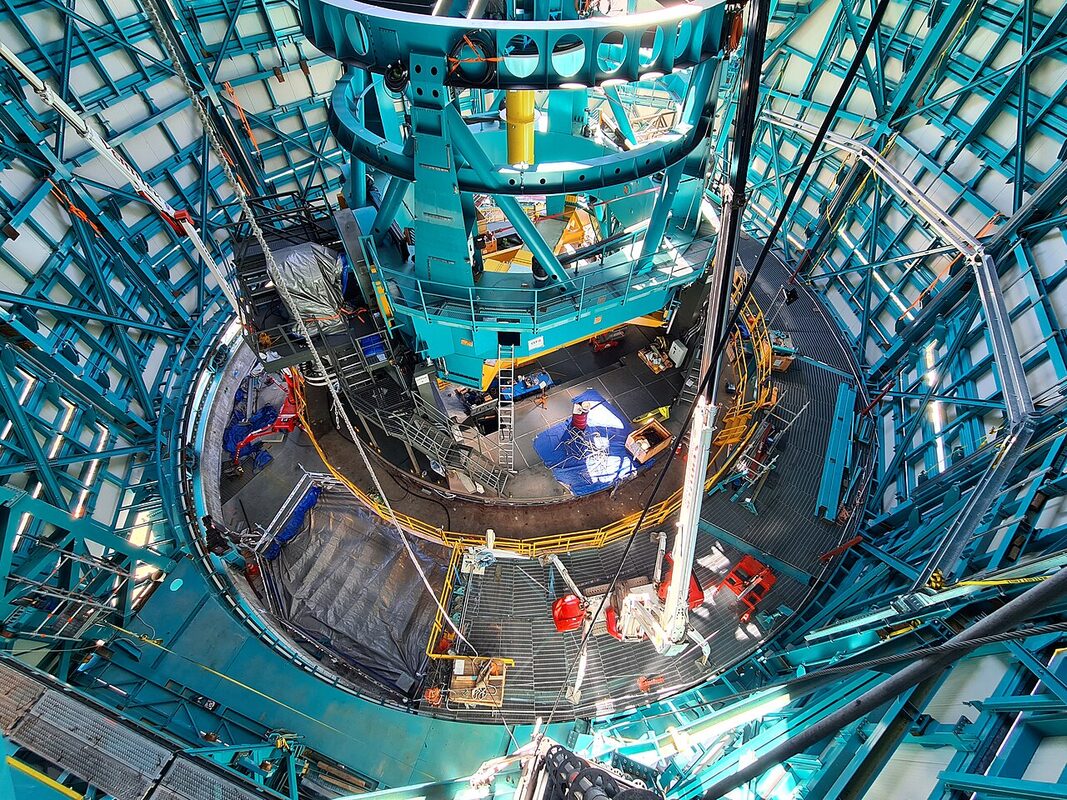
The number that ought to stop you is not 11,000. It is the timeframe attached to it. In roughly six weeks of pre-survey observations — engineering data, taken before its decade-long mission formally begins — the NSF–DOE Vera C. Rubin Observatory in Chile identified more than 11,000 previously unknown asteroids. That single batch was the largest asteroid submission anyone made to the central clearinghouse for such discoveries in the past year. Rubin produced it essentially while clearing its throat.
What the firehose found
The haul came from about a million individual observations. Alongside the 11,000 new objects, Rubin re-detected more than 80,000 already-known asteroids — including some that had been spotted once and then "lost," their orbits too poorly determined to find again, now recovered. Among the new finds were 33 near-Earth objects, the class that warrants tracking because their paths bring them into Earth's neighbourhood. The largest is about 500 metres across; none is on a threatening trajectory. A separate, first peer-reviewed result from the observatory's enormous LSST Camera flagged an oddity at the other extreme of size and speed: an asteroid more than half a kilometre wide, spinning once every two minutes — the fastest rotation ever measured for a body that large, fast enough that it should be flinging itself apart and somehow isn't.
Why one telescope changes the arithmetic
Rubin's advantage is not a sharper eye but a wider, faster one. Its 8.4-metre mirror feeds a 3,200-megapixel camera — the largest ever built for astronomy — and the whole system is engineered to photograph the entire visible southern sky every few nights, over and over, for ten years. That cadence is the point. An asteroid betrays itself by moving against the fixed stars between exposures; a survey that revisits the same sky constantly turns moving dots into orbits almost automatically. Where older surveys hunted asteroids one patch at a time, Rubin sweeps the whole sky on repeat and lets software do the bookkeeping at industrial scale.
The projections that follow are genuinely hard to absorb. Once the formal Legacy Survey of Space and Time begins later this year, scientists expect Rubin to discover this many asteroids every two to three nights in the early going. Over the decade it is forecast to roughly triple the catalogue of known asteroids and increase the tally of distant trans-Neptunian objects by nearly an order of magnitude. The observatory has also stood up a real-time alert system that broadcasts anything that moves or changes brightness, so the rest of the astronomical community can react within minutes — a "discovery machine" running continuously rather than a telescope booked one night at a time.
The hardware behind the flood is worth pausing on. Rubin pairs an 8.4-metre mirror with a 3,200-megapixel camera — the largest digital camera ever built for astronomy, each image covering an area of sky some forty times the size of the full Moon. Over ten years the Legacy Survey of Space and Time will photograph the entire southern sky on a roughly three-night loop, building a time-lapse movie of the changing universe. That cadence generates data on a scale no team can eyeball: millions of alerts a night, each flagging something that moved or brightened, funneled to automated "brokers" that sift them in real time and route the interesting ones to astronomers worldwide. The observatory is less a telescope in the traditional sense than a continuously running detector for change in the night sky.
The shift underneath the spectacle
The deeper change is what this does to planetary-defense and solar-system science as disciplines. For decades the limiting factor was discovery: you cannot study, track, or assess the hazard of an object you have not found. Rubin inverts the bottleneck. Soon the constraint will not be finding asteroids but following up on the flood of them — measuring compositions, refining orbits, deciding which of the millions deserve a closer look. The six-week warm-up was a preview of an instrument that will, for ten years, find the solar system faster than anyone can keep up. The catalogue of the sky is about to be rewritten, and the first 11,000 entries were just the observatory testing its pen.
