
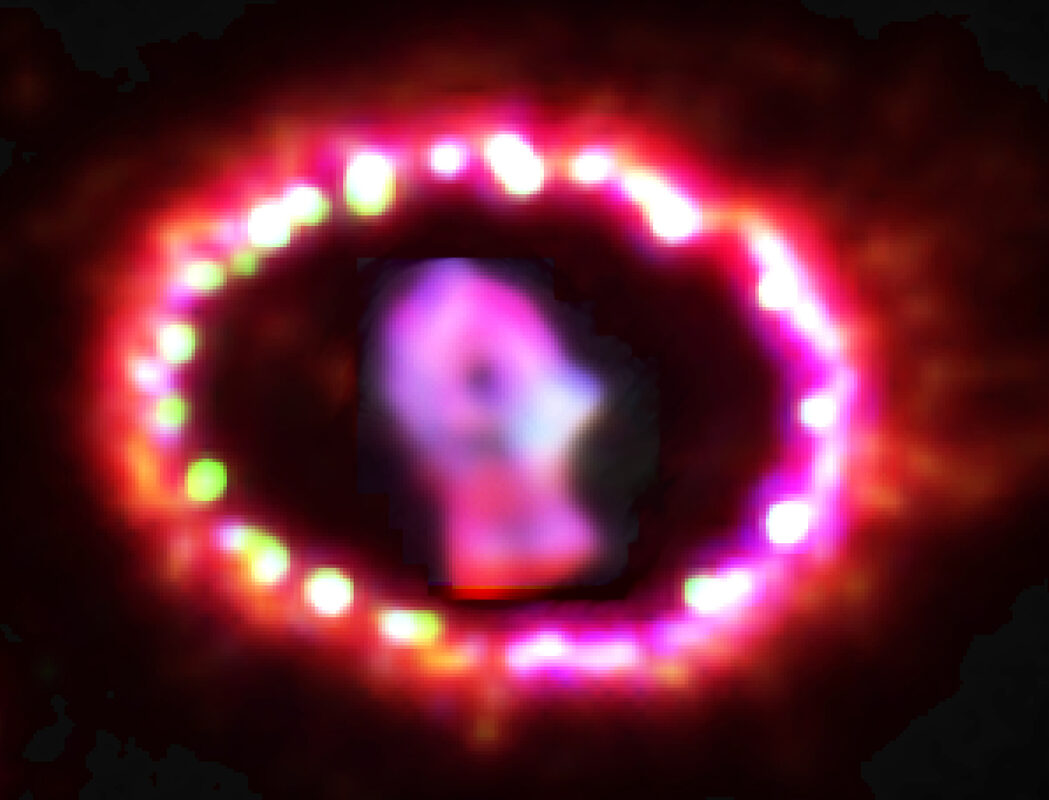
On March 21, 2026, a patch of sky in a galaxy 500 million light-years away brightened in X-rays and then faded, and almost nobody noticed. It wasn't a gamma-ray burst — the kind of explosion that dominates headlines for its ability to outshine entire galaxies. It was something quieter, and arguably rarer: the naked shock wave of a massive star's core collapsing, caught in the brief window before it either becomes a spectacular jetted explosion or simply... doesn't.
The event, designated EP260321a, was picked up by China's Einstein Probe, a satellite purpose-built to catch fast, faint X-ray transients that older missions would blink and miss. What followed was a monthslong, multi-observatory chase to figure out exactly what kind of stellar death had just announced itself — and the answer, published August 5 in a study led by Brendan O'Connor of Carnegie Mellon University and Jillian Rastinejad of the University of Maryland, turned out to be a genuine surprise.
Catching a star's death in the act
Most supernovae are discovered after the fact — a galaxy that was dark last week has a new point of light in it this week, and astronomers work backward to reconstruct what happened. Shock breakouts are different. They are the literal first flash of light escaping a dying star, the moment the supernova's shock wave punches through the star's outer layers and radiation finally outruns the explosion itself. That flash is fast, faint, and almost always in X-rays or ultraviolet, which means it's gone before most survey telescopes have a chance to look.
According to the Carnegie Mellon announcement, EP260321a is only the second unambiguous X-ray shock breakout confidently observed in more than 20 years of trying. Einstein Probe caught it with a peak thermal luminosity of about 1.0×10^45 erg/s, according to the team's paper posted to arXiv — a genuinely faint signal by supernova standards, and the faintest shock breakout ever recorded in association with this particular class of explosion.
Once Einstein Probe flagged the transient, ground- and space-based telescopes scrambled to characterize it. Follow-up spectroscopy established the host galaxy's redshift at z=0.0344, consistent with the roughly 500-million-light-year distance cited by Carnegie Mellon. A wide net of additional instruments, including Chandra, DECam, the Rubin Observatory, DESI, the Hobby-Eberly Telescope, SALT, the VLA, the Zwicky Transient Facility, GMOS, SOAR, and Palomar, followed up over subsequent weeks to track how the resulting supernova, now designated SN 2026gzf, evolved.
A supernova built like a gamma-ray burst — that isn't one
What they found was a puzzle. SN 2026gzf is a broad-lined Type Ic supernova — Ic-BL for short — the specific supernova flavor produced when a massive star has already shed its outer hydrogen and helium envelopes before exploding, and does so with unusually high kinetic energy. Broad-lined Ic supernovae are notable because they are the only confirmed supernova class linked to long-duration gamma-ray bursts, the universe's most powerful sustained explosions, thought to be driven by a relativistic jet drilling out of the collapsing star.
By every measure the team could check, SN 2026gzf looked the part. The progenitor was a stripped-envelope Wolf-Rayet star of roughly 20 solar masses — squarely the kind of star thought capable of launching a gamma-ray burst. "SN 2026gzf looks remarkably similar to other energetic supernovae that have been previously linked to gamma-ray bursts," O'Connor said in the Carnegie Mellon announcement.
Yet the jet never showed up. Deep follow-up observations with Chandra placed strict limits on X-ray emission at the position of SN 2026gzf and found nothing resembling the afterglow a gamma-ray-burst jet would leave behind. No relativistic outflow, no afterglow, no burst — despite a progenitor and explosion energy that, on paper, checked every box.
Why It Matters
Astronomers have long suspected that gamma-ray bursts and ordinary broad-lined Ic supernovae aren't two separate phenomena but two outcomes on a spectrum — the same basic stellar collapse, with a successful jet breakout marking the difference between a spectacular gamma-ray burst and a merely energetic supernova. The trouble is that shock breakouts are so faint and so brief that almost nobody has caught one clearly enough to test that idea directly.
EP260321a changes that. Because Einstein Probe caught the explosion at its literal first instant — the shock breakout itself, rather than the supernova light that follows days later — and because the follow-up campaign was thorough enough to rule out a hidden jet, SN 2026gzf offers one of the cleanest tests yet of what separates a gamma-ray burst from an ordinary, if energetic, stellar death. The star did everything a gamma-ray-burst progenitor is supposed to do, and the jet simply never punched through — or never formed in the first place. That distinction matters for models of how jets are launched inside collapsing stars, and for understanding why some massive-star deaths make the news while structurally similar ones pass almost unnoticed.
It's also a demonstration of what a purpose-built fast-transient hunter like Einstein Probe can do that older, less specialized X-ray missions couldn't: catch the process, not just the aftermath. With two confirmed shock breakouts now on the books after two decades of near-misses, astronomers have reason to expect more will follow — and each one narrows the gap between the ordinary and the extraordinary ways massive stars die.
