
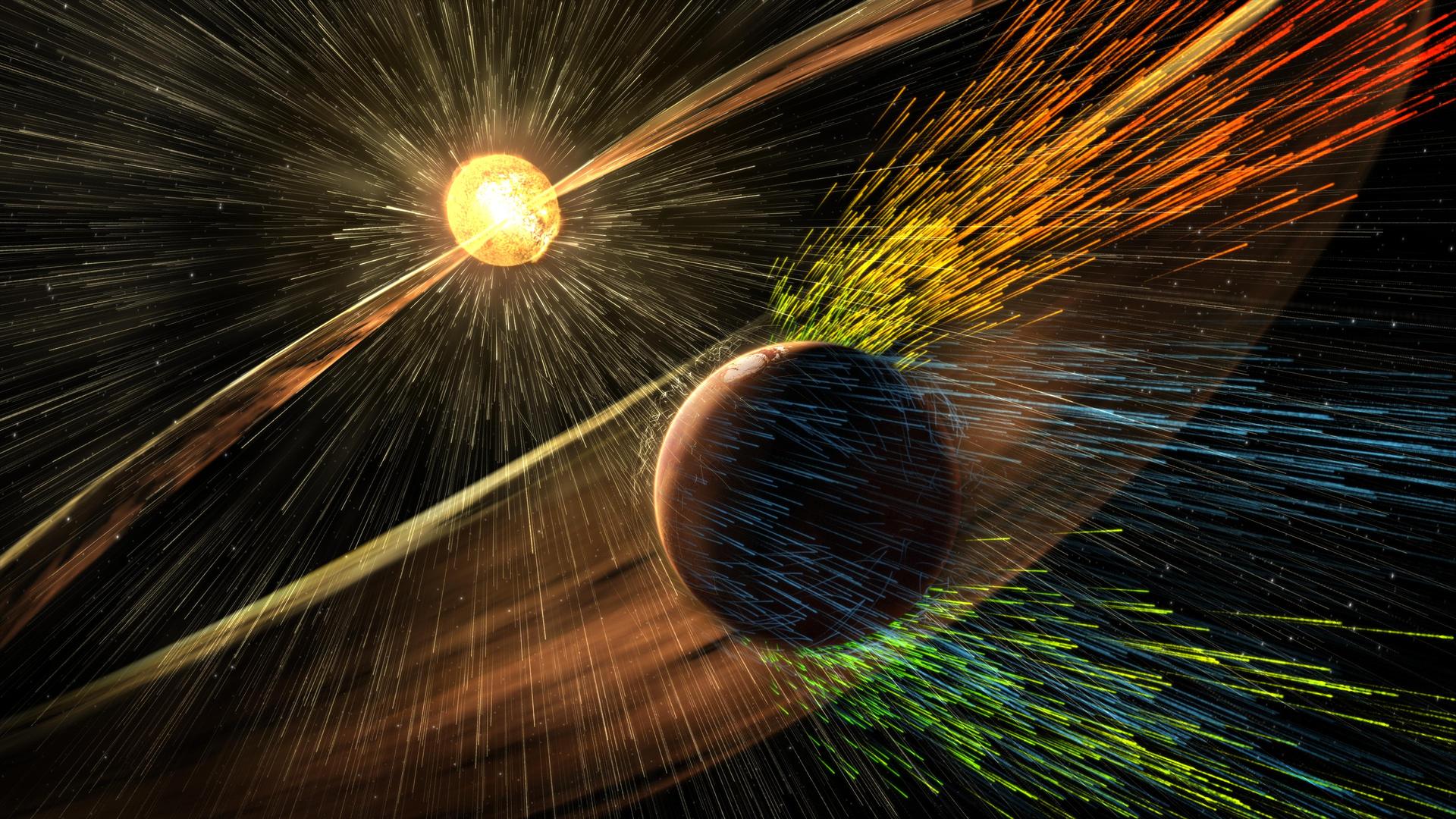
Mars has been losing its atmosphere to space for billions of years, and researchers have generally understood the slow, steady mechanisms behind that loss: the solar wind stripping ions away at a fairly constant clip through a couple of well-mapped escape channels. But a new study combining simultaneous data from two spacecraft — NASA's MAVEN and China's Tianwen-1 — shows that a far more violent process has been hiding in plain sight, one that can strip atmospheric ions away 10 to 100 times faster than those steady channels ever could.
The culprit is something familiar to anyone who has watched wind ripple across a lake: Kelvin-Helmholtz instability. It's the same fluid-dynamics phenomenon that turns a flat water surface into rolling waves when wind blows across it, and the same one that occasionally sculpts wavelike cloud formations in Earth's sky. At Mars, it turns out, the "water" is the planet's ionosphere and the "wind" is the solar wind — and the resulting waves are large enough to pinch off entire clouds of plasma and hurl them into space.
How the Waves Form
Because Mars lacks a global magnetic field like Earth's, it has no protective magnetosphere to deflect the solar wind wholesale. Instead, the solar wind interacts directly with the planet's upper atmosphere and ionosphere, dragging across the boundary layer between the two. According to the study, led by Chi Zhang of Boston University's Center for Space Physics and published in Science Advances on July 31, 2026, that dragging motion sets up the same shear instability seen in wind-driven water waves. When the shear becomes strong enough, the boundary doesn't just ripple — it breaks, spinning off discrete clouds of dense plasma that get carried away by the solar wind.
What sets this work apart is the observational setup that made it possible. MAVEN has spent years orbiting Mars and cataloging atmospheric ion escape, but on its own it can only see what's happening near the planet, not what's driving it. Tianwen-1, China's Mars orbiter, was positioned to monitor the incoming solar wind upstream of the planet at the same time. By combining the two datasets, Zhang's team could directly connect specific solar-wind conditions to specific ion-loss events at Mars for the first time — rather than inferring a relationship after the fact.
That pairing let the researchers rule out a simpler explanation. It might seem intuitive that a sudden gust in the solar wind — a burst of higher-density or higher-speed plasma slamming into Mars — would be enough to rip away extra atmosphere. But the data didn't support that. Instead, the trigger was the wave instability itself, growing out of the steady shearing motion between the solar wind and the ionosphere rather than any single gust.
A Lopsided Process
The escape isn't uniform across the planet. According to the research team, the plasma clouds form preferentially on one side of Mars, and which side depends on the orientation of the solar wind's electric field at the time. That directional dependence adds a layer of complexity to modeling total atmospheric loss: it's not simply a function of solar wind speed or density, but also of the geometry of the interaction as the solar wind's field lines sweep past the planet.
Inside those plasma clouds, ion fluxes were measured at 10 to 100 times higher than the rates seen in Mars' two previously identified steady escape channels — a striking jump that suggests these wave-driven bursts could be doing far more work than anyone had accounted for. What the study does not yet establish is exactly how much these bursts add up to over time. The researchers describe the overall contribution of this wave-driven process to Mars' total atmospheric loss as still unknown, and say future work will aim to quantify it and figure out what conditions make the waves more likely to grow in the first place.
Why It Matters
Mars wasn't always the cold, dry husk it is today. Evidence from orbiters and rovers has long pointed to a planet that once had flowing water, a thicker atmosphere, and plausibly habitable conditions. The dominant explanation for the transition has centered on Mars' lack of a global magnetic field, which leaves its atmosphere exposed to direct erosion by the solar wind in a way Earth's magnetically shielded atmosphere never experiences.
Until now, models of that erosion have leaned heavily on steady-state escape processes — a slow bleed rather than a hemorrhage. If Kelvin-Helmholtz-driven plasma clouds have been carrying away ions at 10 to 100 times the rate of those steady channels for billions of years, even intermittently, they could represent a previously underweighted piece of the puzzle in how Mars went from potentially habitable to the barren planet we see now. Pinning down how often these waves form, how large they get, and how much material they truly carry away is the next step — and it's the kind of question that dual-spacecraft, simultaneous upstream-and-downstream monitoring is uniquely suited to answer. Expect more of this kind of paired-orbiter science as international Mars missions increasingly overlap in time.
Sources
- Simultaneous Mars-orbit observations reveal Kelvin-Helmholtz instability-driven bulk atmospheric ion escape — Science Advances
- How the sun is stripping away Mars' atmosphere — EurekAlert!
- Giant waves are sweeping Mars' atmosphere into space — ScienceDaily
- Scientists Just Discovered a Powerful Force That Is Quietly Tearing Mars' Atmosphere Away — Daily Galaxy
