
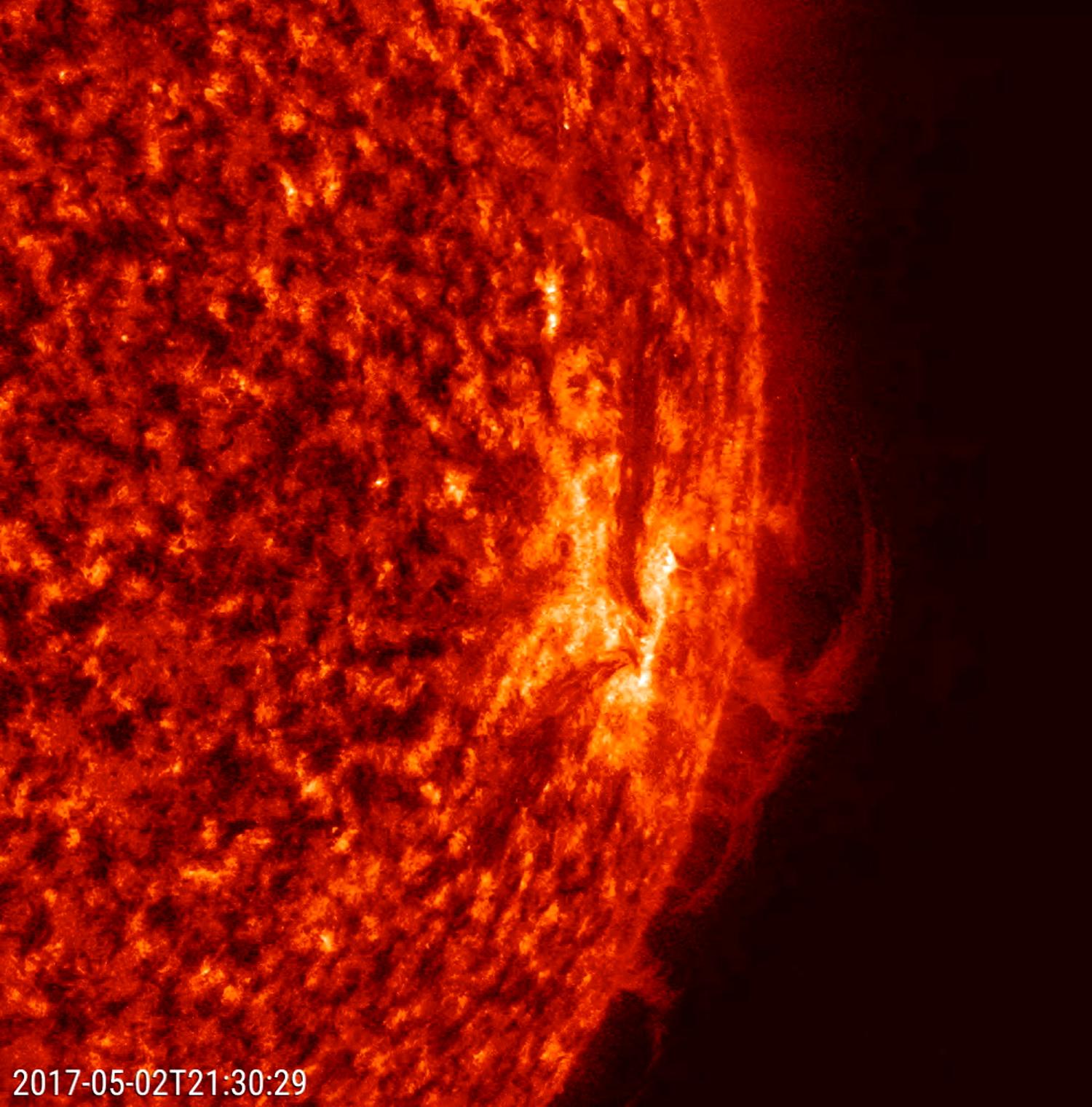
For decades, solar physicists have puzzled over a thermodynamic riddle that seems to break the rules: the Sun's visible surface is far cooler than the tenuous corona above it — the wispy atmosphere visible during a total eclipse — which blazes at over a million degrees Kelvin. Heat isn't supposed to flow that way. Something is pumping energy upward from the surface into the corona, and it has to be doing it efficiently and constantly. New observations from the NSF Daniel K. Inouye Solar Telescope suggest one culprit has been hiding in plain sight, disguised by decades of blurry imaging: small, churning vortices that turn out to be almost everywhere.
The findings, published in Nature under the title "Ubiquitous Kelvin-Helmholtz Instabilities Driving Plasma Mixing on the Sun," come from the 4-meter Inouye telescope perched near the summit of Haleakala on Maui and operated by NSF's National Solar Observatory (NSO). Using data captured in April 2025, an international team from NSO, the NSF NCAR High Altitude Observatory, and the Max Planck Institute for Solar System Research — including David Kuridze and Friedrich Woger — identified a phenomenon called Kelvin-Helmholtz instability (KHI) occurring at a scale and frequency nobody expected.
What exactly did the telescope see?
Kelvin-Helmholtz instability is not unique to the Sun — it's the same fluid-dynamics effect that produces wave-like cloud formations in Earth's atmosphere when two layers of air slide past each other at different speeds. On the Sun, the "fluid" is magnetized plasma, and when adjacent streams of it move past one another at different velocities along a shared boundary, the interface can roll up into streaks and swirls rather than staying smooth. According to NASA's Astronomy Picture of the Day, which featured the discovery on August 6, the underlying image is the highest-resolution picture of the Sun ever taken in visible light — captured at a wavelength of 416 nanometers and rendered in false-color yellow for viewing. The frame covers an area roughly the size of Earth's radius while resolving features down to tens of kilometers across. For context, that's sharp enough to distinguish structures roughly the size of a city from 150 million kilometers away.
Within that image and others like it, the NSO team measured KHI wavelengths — the average distance between vortices — of 50 to 65 kilometers, a match between what the telescope observed and what computer simulations of the same magnetic plasma conditions predicted. That agreement matters: it means the instabilities aren't an imaging artifact or a modeling assumption, but a real, physically consistent process playing out across the solar surface.
Why weren't these seen before?
The short answer is resolution. KHI vortices on the Sun apparently operate at scales so small — tens of kilometers — that earlier generations of solar telescopes simply couldn't resolve them from tens of millions of kilometers away. The Inouye telescope's 4-meter mirror, combined with adaptive optics that compensate for atmospheric distortion in real time, is the first instrument capable of routinely picking out features this fine in visible light. Once the researchers had that resolution in hand, the instabilities didn't turn out to be rare. As Kuridze put it, describing the team's reaction to the data: "What really surprised us was just how many KHI events we found." ScienceAlert, which interviewed the researchers, quoted Kuridze describing the ubiquity of KHI as "simply astonishing" — appearing at magnetic boundaries across the solar surface as a routine, ongoing process rather than an occasional curiosity.
Why It Matters
The coronal heating problem has stood as one of solar physics' most stubborn open questions for decades. Competing theories have proposed everything from nanoflares to wave-driven heating to magnetic reconnection as the missing energy source. Kelvin-Helmholtz instabilities offer a complementary mechanism: by continuously stirring and mixing magnetized plasma at small scales, KHI could serve as an efficient channel for transporting magnetic energy upward and converting it to heat — precisely the kind of steady, widespread process a corona-wide heating puzzle would require. NSO deputy director Dr. David Boboltz called the discovery "a major step forward in our understanding of the dynamics and evolution of solar and stellar plasma," while Woger, a senior scientist on the team, was blunt about how far the implications might reach: the team is, in his words, "only at the beginning of recognizing the wide-reaching impact" the discovery has. Beyond the coronal heating question, understanding how plasma mixes and transports energy near the solar surface feeds directly into space weather forecasting — the discipline that tries to predict solar flares, coronal mass ejections, and the geomagnetic storms that can disrupt satellites, GPS, and power grids on Earth. A better handle on the small-scale processes feeding energy into the corona could sharpen those forecasts.
It's also a reminder that some of the most consequential discoveries in astronomy aren't about finding something new so much as finally being able to see something that was there all along. The Sun has presumably been doing this the entire time; it just took a big enough mirror and a sharp enough adaptive-optics system to catch it in the act.
Sources
- APOD: 2026 August 6 - New Sharpest Image of the Sun Uncovers Instability - NASA
- NSF Inouye Solar Telescope Enables Major Discovery of a Hidden Solar Process - National Solar Observatory (NSO)
- 'Simply Astonishing': Record-Breaking Images Reveal The Sun Is Teeming With Whirling Vortices - ScienceAlert
