
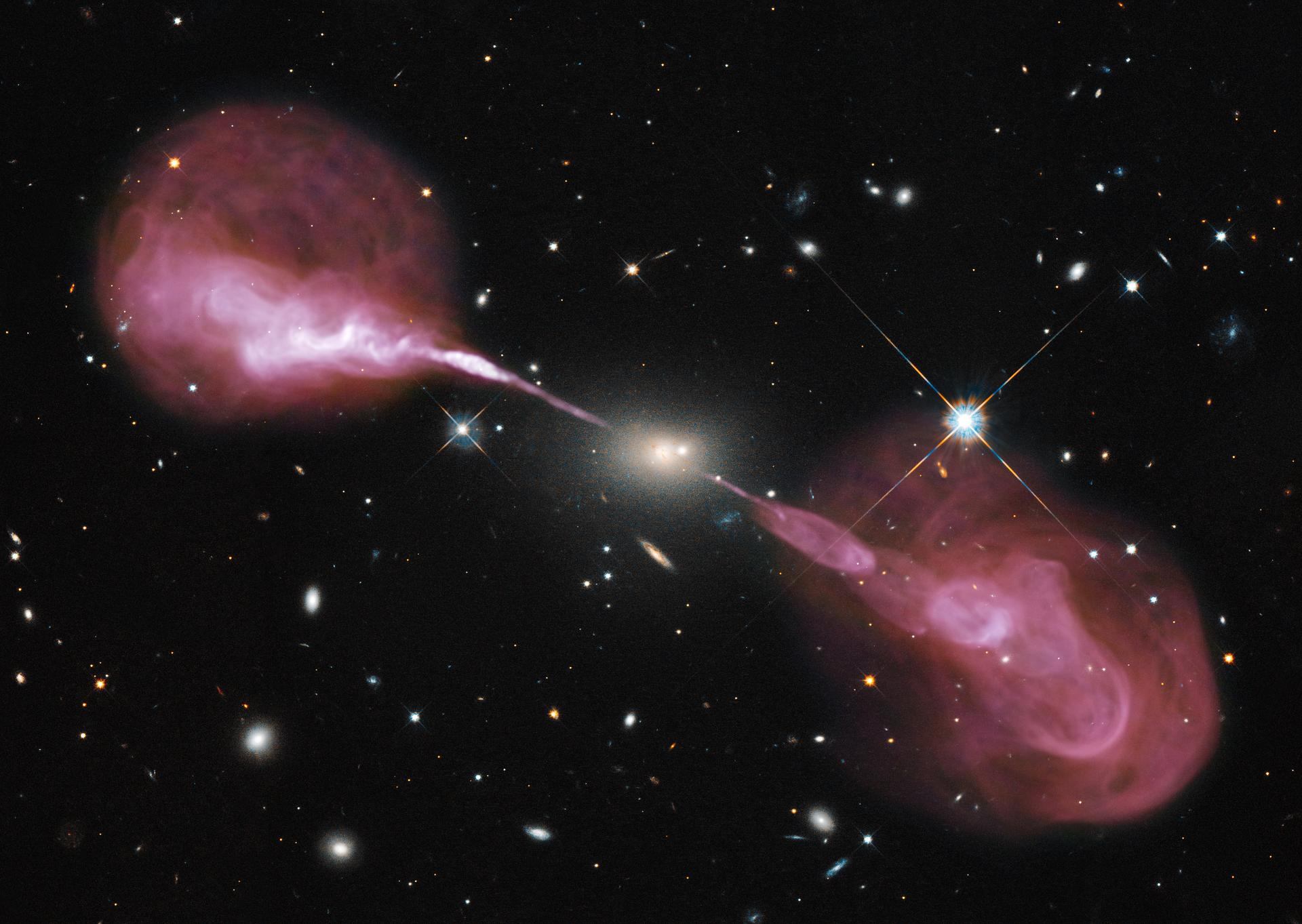
Most radio galaxies are messy but familiar: two jets streaming out from a central black hole, fraying into lobes, sometimes bent by the gas they swim through. The object that astronomers have now nicknamed RAD-BAARG is something else. Reconstructed from ultrasensitive low-frequency radio images, it resolves into a shape that genuinely resembles a drawn bow and arrow — and the "bow" is a glowing arc of radio plasma roughly 560 kiloparsecs across, or about 1.8 million light-years end to end. For scale, that single feature is something like 18 times the width of the Milky Way's stellar disk.
The discovery was announced in late June 2026 in a Monthly Notices of the Royal Astronomical Society: Letters paper by Hota, Dabhade, Ghosh and colleagues, and it carries an unusual origin story. The galaxy was not flagged by a survey pipeline or a machine-learning classifier. It was spotted by a citizen scientist working through the India-based RAD@home Astronomy Collaboratory, sifting through LOFAR (Low-Frequency Array) imagery for exactly the kind of faint, extended structure that automated tools tend to miss.
What you're actually looking at
The "arrow" and the "bow" are two distinct things doing two distinct jobs, and untangling them is the whole point of the paper.
Start with the host galaxy, which is falling into a galaxy cluster — and not gently. It is moving supersonically, meaning faster than the speed of sound in the thin, hot gas that fills the space between cluster galaxies. When anything moves faster than the local sound speed through a medium, it cannot push that medium smoothly out of the way. The gas piles up ahead of it and compresses into a shock front. That is the same physics that produces the sonic boom of a jet aircraft or the bow wave ahead of a boat, scaled up to intergalactic dimensions. Here, the compressed and energized plasma lights up at radio wavelengths, tracing out the enormous curved arc that gives the object its bow-like silhouette.
The jets supply the "arrow." One jet from the galaxy fans out into a sector-shaped cone before curving around and feeding into that giant arc. The opposite jet behaves very differently: it twists into a pronounced S-shape and trails off into a faint, offset tail that stretches nearly 600 kpc. The asymmetry is a clue. Jets that bend, curl, and lag behind their host are telling you that the galaxy is in motion relative to the surrounding gas, and that the environment is doing real work on the outflowing plasma.
Put the pieces together and you get a coherent picture: a galaxy plunging through a crowded cluster environment, its jets swept and distorted by the passage, while the gas it slams into compresses into one of the cleanest large-scale bow shocks yet imaged.
Why a "multi-halo environment" matters
The paper places RAD-BAARG in what it calls a multi-halo environment — shorthand for a region where more than one concentration of dark matter and hot gas is in play, rather than a single tidy cluster. That setting helps explain both the speed and the morphology. A galaxy threading between or into overlapping mass concentrations can pick up the high relative velocity needed to go supersonic, and the surrounding gas it has to push through is exactly the medium that records the resulting shock.
Large-scale bow shocks like this are predicted by the physics, but catching one this cleanly is rare. Most of the time these structures are faint, diffuse, and easy to lose against the noise of a radio image. That is precisely why this detection leans so heavily on two things: the sensitivity of LOFAR at low frequencies, where old, gently glowing plasma shows up best, and a human eye trained to recognize a suggestive shape in the data.
The citizen-science angle is not a footnote
It would be easy to treat "found by a citizen scientist" as a feel-good detail. The RAS framed it as central, and reasonably so. RAD@home is a long-running effort to put genuine LOFAR data in front of trained volunteers in India, and the bow-and-arrow galaxy is the kind of low-surface-brightness, oddly shaped object that survey software is not built to surface. A morphology this unusual — the RAS notes it is unlike previously known radio galaxies — is almost the definition of a thing an algorithm tuned on typical sources will overlook.
There is a practical lesson here for the next decade of radio astronomy. Instruments like LOFAR, and the even larger facilities coming online, are producing far more sky than professional astronomers can personally inspect. Distributed human attention, organized well, remains a real instrument in its own right.
Why It Matters
Bow shocks are one of the few direct, visible records of how galaxies actually move and interact inside the dense, hot environments of clusters. Most of that drama — the supersonic infall, the compression of intracluster gas, the bending of jets — is invisible at optical wavelengths and inferred only indirectly. RAD-BAARG turns that inference into a picture you can point at: a 1.8-million-light-year arc that maps, in real plasma, where a galaxy is shoving the gas around. If it holds up as one of the clearest large-scale bow shocks yet seen, it becomes a benchmark for testing how shocks form and how cluster gas responds to infalling galaxies.
It also reframes who gets to make discoveries like this. The find came out of an Indian-led citizen-science collaboratory working with public radio data, not a closed instrument team. As radio surveys keep outpacing the people available to scan them, that combination — ultrasensitive low-frequency imaging plus trained volunteer eyes — looks less like a charming exception and more like part of the standard toolkit.
Sources
- RAD@home discovery of a bow-and-arrow radio galaxy tracing a ~560 kpc bow-shock structure in a multi-halo environment (Hota, Dabhade, Ghosh et al.) — arXiv preprint
- Bow-and-arrow-shaped radio galaxy discovered by citizen scientist — Royal Astronomical Society
- Bow-and-arrow-shaped radio galaxy discovered by citizen scientist — Phys.org
- Astronomers Catch the Glowing Shockwave of a Galaxy on the Move — Universe Today
