
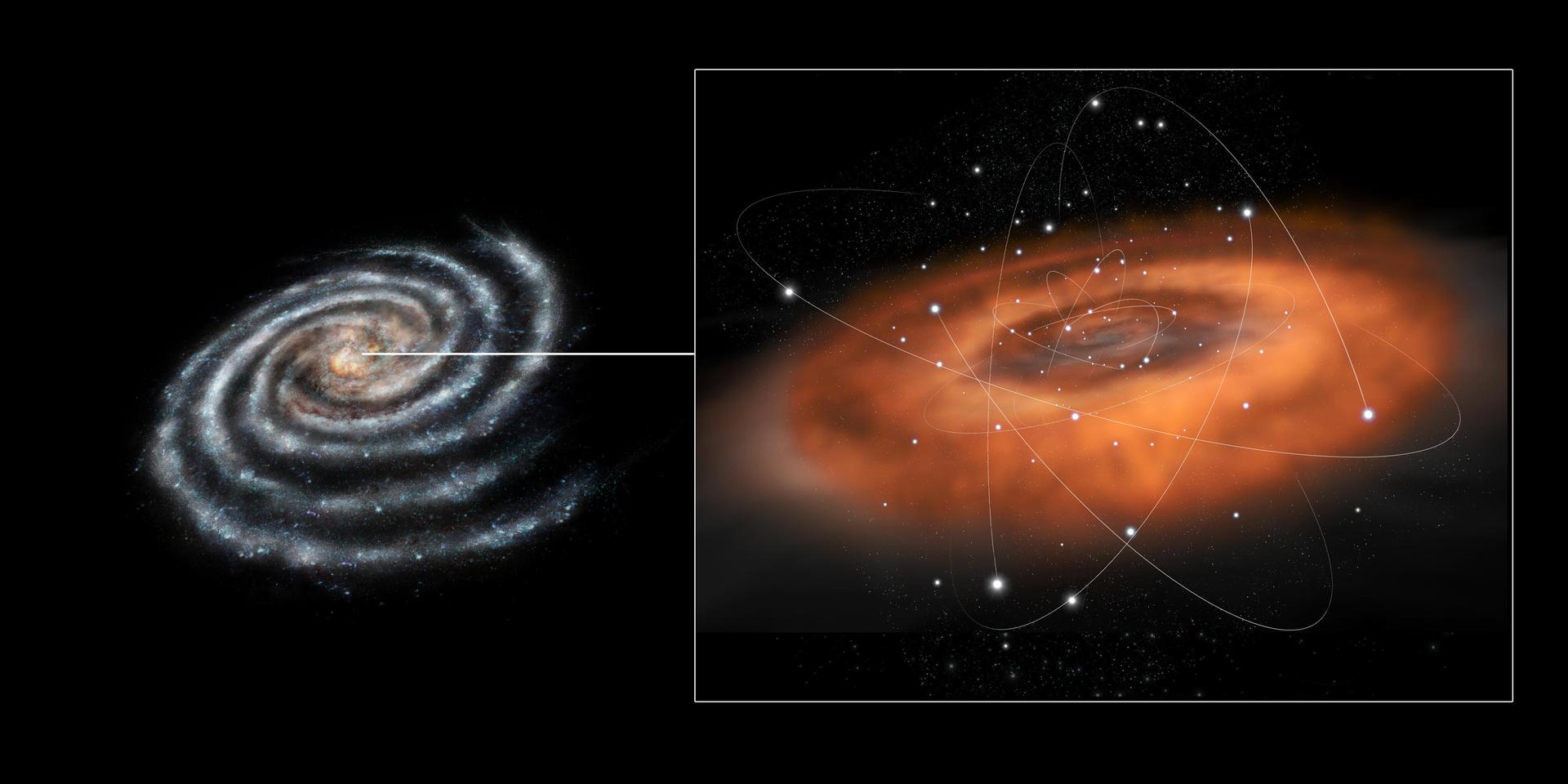
On June 24, 2026, NASA and ESA released what is now the largest and most detailed visible-light image ever made of the Milky Way's central bulge — the dense, star-clogged region at the heart of our galaxy. Captured by ESA's Euclid space telescope, the mosaic contains more than 60 million stars and spans a patch of sky equivalent to roughly 22 full Moons. It is a striking technical achievement on its own terms. But the more interesting part of the story is what the picture is for.
The field Euclid imaged is not a random slice of the galaxy. It overlaps the region that NASA's Nancy Grace Roman Space Telescope will survey after it launches later this summer, with its dedicated bulge observations beginning in spring 2027. By capturing this crowded field now, Euclid effectively gives astronomers an early-epoch baseline — a "before" snapshot against which Roman's later measurements can be compared. The practical result is that Euclid's image extends the scientific reach of Roman's planet-hunting campaign by about two years.
How the image was made
The mosaic was not a single exposure. It was assembled from nine separate observations totaling 26 hours of telescope time, then stitched together into one continuous, high-resolution view of the galactic core. That kind of broad-yet-sharp coverage is exactly what makes the central bulge so hard to photograph well: it is one of the most densely packed regions of sky from our vantage point, with millions of stars crowded into a small angular area. Resolving individual stars across a field that wide, in visible light, is the headline capability on display here. Independent reporting has confirmed both the 60-million-star count and the claim that this is the sharpest broad-field view yet of the Milky Way's core.
Why a static image helps find moving planets
Here is where it gets clever. The technique Roman will use to find planets in this field is called gravitational microlensing, and it is unusually demanding about timing and reference data.
Microlensing works like this: when one star passes almost exactly in front of a more distant background star, the foreground star's gravity bends and briefly magnifies the background star's light. If the foreground star happens to host a planet, the planet adds its own small, characteristic blip to that magnification signal. The method does not require the planet to emit or reflect detectable light — it reveals the planet purely through gravity. That makes it sensitive to a category of worlds the more familiar detection methods routinely miss.
Transit surveys, which watch for the tiny dimming as a planet crosses its star, and radial-velocity surveys, which track the star's gravitational wobble, are both strongly biased toward planets in tight, fast orbits close to their stars. Microlensing fills in the opposite regime: cold, wide-orbit planets — the distant, frigid worlds the other methods rarely catch. Because the technique is essentially unbiased about what it turns up, it is, in effect, the only practical way to take a census of these cold planets in large numbers.
To date, microlensing has turned up close to 300 exoplanets — and every one of them was found from the ground. Roman will be the first to run a large microlensing survey from space, above the blurring effects of Earth's atmosphere, in the crowded bulge where the odds of catching an alignment are highest.
But microlensing events are fleeting and only happen once; you cannot rewind a chance stellar alignment. Having a deep, accurate map of where every star sat before the survey begins makes it far easier to interpret the brightening events Roman will catch, to pin down the stars involved, and to extend the effective time baseline of the whole campaign. Euclid's image is that prior map.
A division of labor between two telescopes
It is worth being precise about the relationship here, because it is a genuine collaboration rather than a redundancy. Euclid has delivered a broad, sharp, single-epoch portrait of the bulge in visible light. Roman will follow with a later, deeper, repeated survey of the same crowded region — the kind of monitoring campaign needed to catch microlensing blips as they happen. One telescope provides the wide reference frame; the other provides the time-domain monitoring. The Euclid image is both a showpiece and a down payment on the science Roman is being built to do.
Why It Matters
Most of the exoplanets cataloged so far are skewed toward a particular kind of world: relatively close to their host stars, where transits and stellar wobbles are easiest to detect. That leaves a large blind spot over the cold, distant planets that may be just as common. Microlensing is the tool that can fill in that blind spot, and Roman is poised to do it at scale from space for the first time. By releasing this 60-million-star baseline image now — two years ahead of Roman's bulge campaign — astronomers are effectively front-loading the survey, squeezing more science out of a mission that has not yet launched. It is a reminder that big discoveries in astronomy increasingly depend not on a single instrument, but on observatories handing each other carefully timed reference data. The pretty picture is real; so is the strategy behind it.
