
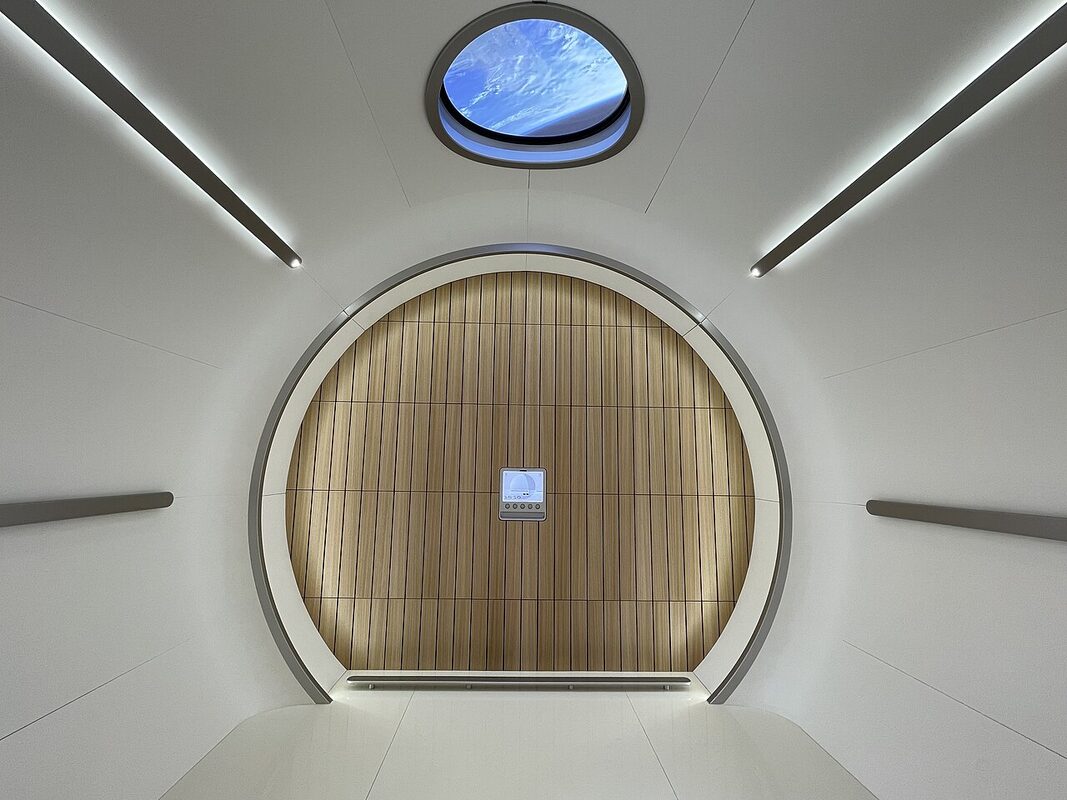
For a quarter of a century, every human being living off-planet has done so aboard a government-built outpost. Vast, a California company, intends to change that. Its Haven-1 module is being prepared to launch on a SpaceX Falcon 9 and become the first commercially owned and operated space station in orbit — a milestone that, if it holds its schedule, arrives within the next year or so. Recent updates have pushed the target around the 2026 mark, with some slippage toward early 2027; pinning a precise date on a first-of-its-kind spacecraft is its own kind of forecast.
A deliberately small beginning
Haven-1 is not a sprawling complex. It is a single module, sized to host four astronauts for stays of roughly ten days, who would arrive aboard a SpaceX Crew Dragon. Over an orbital life of about three years, only a handful of crewed visits are planned. Measured against the football-field-sized International Space Station, that is tiny. But the modesty is the strategy: Haven-1 is a proof of concept, a way to demonstrate that a private company can build, launch, certify, and operate a crewed habitat — and find paying customers for it — before committing to anything larger. Vast has described it as the first rung of a ladder toward bigger stations.
What Haven-1 sells is access — to research and to the experience of orbit. Its crews are expected to be a mix of national space agencies buying flights for their astronauts, researchers running microgravity experiments, and private travelers, the same blend that has sustained the early commercial-spaceflight market. The module is being fitted out with a large window and a habitable volume designed for the realities of living, not just working, in space — a recognition that the customers paying to be there will judge the experience as much as the science.
Vast's longer ambition is more radical: the company has said it intends to build toward stations that spin to generate artificial gravity, addressing the muscle and bone loss that weightlessness inflicts on long-duration crews — a problem the International Space Station manages with hours of daily exercise but has never solved. Haven-1 is deliberately humble against that backdrop: prove you can fly a small station and keep people alive and comfortable aboard it, then scale. First, though, the small one has to reach orbit.
The deadline driving everyone
The reason this is happening now, and with urgency, is a date on NASA's calendar: 2030, when the International Space Station is scheduled to be retired and guided to a controlled destructive reentry. NASA does not intend to replace it with another government station. Instead, the agency is seeding a market — its Commercial LEO Destinations program is funding and contracting private companies to build the outposts that will, the plan goes, be flying before the ISS comes down. The goal is continuity: no gap in permanent human presence in low Earth orbit, and a shift in NASA's role from station owner to station customer, buying time aboard facilities it doesn't operate.
Vast is not alone in the race. Axiom Space is building modules designed to attach to the ISS first and later detach into a free-flying station of their own, backed by NASA contracts, with early hardware targeted for orbit around the end of 2026. Other ventures are pursuing their own designs. The competition is the point: NASA is betting that several companies chasing the same market will produce cheaper, more capable outposts than a single agency program could. The risk is timing. If the commercial stations slip and the ISS retires on schedule, the United States could face a gap in its human presence in orbit — exactly the outcome the whole strategy exists to prevent. Haven-1's launch will be the first real test of whether the private sector can move fast enough to catch the falling baton.
