
Roughly 70 percent of the universe's energy budget is something physicists can't account for. They call it dark energy. It drives the accelerating expansion of the cosmos, and nobody knows what it is. The usual response is to add something new to physics: an unseen field, an exotic particle, or a constant chosen to match the observations.
A team from the University of British Columbia and the University of Sheffield proposes another answer. Dark energy may need no new ingredient at all, they argue, because it could come from physics we already know: the quantum vacuum of the strong nuclear force.
The paper, titled "Evolving Dark Energy Is Vacuum Energy After All," was published on November 20, 2026, in The Astrophysical Journal (Vol. 1012, No. 2, article 172). The authors are Dong Ha Lee, Carsten van de Bruck, Eleonora Di Valentino, Ludovic Van Waerbeke, and Ariel Zhitnitsky.
The idea in brief
Quantum chromodynamics, or QCD, is the theory of the strong force, which binds quarks inside protons and neutrons. In quantum field theory, the vacuum is not empty. It is filled with subatomic fields and quantum energy. According to UBC's description of the work, the researchers' model holds that the QCD vacuum has topological properties that can affect space over vast distances. As the universe expands, this subatomic structure responds differently over time. In the model, that produces an energy shift just strong enough to drive cosmic acceleration, and no new particles are required.
That is the central claim, and it is a bold one. Many proposed explanations for dark energy add hypothetical fields or particles that have never been detected. This one tries to get the effect from the Standard Model of particle physics, a framework that is already well established.
The scale problem
Any theory of dark energy has to explain how strong it is. The team's answer is that the relevant energy scale comes out of the combination of QCD vacuum physics and gravity, and that it lands close to the observed dark-energy scale today. Zhitnitsky said this is why no new particles may be required, and that the result does not need an ad hoc new field or a new parameter. Van Waerbeke called it the most striking result: the observed dark-energy scale emerges naturally from known physical constants, without any additional fitting parameters.
If that holds up, it is the most interesting part of the proposal. A model that reproduces the data only after its parameters are tuned to the data is not very persuasive. A model whose key number comes from constants already measured elsewhere is much harder to dismiss.
Does it match the sky?
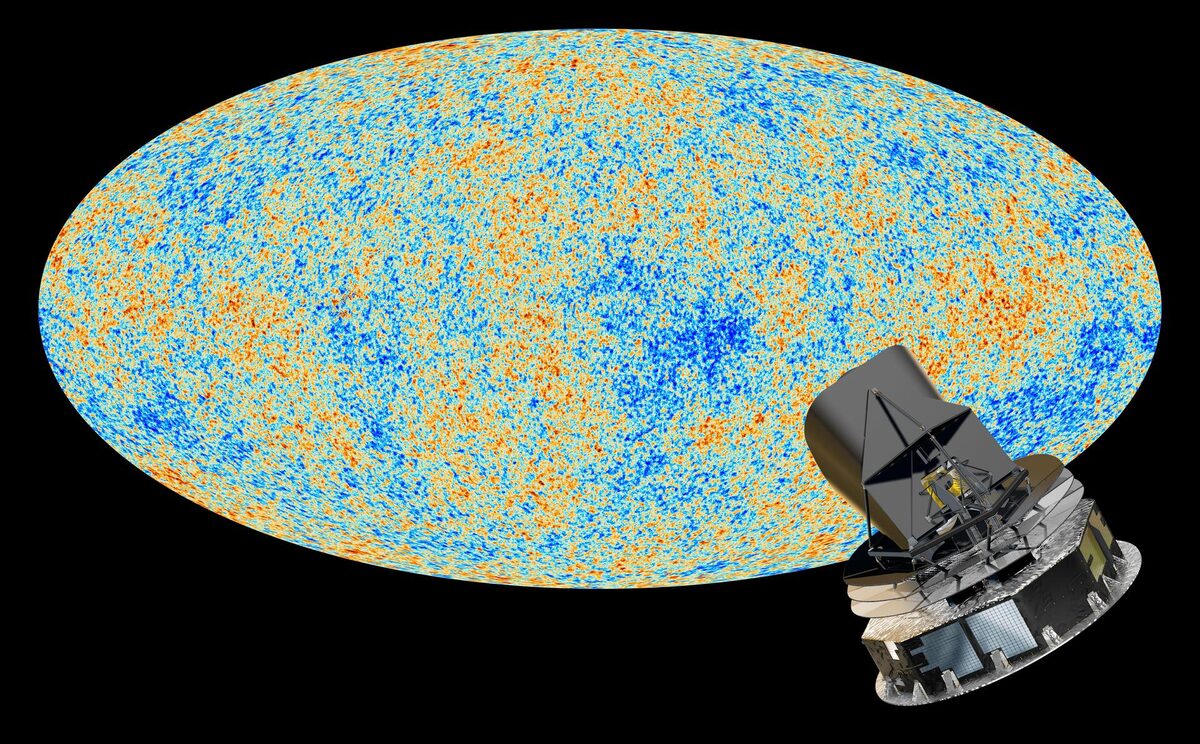
A neat theoretical argument still has to agree with observations. The researchers compared their model with two kinds of data: light from distant exploding stars, or supernovae, which trace the expansion history of the universe, and the cosmic microwave background, the radiation left over from the early universe.
Lead author Dong Ha Lee of Sheffield said the model can reproduce the evolving dark-energy behaviour suggested by current observations. In these tests the model matched the observations just as well as standard cosmological models, according to UBC. That second point matters. The model does not beat the standard picture, but it fits the data about as well while offering a possible explanation for the physical origin of dark energy.
The paper's title is aimed at a live debate. Current observations suggest that dark energy may not be perfectly constant and may instead change over cosmic time. A fixed vacuum energy would not change, so an evolving signal might seem to count against a vacuum explanation. The authors argue the opposite. In their framework, the vacuum's energy can evolve because the QCD vacuum responds to cosmic expansion. In other words, evolving dark energy could be vacuum energy after all.
Why It Matters
Dark energy is among the largest open problems in physics. Many explanations on offer involve new fields, new particles or a constant chosen to fit the observations. A model that gets both the size and the behaviour of dark energy from the strong force, with no new particles and no fitting parameters, would change the question in a basic way. Dark energy would no longer point toward unknown physics. It would become a consequence of physics already in the textbooks, one that turns out to matter on cosmic scales.
There are reasons for caution. Matching today's data as well as standard models is necessary but not sufficient, because it does not by itself show the QCD vacuum is the right explanation. Lee himself framed the result as motivation for more work: the team says it needs further theoretical work to understand how the QCD vacuum responds to cosmic expansion, and predictions that future observations can test. A model with few adjustable parameters has little room to hide, which is part of its appeal.
What comes next
According to Universe Today's coverage, the next step is to keep refining the model and its calculations. Data from the next generation of telescopes, such as NASA's Nancy Grace Roman Space Telescope, could prove very useful in testing ideas about the nature of dark energy and its effect on the expanding universe over time. UBC says the team plans to test the framework against incoming data from next-generation space telescopes, which are set to provide unprecedented detail on the history of the universe over the coming years.
Either way, the work is a reminder that the explanation for the universe's largest-scale behaviour may lie in its smallest-scale physics.
