
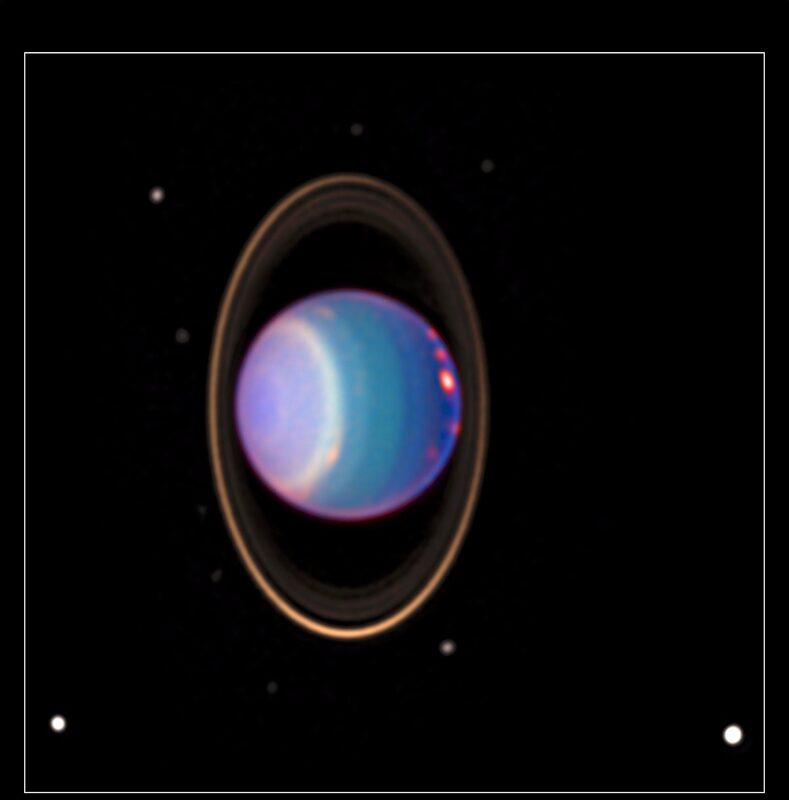
The outer solar system's fall opposition season ends this month. Neptune reached opposition on Sept. 26 and Saturn followed on Oct. 4. Now it's Uranus's turn. The seventh planet from the Sun reaches opposition on Wednesday, Nov. 25, 2026, the eve of the US Thanksgiving holiday. On that date Earth lies directly between Uranus and the Sun, so the planet rises around sunset, stays up all night and is about as close and as bright as it gets this year.
There's a catch, and it's a big one. November's full Moon, the Beaver Moon, falls on the same date. Planning around the Moon matters more than the opposition date itself.
Where to Look
This year Uranus sits in Taurus, in the patch of sky between two of the best-known star clusters, the Pleiades and the Hyades. That makes it easier to find, since both clusters make useful signposts for a star chart. Uranus lies in the gap between them, appearing as a faint, star-like point.
According to EarthSky, Uranus shines at about magnitude +5.6 from roughly mid-October to mid-December. Universe Today puts it at about +5.5. Either figure sits right at the limit of naked-eye visibility. In principle a sharp-eyed observer under a truly dark sky can see it without optics. In practice, EarthSky notes Uranus is tough to locate without optical aid, and it is easily visible in good binoculars or a telescope. A good finder chart helps tell Uranus apart from the background stars.
EarthSky gives the exact moment of opposition as 23:00 UTC on Nov. 25. Writing in BBC Sky at Night Magazine, Pete Lawrence notes that on that date the planet is due south and at its highest at 00:03 UT. At that point it is only 6 degrees from a bright full Moon.
The Moon Problem, and a Workaround
A full Moon 6 degrees away makes a magnitude +5.6 target much harder to pick out. Lawrence's solution is to skip the opposition date. He picks the night of Nov. 22 as the best opportunity: Uranus is due south at 00:15 UT, at an altitude of 58 degrees, and the Moon is a little farther away.
Opposition is not a single-night event. Lawrence notes that the appearance of Uranus won't change much over the weeks before and after opposition, because the planet is so far away that the advantages are slight. A slightly earlier night with the Moon farther off beats the nominal date. EarthSky notes that the planet remains in the evening sky through April 2027, so there is plenty of time.
The Moon offers its own show the night before opposition. Universe Today reports that the Moon occults, or passes in front of, the Pleiades on Nov. 24, an event visible from the Arctic.
What You'll See Through a Telescope
At low magnification Uranus looks like a star. Universe Today describes it as a blue-green ‘star’ that refuses to snap into focus. Increase the power and it resolves into a tiny disc. Sky at Night and EarthSky both give its apparent diameter as 3.8 arcseconds. Universe Today rounds that to about 4 and calls it barely resolvable, with detail tough to tease out. The main thing you'll notice is the colour: Sky at Night describes a green-hued disc, and EarthSky a greenish one.
The moons are a real challenge, and aperture is the main factor. Sky at Night gives a rough guide:
- Small telescope: a tiny green disc.
- 200 to 250 mm (8 to 10 inches): may pick up Titania and Oberon, the largest and outermost of the brighter moons.
- 300 mm (12 inches) and up: Ariel and Umbriel come into range.
- 400 mm (16 inches) and up: tricky Miranda needs at least this much aperture.
EarthSky says up to four moons may be visible. Universe Today adds that only five of Uranus's moons are within potential reach of amateur telescopes, with Titania the brightest at magnitude +13.9.
How Far Away Is It?
At opposition Uranus is about 18.4 astronomical units from Earth, according to EarthSky. That is roughly 18.4 times the Earth-Sun distance. Sunlight reflected from the planet takes about 2.6 hours to reach your eyepiece, a figure EarthSky also gives.
Universe Today notes that Uranus reached aphelion, its farthest point from the Sun at 20 AU, in 2009. It is now heading toward perihelion at 18.3 AU in 2050. NASA lists its orbital period as about 84 Earth years (30,687 days), so the planet moves only slowly against the stars. Universe Today notes that in 2033 it will pass the spot in Taurus where William Herschel discovered it in 1781.
Because Uranus moves so slowly, Earth needs only a little extra time to catch up with it each year. Universe Today gives the synodic period, the time between successive oppositions, as 370 days, so oppositions slide forward about five days each year. Lunar occultations of Uranus are also on the horizon: Universe Today says the next cycle begins Sept. 29, 2029.
Why It Matters
Uranus is a worthwhile target for modest equipment. It was the first planet found with the aid of a telescope, discovered by William Herschel in 1781, according to NASA. Finding it yourself retraces one of the more important moments in astronomy. Universe Today notes that Herschel's discovery came when Saturn was thought to mark the solar system's outer boundary.
The planet is also very strange. NASA gives its axial tilt as 97.77 degrees, which means Uranus essentially orbits on its side. NASA says it is surrounded by 13 faint rings and 28 known moons, named after characters from the works of William Shakespeare and Alexander Pope. Universe Today puts the moon count at 29, a reminder that the tally keeps changing.
Practically, this year's placement is a good one for a beginner. Two star clusters flank the planet, which should make the starhop short. Opposition puts it highest in the sky around midnight, and EarthSky says it stays in the evening sky through April 2027. The Moon makes the opposition date itself a poor choice, but the opportunity lasts much longer than one night.
