
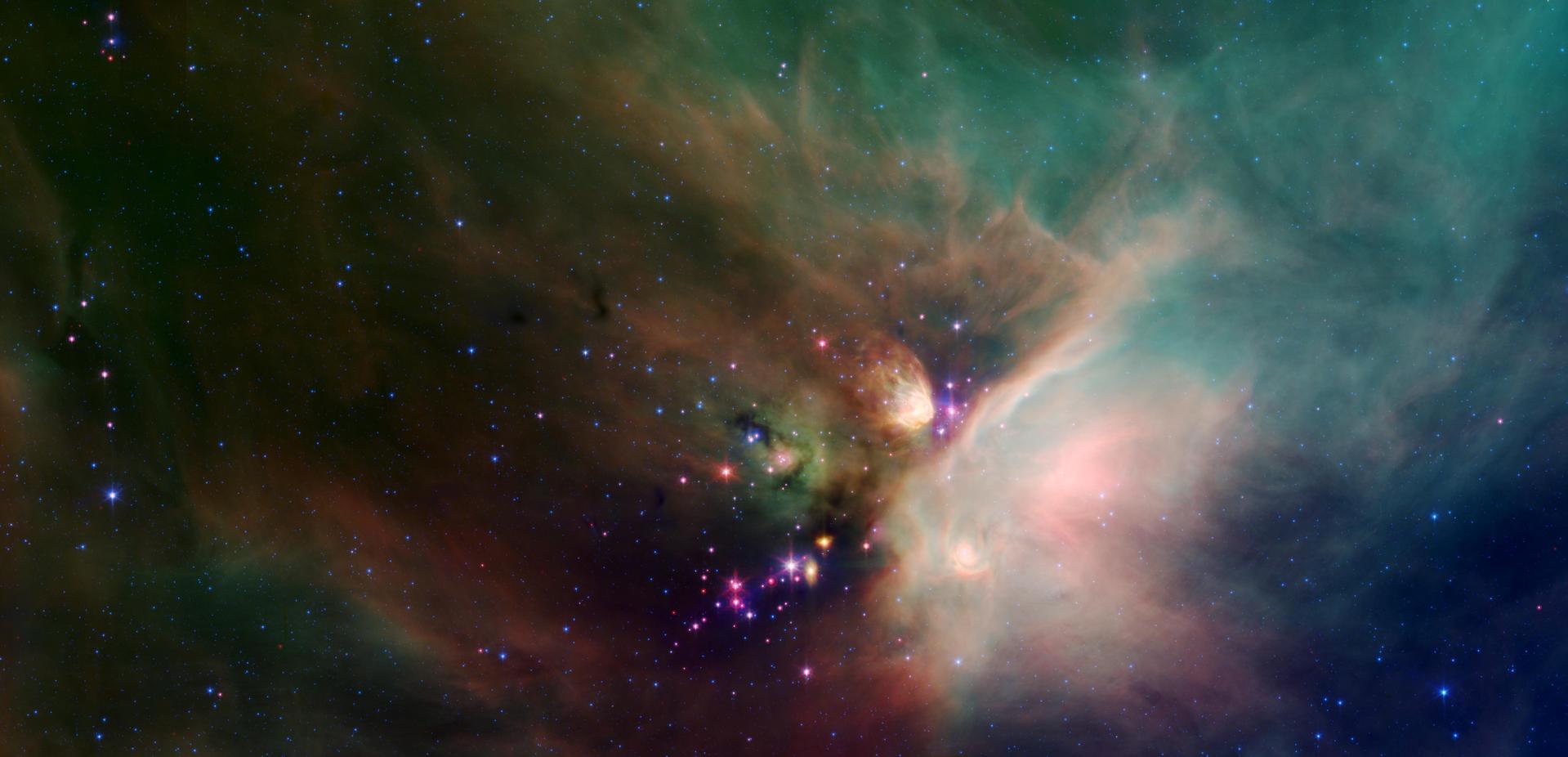
Most astronomy images are already translations. X-rays and infrared light are invisible to human eyes, so the pictures we see of nebulae and galaxies are data mapped onto colors we can see. On Nov. 17, 2026, NASA's Chandra X-ray Observatory went one step further and released an album of four sonifications, which map that same data onto pitch, timbre and rhythm. The subject this time is baby stars: young, energetic objects in three star-forming regions of our galaxy and one in another galaxy.
The new tracks combine Chandra's X-ray observations with data from the James Webb Space Telescope, and for the M82 track also the Hubble Space Telescope and the Spitzer Space Telescope. Each instrument's wavelength range gets its own sound, so a listener can pick out which telescope is "speaking" at any point in a track.
Four regions, four sound designs
The album does not use one template for all four tracks. Each sonification is built around what is most interesting in its region, and the design choices tell you something about the science.
M82: a galaxy in overdrive
M82 is a starburst galaxy, and NASA describes it as forming stars at a rate tens or even hundreds of times higher than in the Milky Way. Its sonification draws on all four observatories (Chandra, Hubble, Webb and Spitzer) and begins with a radar-like scan that is louder where sources are brighter. The sweep turns a still picture into something that unfolds over time, so the listener meets the galaxy's features one after another instead of all at once.
The Orion Nebula: a crowd of young stars
In the Orion Nebula, Chandra sees more than 1,000 young stars, which the sonification renders as twinkling sounds. The track layers Webb's infrared data on top as lower musical tones, distorted string instruments and a digital harp, so the X-ray stars and the dust and gas the nebula is built from sit in different registers.
Orion is also the track most listeners can connect to their own sky. According to EarthSky, the Orion Nebula lies about 1,300 light-years away, making it one of the closest star-forming regions to Earth, and it is visible to the unaided eye as a misty patch on Orion's Sword, just below the Belt.
The Carina Nebula's "Cosmic Cliffs"
The Carina track focuses on the region known as the Cosmic Cliffs. Here individual baby stars that Chandra detects through the dust and gas are rendered as short string sounds, so each young star gets its own brief note. EarthSky notes that the Carina Nebula spans about three times the width of the full moon in Southern Hemisphere sky and is home to Eta Carinae and the Homunculus Nebula.
Rho Ophiuchi: hearing the dark
The Rho Ophiuchi sonification may be the most instructive of the four, because silence is part of the data. X-rays play as high, glassy tones and stars as metallic plucks, while Webb's infrared clouds are mapped to differently pitched sounds. A gap in the middle of the piece marks dark dust clouds that emit very little light. A dust lane in an image looks like a dark patch, and in sound it becomes an absence you can hear.
How a sonification works
Sonification isn't a soundtrack laid over an image. It assigns properties of the data to properties of sound. Position in the image can become timing as a scan line moves across it, brightness can become volume or pitch, and different wavelengths can be given different instruments. The four tracks here use all of these: a radar scan for M82, separate instruments for Webb and Chandra data in Orion, short string notes for individual stars in Carina, and a gap for dust in Rho Ophiuchi.
The work comes from the Chandra Sonification Project, which began in 2020 as NASA's first ongoing, sustained program to sonify astronomical data. It is led by Kimberly Arcand of the Chandra X-ray Center with Matt Russo and Andrew Santaguida of System Sounds, and with accessibility consultant Christine Malec. All four are credited on the new album. NASA's Marshall Space Flight Center manages the Chandra program, and the Smithsonian Astrophysical Observatory's Chandra X-ray Center controls science and flight operations.
Why It Matters
The obvious audience is people who are blind or have low vision, for whom a nebula photo carries little information. That is why the project works with an accessibility consultant and why its design choices aim to carry real structure, not just atmosphere. According to the Chandra X-ray Center, a research study with blind and sighted users found high learning gains, enjoyment and strong emotional responses to the data, so the benefit was not limited to people who can't see the images.
Accessibility isn't the only reason these tracks are worth hearing. Multiwavelength astronomy is hard to explain in a single picture. Combining X-ray, infrared and optical data into one image means flattening very different kinds of light into one color palette. Sound offers another axis. When X-rays are glassy tones and stars are plucks, or Webb's infrared is a low harp under Chandra's star field, the listener can follow each layer of data on its own while still hearing them together.
Then there's the subject. Star formation is one of astronomy's central questions, and these four regions cover a wide range: the nearby Orion Nebula, the dusty Rho Ophiuchi region, the young stars of Carina's Cosmic Cliffs, and a whole galaxy making stars far faster than our own. Hearing them side by side makes it easier to compare a crowded stellar nursery, a dust-blocked cloud and a galaxy-wide starburst.
The release is an album, not a discovery, but it shows how much information is packed into the data behind familiar images. If you have a clear night this winter, find Orion's Belt, look just below it, and then listen to the Orion track. The faint smudge you can see is home to more than a thousand young stars that Chandra can detect.
