
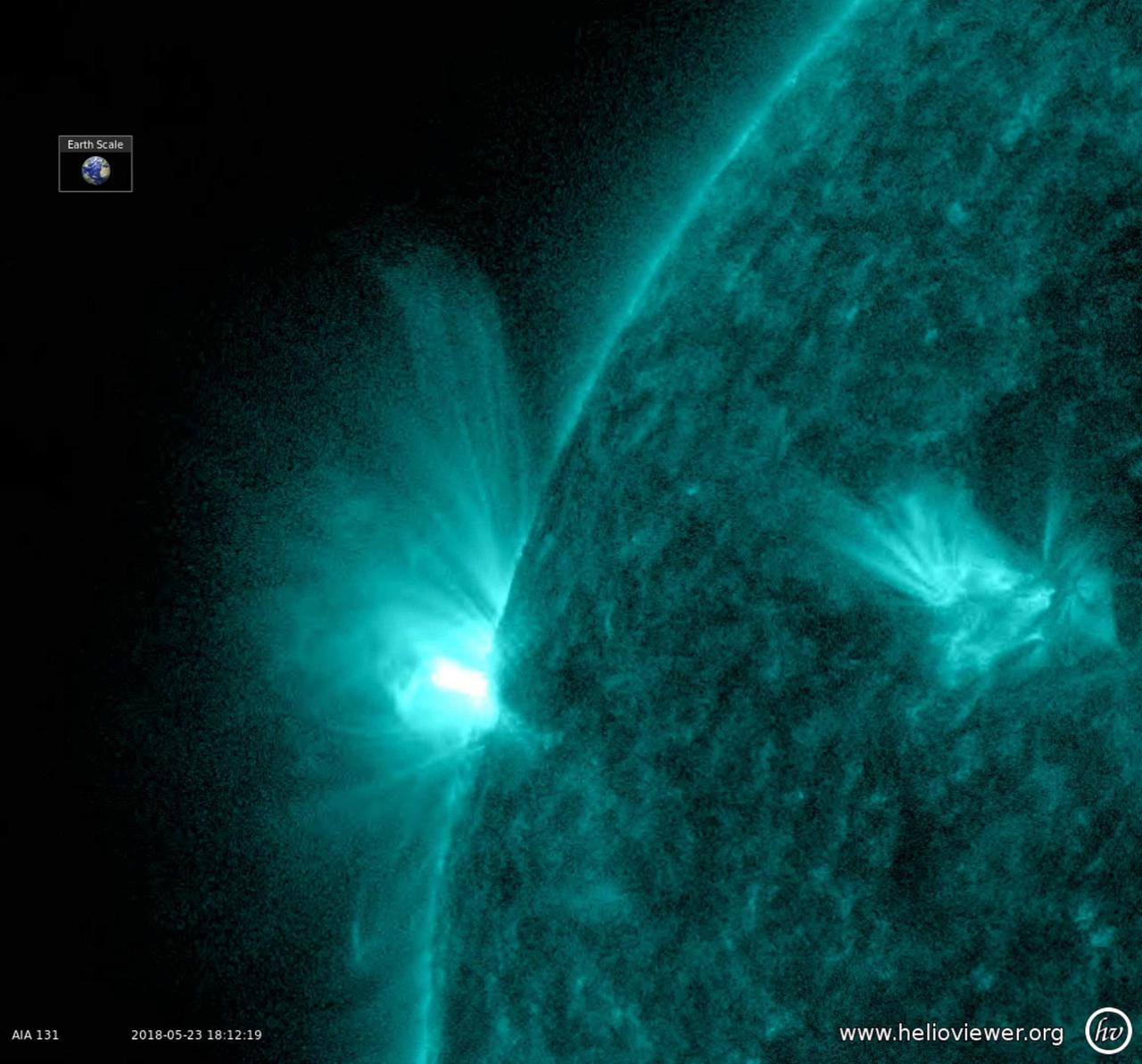
For several days the Sun had produced nothing bigger than B- and C-class flares. That ended on Nov. 17, when sunspot region AR4578 fired two M-class flares about six hours apart. Each caused an R1 (minor) radio blackout. The first one also launched a coronal mass ejection (CME), and part of it now looks likely to reach Earth around early Nov. 22.
EarthSky's daily sun report summed up the change with the headline "Our star awakens with 2 M flares." The numbers back it up. In the 24-hour period covered by the report, the Sun produced 21 flares: two M-class, 19 C-class and no X-class.
The Two Flares
According to the NOAA Space Weather Prediction Center (SWPC) forecast discussion issued at 12:30 UTC on Nov. 18, both flares came from Region 4578. SWPC lists the region at S11W73 with a Dri/beta-gamma magnetic classification. In plain terms, it sits in the southern hemisphere and is close to the Sun's western limb.
- M1.1 at 15:49 UTC, Nov. 17. EarthSky reports that this flare caused an R1 (minor) radio blackout over Brazil.
- M1.7 at 21:39 UTC, Nov. 17. This one caused an R1 blackout over the Pacific near Easter Island.
A NASA Astronomy Picture of the Day published on Nov. 18 explains this class of event. It describes M-class flares as moderately bright in X-rays and able to cause radio blackouts at the poles and minor radiation storms. (The APOD image is an H-alpha view of a different M1 flare from May 14, 2025, not the Nov. 17 events.)
The CME and the Nov. 22 Forecast
The more consequential product of the day may be the CME. SWPC says material from the M1.1 eruption first appeared in the LASCO C2 coronagraph around 16:00 UTC on Nov. 17. SWPC's modeling indicates that this CME gets tangled with CMEs launched on Nov. 16, and that the combined structure may produce a glancing blow early on Nov. 22. EarthSky also says part of the M1.1 CME is headed toward Earth, with a possible glancing blow on Nov. 22.
The word "glancing" matters. Region 4578 is near the western edge of the disk, which fits with only part of the CME heading toward Earth. A glancing blow generally means Earth passes through the outer edge of the ejecta rather than its core. The Nov. 16 CMEs add uncertainty, since SWPC's modeling has the CMEs tangling together. Neither source gives a geomagnetic storm level for Nov. 22. Treat this as something to watch for, not a reason to schedule a trip.
The day produced one more CME. SWPC notes an eruption near Region 4579 at about 19:30 UTC on Nov. 17, which launched a CME away from the Sun-Earth line. EarthSky connects AR4579 to a C7.3 flare and agrees that its CME is not Earth-directed.
Meanwhile, a G1 Watch for Nov. 18
Before any of the Nov. 17 material arrives, Earth already has a separate source of geomagnetic activity. SWPC's 3-day forecast predicts a greatest 3-hour Kp index of 4.67 for Nov. 18 during the 12-15 UT window. That counts as G1, the minor-storm level. SWPC's 3-day forecast attributes it to a positive-polarity coronal hole high-speed stream. The highest Kp observed over the previous 24 hours was 3.
EarthSky's assessment is a bit more aggressive. It suggests that the Nov. 14 CME combined with the coronal hole stream could push activity to G1 (Kp 5) on Nov. 18, with aurora possibly visible as far as northern Scotland and far southern New Zealand. SWPC's forecast discussion also expects G1 conditions, citing the high-speed stream together with the possible arrival of the Nov. 14 CME late in the period. The two sources agree on G1 and differ mainly on the exact Kp ceiling.
For skywatchers, EarthSky's aurora range of northern Scotland and far southern New Zealand suggests this is a high-latitude event.
What Comes Next
AR4578 doesn't have much time left on the visible disk. SWPC forecasts low solar activity for Nov. 18-19 with a chance of M-class flares capable of R1-R2 radio blackouts. That chance should drop as Region 4578 rotates off the western limb. EarthSky puts the M-flare probability at 25% and the X-flare probability at 5%.
Other regions are on the disk. EarthSky counts seven numbered regions, including AR4581, which rotated into view at the southeast limb and was newly numbered by SWPC. EarthSky also notes that jets and prominences of plasma streamed out from AR4578 near the Sun's western edge.
The chance of a radiation storm is small. SWPC puts the probability of an S1 or greater solar radiation storm at 5% on Nov. 18 and 19, falling to 1% on Nov. 20. Separately, SWPC reports that the flux of high-energy electrons (above 2 MeV) at geosynchronous orbit peaked at 3,668 pfu at 17:10 UTC on Nov. 17.
Why It Matters
Moderate flares like these are not dramatic, but they are a useful test of the forecasting chain. The M1.1 caused an R1 radio blackout over Brazil. It also produced a CME that forecasters now have to track over several days of travel while it interacts with earlier ejecta. The question is whether the modeled glancing blow on Nov. 22 actually arrives on time and at the expected strength. As the NASA APOD explainer notes, this kind of monitoring is the reason NASA, NOAA and other agencies watch the Sun continuously.
For aurora chasers, the outlook has two parts. The first chance comes on Nov. 18 from a coronal hole stream that SWPC has already forecast at G1. A second, less certain chance comes around Nov. 22 if the tangled CMEs connect. High-latitude observers should keep an eye on both dates, and everyone should check updated SWPC forecasts as the arrival window gets closer.
