
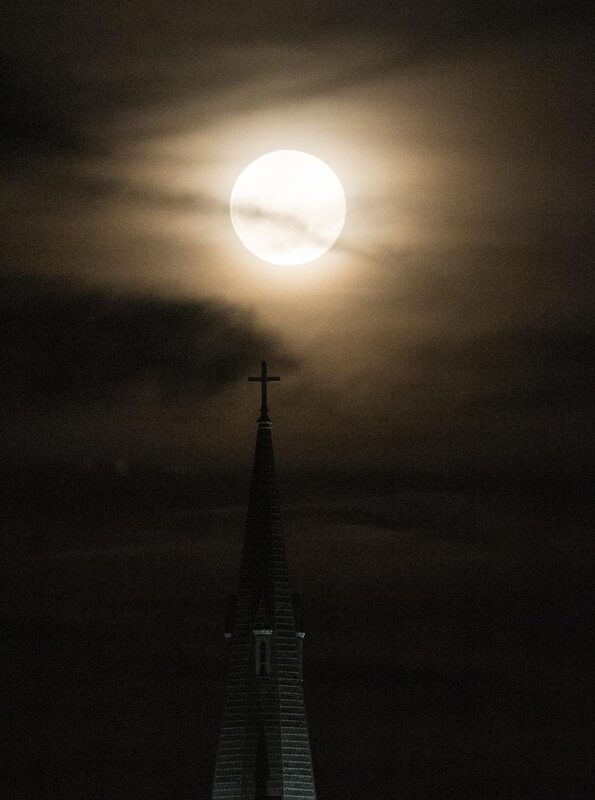
Thanksgiving week gives skywatchers two very different targets. One is the hardest naked-eye planet to catch, and it only shows up for a short window in dawn twilight. The other is a full Moon that needs no help to find. Mercury reaches its greatest distance from the Sun in the morning sky on Nov. 21. Three days later, the Beaver Moon turns full on Nov. 24, and NASA counts it as the first of several supermoons in a row.
Here is when to look, where to point, and how much to expect from each one.
Mercury: A Short Morning Window
Mercury passed between Earth and the Sun at inferior conjunction on Nov. 4, 2026, according to EarthSky. Since then it has been pulling away from the Sun's glare into the predawn sky. It reaches greatest western elongation, its widest apparent separation from the Sun on the morning side, at 0 UTC on Nov. 21. In North American time zones that is 6 p.m. Central Time on Nov. 20.
The exact hour doesn't matter much for viewing. Elongation changes slowly, so the mornings around Nov. 21 all give roughly the same view. At its peak, Mercury will be about 20 degrees from the Sun. That is near the low end of the planet's range: EarthSky notes that Mercury's greatest elongations run from about 18 to 28 degrees.
Twenty degrees is not much. Mercury will sit low in the east as dawn brightens, so you need a clear, flat horizon in that direction. A field, a beach, or an upper-floor window with an open eastern view is better than a backyard ringed by trees and houses.
What to look for
Mercury should shine at about magnitude -0.6 on Nov. 21 and brighten to about -0.9 over the following days. Astronomical magnitudes run backward, so lower numbers mean brighter objects. That makes Mercury bright enough to see without optics once you know where it is. The hard part is that it shows up against a sky that is already getting lighter.
You have two guides. Brilliant Venus rises earlier than Mercury, appears higher in the sky, and is impossible to miss. The bright star Spica is also nearby. Find Venus first, then look lower toward the eastern horizon as twilight builds, and Mercury should come into view.
Which hemisphere wins
This apparition favors the Northern Hemisphere. EarthSky says Southern Hemisphere observers might still glimpse Mercury, especially with binoculars scanning the eastern horizon, where it will sit low. EarthSky also notes that autumn mornings are best for morning elongations in both hemispheres.
If you use binoculars, put them away before the Sun comes up. Never sweep optics near the eastern horizon once there is any chance the Sun is above it.
You have a few weeks, but not many. By EarthSky's estimate, Mercury will be lost in the twilight again by mid-December, so the days just after elongation are the best time to try.
The Beaver Moon: Full on Nov. 24
The Moon reaches full phase at 9:53 a.m. EST (1453 GMT) on Nov. 24, per Space.com. In the United States the Moon will be below the horizon at that exact moment. That isn't a real problem, because a full Moon looks full to the eye for more than one night. Space.com says it will appear full on both Nov. 23 and Nov. 24.
That gives you two good times to look:
- Before dawn on Nov. 24: Space.com recommends watching the Moon set in the west in the hours before sunrise. Near the horizon it should look yellow-orange, because its light passes through more atmosphere there.
- Evening of Nov. 24: NASA's November skywatching guide says the evening sky "will be lit by a supermoon" on Nov. 24, and suggests looking east around sunset as the Moon rises.
Readers outside the U.S. will catch the exact moment of full phase at different local times. Space.com lists 2:53 p.m. GMT in London, 10:53 p.m. CST in Beijing, 11:53 p.m. JST in Tokyo, and 1:53 a.m. AEDT on Nov. 25 in Sydney.
"Beaver Moon" is the traditional name for November's full Moon, per Space.com. Space.com notes alternate names including the Frost Moon and the Digging Moon.
How many supermoons in a row?
This depends on whose definition you use. NASA calls the Nov. 24 full Moon the first of three consecutive supermoons, in November, December, and January. Space.com describes it as the first of four. Both can be right. Space.com calls "supermoon" a non-scientific term, applied here to full Moons within 90% of perigee, the Moon's closest approach to Earth, so a different cutoff can change the count. The safe version: the Nov. 24 full Moon starts a run of at least three supermoons, and the exact count depends on the definition.
Set your expectations to match. A supermoon is somewhat larger and brighter than an average full Moon, but NASA says the difference can be subtle. The real reason to go outside is the moonrise or moonset itself: a big, warm-colored disk sitting low over the landscape.
Why It Matters
Mercury is hard to see. It never strays far from the Sun, so it only appears in bright twilight, low on the horizon, for a few weeks at a time. A morning elongation with Venus nearby as a guide, in a season that favors northern observers, is one of the more forgiving chances. You don't need a telescope, just an early start and a clear eastern horizon.
The supermoon run matters for a different reason. Full Moons are among the most accessible sky events: they work from cities, through light pollution, and for people with no equipment. A stretch of supermoons from late November into the new year gives you several reasons to step outside on long winter evenings. The disagreement over how many count is also a useful reminder that popular sky labels like "supermoon" are conventions rather than formal scientific categories.
Also This Month
NASA's November roundup, narrated by Raquel Villanueva of JPL, notes a few other events, some of which have already passed. The Leonid meteor shower was best on the early mornings of Nov. 17 and 18 after moonset, with about 15 meteors per hour at best. Mars and Jupiter appeared about 1.2 degrees apart on Nov. 15 and 16. NASA also notes that Voyager 1 is becoming the first human-made object to reach one light-day from Earth, which you can't see in the sky but is still a milestone.
For this week, the plan is simple. Get up early around Nov. 21 and look east for Mercury below Venus. Then on Nov. 24, catch the Beaver Moon setting before dawn or rising at dusk.
