
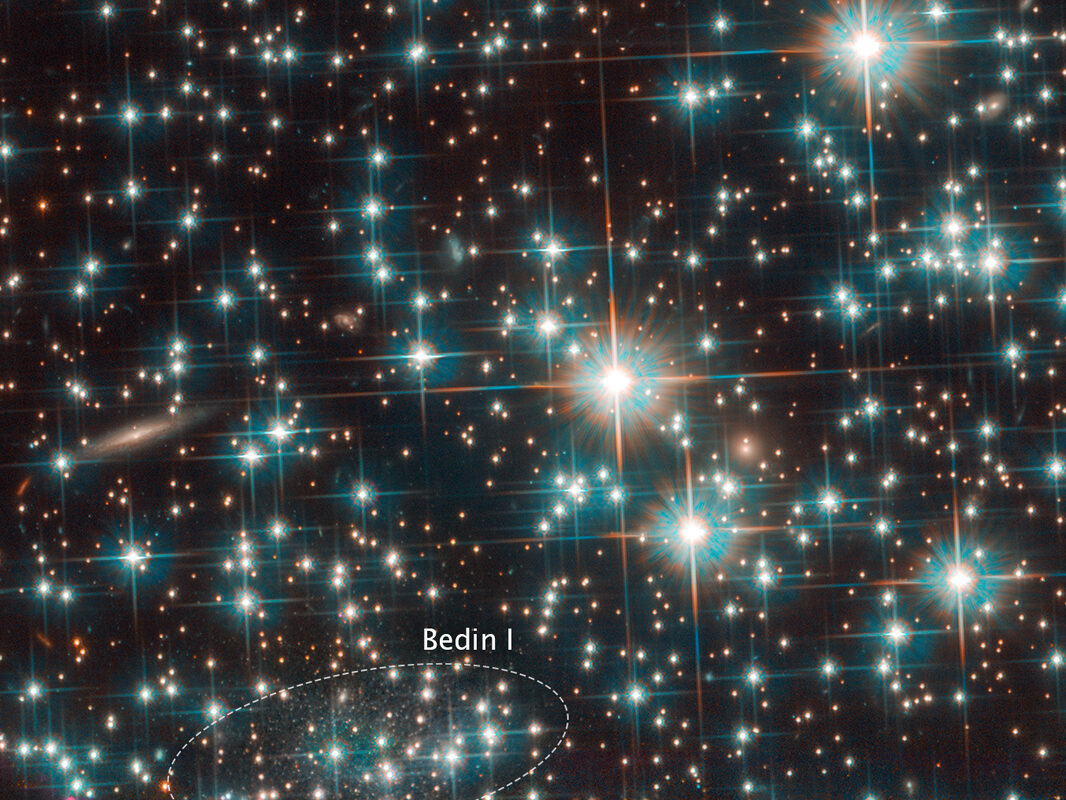
The Milky Way's list of known companions grew by four this week. They aren't the bright Magellanic Clouds or anything you could find with binoculars. They are faint clumps of stars, and only careful statistics can pull them out of the foreground stars of our own galaxy. A paper posted to arXiv on Nov. 25 by the UNIONS collaboration describes them. Its authors include Simon Smith, Alan McConnachie, de Boer, Chambers, Gwyn and Hildebrandt.
Two of the new objects, named Bootes VI and Draco III, are probably ultra-faint dwarf galaxies. The other two, UNIONS 2 and UNIONS 3, are odder. They are so faint and so compact that the team cannot say whether they are ordinary star clusters or tiny galaxies held together by dark matter.
A search, not a lucky find
The paper's title, "State of the UNIONS: Four Milky Way companions discovered in a systematic search for northern Local Group satellites," explains the method. These objects weren't found by chance. They came out of a deliberate sweep of the survey's gri photometry (images taken through three optical filters) looking for small overdensities of stars that could mark a satellite system.
Smith and McConnachie, of the University of Victoria and NRC Herzberg, presented preliminary results from this search in proceedings from IAU Symposium S379. They described a systematic UNIONS search for new Local Group dwarf galaxies. Its end goal is to put firm constraints on the detectability and completeness of Local Group dwarf galaxies. The point is not only to add names to a catalog. It is to learn how many satellites a survey like this should be finding, and how many it is likely missing.
The program already has a track record. In 2022, the team reported Bootes V, a dwarf galaxy candidate about 100 kpc away with a half-light radius of about 26.9 pc and a V-band absolute magnitude of −4.5 ± 0.4. Its member stars were identified with Gaia DR3 astrometry, and its brightest star was followed up with the Gemini GMOS-N spectrograph. The same group, led by Smith, later found Ursa Major III/UNIONS 1, described as the least luminous known Milky Way satellite.
The two likely galaxies
Astronomers rank brightness by absolute magnitude, MV. The scale runs backward, so more negative numbers mean brighter objects. Bootes VI has MV = −2.7 and Draco III has MV = −4.0. Both are extremely dim by galaxy standards. Both lie at roughly 100 kpc or more from the Galactic center, well into the Milky Way's outer halo.
The case for calling them galaxies rests mostly on size. Each has a half-light radius of about 50 pc, the radius that contains half of an object's light. According to the paper, that is about twice the size of the most extended Milky Way globular clusters of similar luminosity. A star cluster holds itself together with the gravity of its own stars, while ultra-faint dwarf galaxies are thought to be held together by dark matter. A system this extended and this faint is therefore a candidate galaxy, though the authors say chemodynamical analyses will be needed to secure the classification.
Bootes V gives a useful comparison. It is brighter than either new object, yet it is only about half as wide, at about 27 pc. Bootes VI and Draco III are both larger and fainter. That makes them diffuse and hard to spot, which is exactly the kind of object a systematic search is built to find.
The two puzzles
UNIONS 2 and UNIONS 3 are harder to classify. Their absolute magnitudes are +0.4 and −0.7. Their half-light radii are about 5 and 10 pc, far smaller than the two galaxy candidates. The paper also notes that no giant stars are identified in either system.
That leaves the team unable to decide. The authors say that morphological measurements alone are not sufficient to assess the presence of dark matter in either system, so they do not provide definitive classifications. They describe the two as archetypal of the faintest satellites that upcoming wide-field surveys will find in increasing numbers. Settling the question will take chemodynamical analysis: spectroscopy that measures how fast the member stars move and what they are made of.
Ursa Major III/UNIONS 1 shows how deep that ambiguity goes. According to the University of Hertfordshire research profile of its discovery paper, it has MV = +2.2 and a total stellar mass of only about 16 solar masses. Its population is old (more than 11 billion years) and metal-poor ([Fe/H] ≈ −2.2), about 10 kpc away, and compact, with a half-light radius of 3 ± 1 pc. UNIONS 2 and UNIONS 3 are brighter and somewhat larger than that, but they are in the same general regime.
The numbers side by side
- Bootes VI: MV = −2.7, rh ≈ 50 pc, roughly 100 kpc or more away. Likely an ultra-faint dwarf galaxy.
- Draco III: MV = −4.0, rh ≈ 50 pc, roughly 100 kpc or more away. Likely an ultra-faint dwarf galaxy.
- UNIONS 2: MV = +0.4, rh ≈ 5 pc, no giant stars identified. Nature unresolved.
- UNIONS 3: MV = −0.7, rh ≈ 10 pc, no giant stars identified. Nature unresolved.
- For comparison, Bootes V: MV = −4.5 ± 0.4, rh ≈ 26.9 pc, ~100 kpc away.
- For comparison, Ursa Major III/UNIONS 1: MV = +2.2, rh = 3 ± 1 pc, ~10 kpc away, ~16 solar masses of stars.
Why It Matters
Ultra-faint dwarf galaxies are among the faintest galaxies known, and each confirmed one adds to a census that models of galaxy formation have to reproduce. That census is only useful if astronomers know how complete it is. Bootes VI and Draco III, both large, faint and far away, show what a careful survey can detect at faint limits. That is the completeness and detectability question Smith and McConnachie set out to answer.
UNIONS 2 and UNIONS 3 matter for a different reason. They sit right where the line between star cluster and galaxy is still unsettled. Whether dark matter is present in them is exactly what the authors say morphology alone cannot decide. If follow-up spectroscopy shows the stars moving faster than their visible mass can explain, that would point to dark matter. If it doesn't, they are faint clusters, and they still help show where clusters end and galaxies begin. For now, all four objects need chemodynamical follow-up before anyone can say for sure what they are.
Sources
- State of the UNIONS: Four Milky Way companions discovered in a systematic search for northern Local Group satellites (arXiv:2611.34775)
- The discovery of the faintest known Milky Way satellite using UNIONS (University of Hertfordshire)
- Discovery of a new Local Group Dwarf Galaxy Candidate in UNIONS: Bootes V (arXiv:2209.08242)
- Census of Northern Local Group Dwarf Galaxies using UNIONS (IAU Symposium S379 proceedings)
