
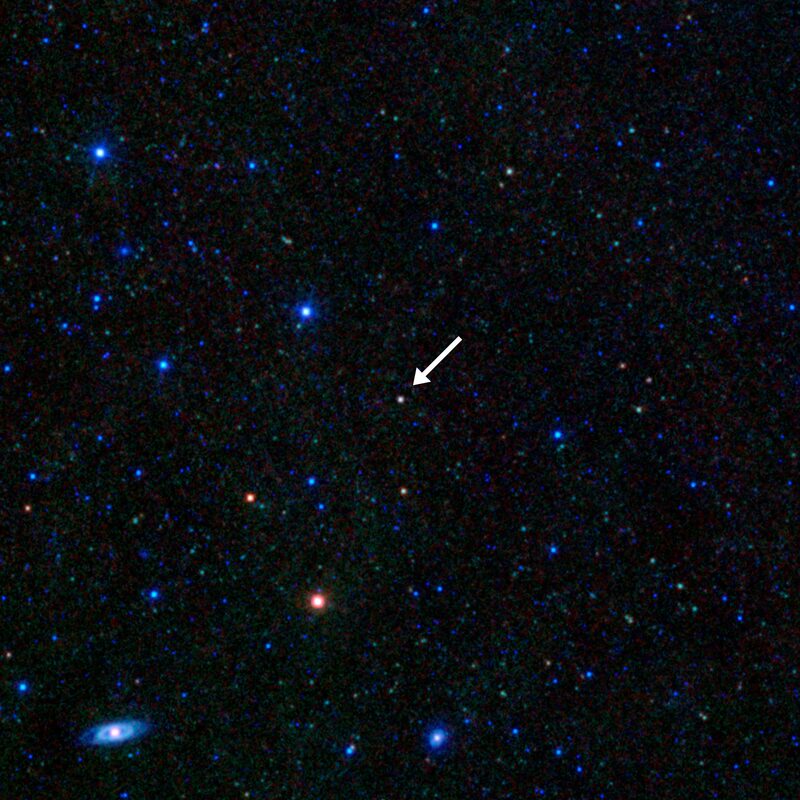
The Event Horizon Telescope is best known for two portraits of black hole shadows, but it has increasingly turned to the jets that some supermassive black holes push out into intergalactic space. A new analysis of the blazar 3C 279, led by Hendrik Müller and published in Astronomy & Astrophysics, looks closer to the base of one of those jets than earlier work could. The base turns out to be oddly shaped, extremely fast and almost pointed straight at us.
The paper, posted to arXiv in July 2026 and covered by Universe Today on November 25, uses EHT observations from the 2021 campaign. Its conclusion: on sub-parsec scales, the inner jet of 3C 279 bends toward Earth, which strongly amplifies what we see.
The target
3C 279 is a blazar, an active galaxy whose jet points close to our line of sight. According to Universe Today, it sits roughly 538 million light-years away. It is powered by a supermassive black hole of about 800 million solar masses, while Sagittarius A* at the center of the Milky Way has about 4.3 million. Universe Today notes that because of its brightness, 3C 279 is considered a prime target for very long baseline interferometry (VLBI) and is frequently used for calibration.
The 2021 data come from what Universe Today describes as the largest EHT array published to date. That year the network added the Kitt Peak 12-meter telescope and NOEMA, the observatory in the French Alps. Both provided intermediate baselines that improved coverage at intermediate angular scales. In interferometry, the distance between two antennas sets the spatial scale a pair can resolve, so a mix of baseline lengths is needed to constrain both compact and extended structure in the jet. Müller is now a staff scientist at the National Radio Astronomy Observatory and was formerly at the Max Planck Institute for Radio Astronomy.
A core that points the wrong way
The most striking result is geometric. The reconstructed images consistently show a compact core elongated nearly orthogonal to the large-scale jet axis. The base of the jet appears stretched almost sideways relative to where the outflow ends up going.
With very long baseline interferometry, a result like that invites immediate suspicion. Images are reconstructed from sparse measurements, and odd shapes can come from the imaging process rather than the sky. The authors address this directly. According to the paper's abstract, this rarely observed morphology recurs across multiple epochs and across frequencies from 22 GHz up to 230 GHz, and is therefore intrinsic rather than an imaging artifact. Universe Today adds that the team used several imaging packages that make different assumptions, to build confidence by checking that the results agree across methods.
Faster than light, apparently
Geometric model fitting identified several components, the bright knots within the jet, with apparent speeds of up to 10 times the speed of light. Nothing is actually breaking relativity. Apparent superluminal motion is a projection effect: when material moves at nearly light speed almost directly toward the observer, the light it emits later has less distance to travel, which compresses the apparent timeline and inflates the measured transverse speed.
That illusion is also a tool. From the apparent speeds, the authors require bulk Lorentz factors greater than 10.3 and constrain the viewing angle to less than one degree. The Lorentz factor is the usual measure of how relativistic a flow is. In other words, the inner jet of 3C 279 is aimed almost exactly at Earth.
The paper also reports rest-frame brightness temperatures that are systematically low, between 109 and 1010 kelvin, consistent with optically thin emission at 230 GHz. Optically thin means radiation from deeper in the jet escapes rather than being self-absorbed, so at the EHT's highest frequency the observations see into the structure instead of just its outer surface.
Putting it together: a bend
A core stretched across the large-scale jet direction, plus a viewing angle under one degree, points to one explanation. The jet is not a straight pipe. On sub-parsec scales, the abstract states, it bends toward the observer, producing strong relativistic beaming.
Müller explained to Universe Today why a small change in direction matters. Because the plasma moves close to the speed of light, its radiation is concentrated in the direction it travels, so when that direction lines up more closely with Earth we see brighter emission. At the same time, features moving more nearly straight toward us can appear to move more slowly across the sky, like a car approaching almost head-on. The EHT images also show that the direction of the inner jet changes over time. Müller added that some features near the apparent base already move at apparent speeds comparable to those much farther downstream, which suggests the jet gains much of its speed over a short distance near its base.
What bends a jet?
The authors list several possible drivers of the bending and its evolution without picking a winner:
- Interaction with the interstellar medium. The jet could be deflected as it plows through surrounding gas.
- Plasma instabilities. Kink and Kelvin-Helmholtz instabilities can make a jet wiggle or twist as it propagates.
- Magnetic reconnection. The paper points to reconnection near the horizon, where a rearrangement of the magnetic field could release energy and alter the flow.
- Binary-induced precession. If the central engine involves a pair of black holes, their orbital dynamics could make the jet's launch direction precess.
The paper is frank about the limits. The current temporal coverage of VLBI data is insufficient to distinguish between these mechanisms, and the authors say continued multifrequency VLBI monitoring will be essential. Universe Today notes that astronomers have decades of observations of the jet on larger scales but only a few images of how it behaves at the sub-parsec level.
Why It Matters
Relativistic jets carry enormous energy out of galactic nuclei, and the region where they are launched and collimated is one of the least understood places in astrophysics. Universe Today describes the mechanisms driving the central jet of 3C 279 as still a mystery, even though it is one of the best-studied quasars in radio astronomy. The EHT's resolution makes it possible to measure the structure at the jet base, and this result shows that structure is not simple: a core oriented nearly perpendicular to the large-scale direction, with a jet curving to within a degree of our line of sight. Any model of how these outflows form will have to account for that geometry.
It also fits a broader shift in what the EHT is used for. According to Universe Today, between 2024 and 2026 the collaboration also imaged the jets of 3C 84 and M87. An array built to photograph event horizons is increasingly being used for jet physics, and each added telescope, such as Kitt Peak and NOEMA in 2021, improves its coverage of structure across scales.
The obvious next step is time. The authors' conclusion, that existing VLBI coverage cannot separate these scenarios, amounts to a call for continued monitoring. Müller told Universe Today that EHT observations from several years, along with observations at other frequencies scheduled around the same time, are currently being analyzed, and that he expects a series of results over the next few years. He called 3C 279 one of the best opportunities to understand how a black hole launches a jet and how that jet reaches nearly the speed of light.
Sources
- Dynamics and geometry of the inner sub-parsec-scale jet in 3C 279 observed with the Event Horizon Telescope (arXiv:2607.16104)
- Dynamics and geometry of the inner sub-parsec scale jet in 3C 279 (Heriot-Watt University research portal)
- The Event Horizon Telescope Views the Dynamics and Geometry of a Black Hole Jet in Extreme Detail (Universe Today, Nov 25, 2026)
