
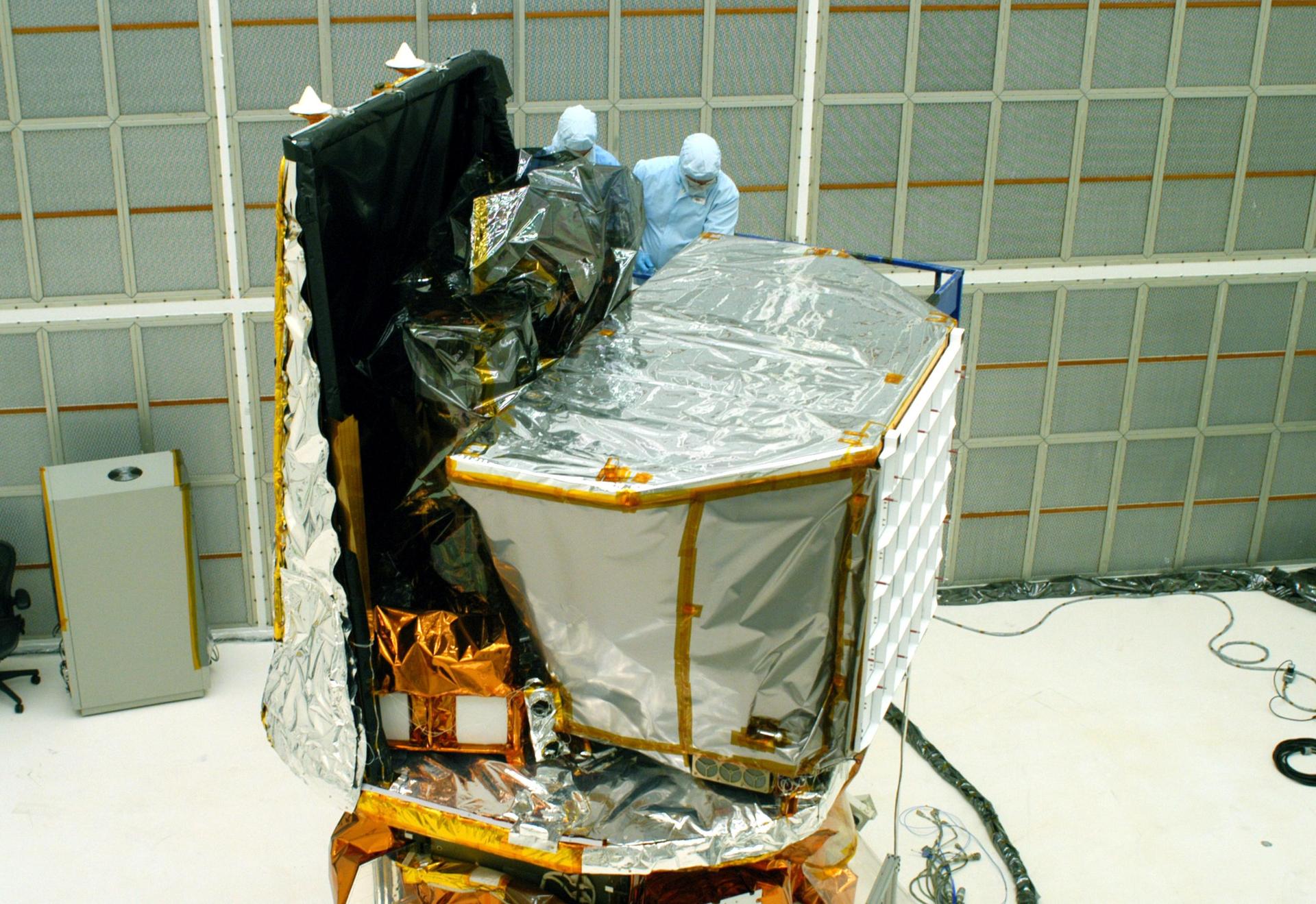
The mission meant to save NASA's Neil Gehrels Swift Observatory is, for the moment, going nowhere. Over three consecutive days spanning the end of June and the start of July, the launch of Katalyst Space's LINK servicing spacecraft has slipped from the calendar again and again — first for weather, then for weather once more, and then, according to follow-up reporting, because the rocket itself would not leave the belly of its carrier aircraft.
It is an unglamorous start to what is shaping up to be one of the more consequential flights of the year: an early, real-world test of whether a commercial robot can rendezvous with a working NASA science satellite and physically shove it back into a healthier orbit.
What's actually being launched
The spacecraft is LINK, built by Katalyst Space. Its ride to orbit is a Northrop Grumman Pegasus XL — the veteran air-launched rocket that doesn't lift off from a pad but instead drops from beneath an L-1011 carrier aircraft before igniting. The staging point for the campaign is Kwajalein Atoll in the Marshall Islands, a remote equatorial launch corridor in the Pacific.
Once flown, LINK is designed to chase down the Swift observatory, grapple onto it, and then slowly raise its altitude over the course of several months. That patient, incremental reboost is the whole point: Swift's orbit has been decaying, and left alone the spacecraft is on a path toward atmospheric reentry. LINK is meant to reverse that decline and buy the observatory more operational life.
The scrub timeline
The launch has been a moving target all week. The attempt originally sat on June 30, and weather knocked it out. NASA's own Swift blog confirmed that the try was pushed again on Wednesday, July 1, once more because of unfavorable weather, with the next opportunity set for Thursday, July 2 at 5:09 a.m. EDT.
That July 2 window did not go cleanly either. Per follow-up reporting, the Thursday attempt was scrubbed when a problem with the launch vehicle kept the Pegasus from deploying from its L-1011 carrier — a different failure mode entirely from the two weather calls that preceded it. Air-launched systems have their own choreography: the carrier aircraft has to reach the drop box, conditions aloft have to cooperate, and the release itself has to work. A hang-up at any of those stages sends everyone home to try again.
Two weather scrubs and one vehicle-side hold is a frustrating but not unusual opening act for a Pegasus campaign, which threads an unusually long list of go/no-go conditions across both an aircraft and a rocket.
Why NASA needs a tow truck for Swift
The Neil Gehrels Swift Observatory, operated by NASA's Goddard Space Flight Center, is one of the workhorses of high-energy astrophysics. It is built to study gamma-ray bursts — the brief, violent flashes that mark some of the most energetic events in the universe — and it has been doing that job for years. But like any satellite in low Earth orbit, Swift is subject to atmospheric drag that gradually pulls it downward. Without intervention, that decay ends one way.
Swift was never designed to be refueled or grabbed. It has no docking port and no built-in provision for a servicer to latch onto. That makes the LINK approach — rendezvous, grapple, and reboost — a genuinely hard piece of orbital robotics rather than a routine top-up. The plan calls for LINK to raise Swift's altitude gradually over several months rather than in a single dramatic maneuver.
A commercial first
What elevates this beyond a single satellite's reprieve is what it represents. As Astronomy.com framed it, Swift Boost is positioned as one of the first commercial life-extension servicing missions of a NASA astrophysics observatory. In other words, this is a private company being brought in to extend the working life of a government science asset that was never built to be serviced at all.
NASA has been laying the groundwork publicly. The agency documented LINK's integration in an image-article ahead of launch, publishing a photograph of the spacecraft nested inside the Pegasus XL. The hardware, by all accounts, was ready. It's the sky and the rocket that haven't cooperated.
Why It Matters
For decades, the implicit deal with a low-Earth-orbit science mission has been simple: it flies until its orbit decays or its systems fail, and then it's gone. Swift Boost is a test of a different proposition — that a decaying but otherwise healthy observatory can be caught, held, and lifted by a commercial robot, turning what would have been a reentry into a multi-month extension of scientific life.
If LINK succeeds, it validates a business and a capability that could apply well beyond Swift: a whole population of aging satellites that were never designed to be serviced could, in principle, be given more time. If it stumbles, it underscores how demanding rendezvous-and-grapple operations remain, especially against an uncooperative, non-cooperative target. Either way, the outcome will shape how NASA and the commercial sector think about the end of a spacecraft's life. But before any of that can be tested, the Pegasus has to actually drop and light — and this week, it hasn't.
This is a developing launch campaign; details of the current status reflect reporting through July 2, 2026.
Sources
- Weather Delays Launch of Mission to Boost NASA's Swift — NASA Science
- Pegasus XL set to air launch Swift Boost Mission to save NASA space telescope — NASASpaceFlight
- NASA's Swift Boost mission readies for launch — Astronomy.com
- LINK Spacecraft Set for Mission to Boost NASA's Swift Observatory — NASA
