
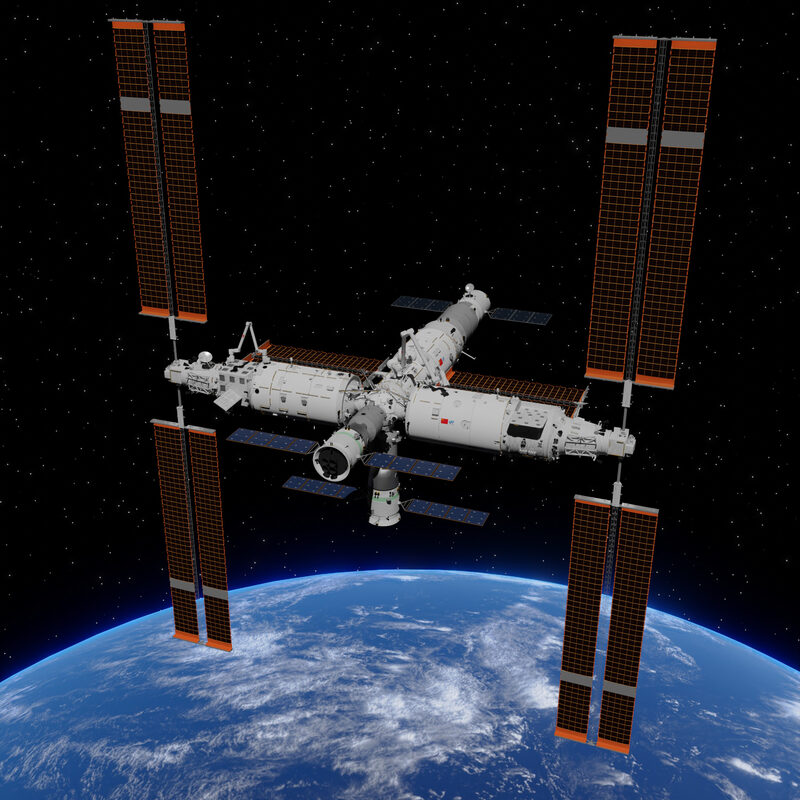
China's Tiangong ("Heavenly Palace") space station reached its final planned configuration in November 2022 with the attachment of the Mengtian experiment module, completing a T-shaped core of three modules: the Tianhe core module (launched April 2021), Wentian (July 2022), and Mengtian (October 2022). The station is in a low Earth orbit at about 390 kilometers altitude and 41.5 degrees inclination. Since the crewed Shenzhou-13 mission in October 2021, China has maintained a continuous human presence aboard Tiangong — a capability matched only by the ISS crew rotations that have continued since 2000. The achievement represents the conclusion of a deliberate, methodical three-decade human spaceflight program that began with the Shenzhou 1 uncrewed test flight in 1999.
The station is operated by the China Manned Space Agency (CMSA) and crewed by taikonauts on missions typically lasting six months, overlapping for crew handovers. Unlike the ISS, which is operated by a 15-nation consortium, Tiangong is operated exclusively by China — partly by design and partly because China was excluded from participating in the ISS by U.S. legislation (the Wolf Amendment, passed in 2011, prohibits NASA from cooperating with China on human spaceflight without explicit Congressional approval). China has offered access to Tiangong for international experiments and has conducted research with scientists from several countries, but no international crewed mission has been flown.
Research program
Tiangong's research program covers the standard domains of low-Earth-orbit science: biomedical (crew health monitoring, bone density and muscle atrophy under microgravity, cardiovascular adaptation, sleep quality), materials science (crystal growth, alloy solidification, semiconductor processing), fundamental physics (precision experiments in quantum entanglement and atomic clocks benefiting from the microgravity environment), and Earth observation using the Xuntian space telescope module planned to co-orbit and dock with Tiangong periodically. Xuntian is a 2-meter class telescope with a field of view 300 times larger than Hubble's, intended to conduct a wide-field sky survey of roughly 40 percent of the sky over its mission lifetime — a uniquely powerful combination of aperture and field that would position China as a major player in observational astronomy.
China's broader space ambitions
Tiangong is the operational core of a broader human spaceflight roadmap that includes lunar missions. China has outlined plans for a crewed lunar landing before 2030, using the Long March 10 heavy-lift rocket and a purpose-designed lunar lander. Unlike the Apollo or Artemis architecture that sends crew directly to the Moon from Earth, China's current plan involves crew rendezvous in lunar orbit and transfer to a separate lander — similar in structure to the Apollo lunar module approach. The sample return missions Chang'e-5 (2020) and Chang'e-6 (2024) have demonstrated the robotic infrastructure that precedes crewed surface access. Tiangong itself serves the long-term purpose of training crews and validating life support, propulsion, and rendezvous systems that will be needed for lunar and eventually Mars missions.
The Shenzhou crewed spacecraft is China's equivalent of the Russian Soyuz: a three-module vehicle (orbital module, reentry capsule, service module) capable of sustaining three crew members for missions of six months. The Shenzhou design has been refined through 19 missions since 1999, incorporating a crew expansion to three, enhanced life support, and an improved propulsion system for the longer-duration Tiangong missions. Tianzhou cargo spacecraft resupply Tiangong with propellant, food, equipment, and experiment materials on a roughly quarterly schedule, using an automatic docking system tested in the Tiangong-1 and Tiangong-2 precursor stations.
The pace of Tiangong's research program reflects a maturation of China's space science community that parallels the station's technical development. Early ISS science was driven primarily by NASA and the international partner agencies with decades of established research pipelines. Tiangong's early years have been dominated by engineering validation and crew adaptation studies — the bread-and-butter of any new human spaceflight program — but the roster of approved experiments for 2025-2027 includes collaborations with universities and research institutes across Europe, Asia, and Latin America, and the quality and ambition of proposals has increased with each open announcement period. Whether Tiangong will ultimately host the kind of transformative fundamental physics and life sciences research that the ISS has enabled over 25 years depends on how long China maintains it and how broadly it opens scientific access — questions that are as much political as scientific.
