
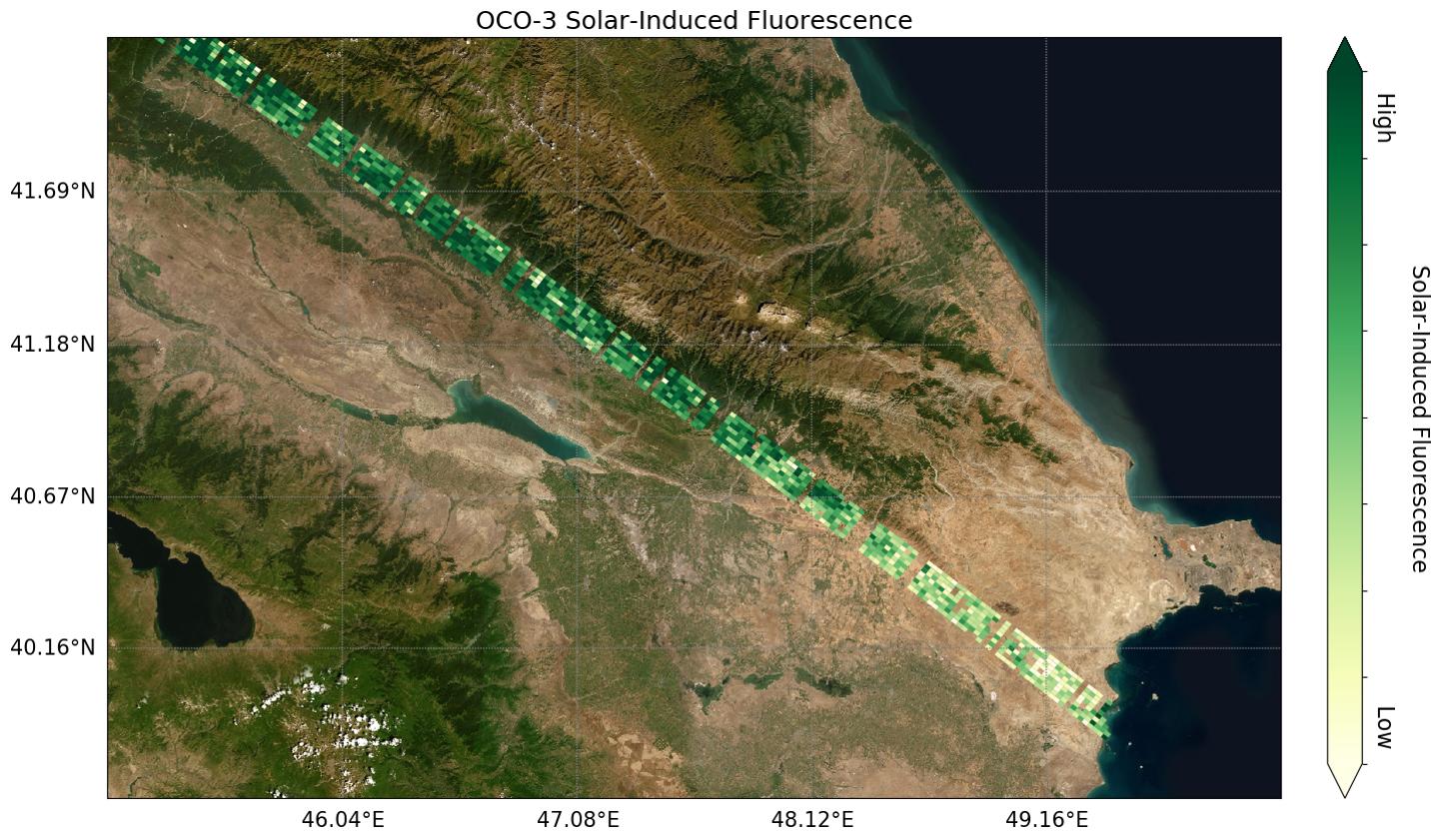
Plants leak light. When chlorophyll absorbs sunlight to drive photosynthesis, a tiny fraction of that energy is re-emitted as a faint red and near-infrared glow — a signal far too dim for the human eye, but a direct fingerprint of a plant actually doing the work of turning carbon dioxide and water into sugar. The European Space Agency is about to point an entire satellite at that glow.
On July 20, 2026, ESA issued a call for interest inviting media to cover the launch of FLEX, the Fluorescence Explorer, which the agency bills as its photosynthesis mission. FLEX is designed to be the first satellite dedicated to detecting plant fluorescence from orbit, and it will not fly alone: it launches together with the Copernicus Sentinel-3C satellite on a Vega-C rocket, flight VV30, from Europe's Spaceport in Kourou, French Guiana. The launch is planned for September 2026.
What FLEX Actually Measures
The instrument doing the looking is FLORIS, the Fluorescence Imaging Spectrometer. It is a tightly specialized piece of hardware. FLORIS covers the 500 to 780 nanometer range and samples as finely as 0.1 nanometers in the oxygen absorption bands — the narrow slices of the spectrum where the fluorescence signal can be teased apart from ordinary reflected sunlight. It uses two spectrometers working together to pull the faint emission out of the far brighter background of light bouncing off leaves and soil.
From its vantage point, FLORIS images a 150-kilometer-wide swath at 300-meter spatial resolution. That combination matters: it is fine enough to resolve differences between fields and forest stands, but wide enough to build up global coverage over time. FLEX flies in a sun-synchronous orbit at roughly 814 kilometers altitude, inclined 98.64 degrees, with a 27-day repeat cycle. ESA plans a 3.5-year mission.
Why It Flies in Formation
FLEX is not designed to work in isolation, and that is the clever part of the mission architecture. It will fly in tandem with a Copernicus Sentinel-3 satellite, positioned about 100 kilometers ahead so that the two spacecraft observe the same ground within a window of 6 to 15 seconds.
The reason is that fluorescence, on its own, is an ambiguous signal. To turn a glow into a meaningful measurement of plant health, you need to know how much sunlight the vegetation is receiving, its temperature, and its color and structure — the kind of context that Sentinel-3's instruments already deliver. Sentinel-3 carries the OLCI ocean and land color imager and the SLSTR sea and land surface temperature radiometer. By combining FLORIS fluorescence data with Sentinel-3's color and temperature measurements taken seconds apart over the same landscape, scientists can convert a raw optical signal into an interpretable readout of photosynthetic activity.
That is also why FLEX shares its ride with Sentinel-3C, the third satellite in the Sentinel-3 series, which monitors ocean, weather, ice and vegetation as part of the European Union's Copernicus program. Launching the two together on the same Vega-C flight puts the fluorescence explorer and its context-providing partner into complementary orbits from the start.
Why It Matters
Existing Earth-observation satellites are very good at telling you how green a landscape is — how much leaf area is present, how it changes with the seasons. What they cannot tell you directly is whether that vegetation is actually photosynthesizing at a given moment, or whether it is stressed and shutting down. Greenness lags; fluorescence is real-time. A crop under drought or heat stress can still look green for days before its productivity collapses, but its fluorescence signal responds to the stress far sooner.
That is the gap FLEX is built to close. ESA says the mission will yield information on global plant health and improve understanding of the carbon exchange between plants and the atmosphere, along with the role photosynthesis plays in the carbon and water cycles. Vegetation is one of the largest and least-constrained terms in the global carbon budget: forests and croplands pull enormous quantities of carbon out of the air, but exactly how much, where, and how that uptake shifts under a warming climate remains uncertain. A direct, global, repeated measurement of photosynthesis in action would sharpen those numbers considerably.
The applications run from the planetary to the practical. The same data that helps climate scientists tighten carbon-cycle models can flag agricultural stress before it shows up as visible crop damage — a lever for food-security monitoring across regions where ground data is sparse. For the first time, a spacecraft will be dedicated to watching the biosphere breathe.
For now, the milestone is procedural rather than fiery: a media call, a launch window, and a rocket being readied at Kourou. But it marks the point where FLEX moves from a decade-long development effort toward the pad. If VV30 holds its September 2026 schedule, the world's first plant-fluorescence satellite will soon be listening for a glow that has always been there, and that no orbiting instrument has ever been built to hear.
