
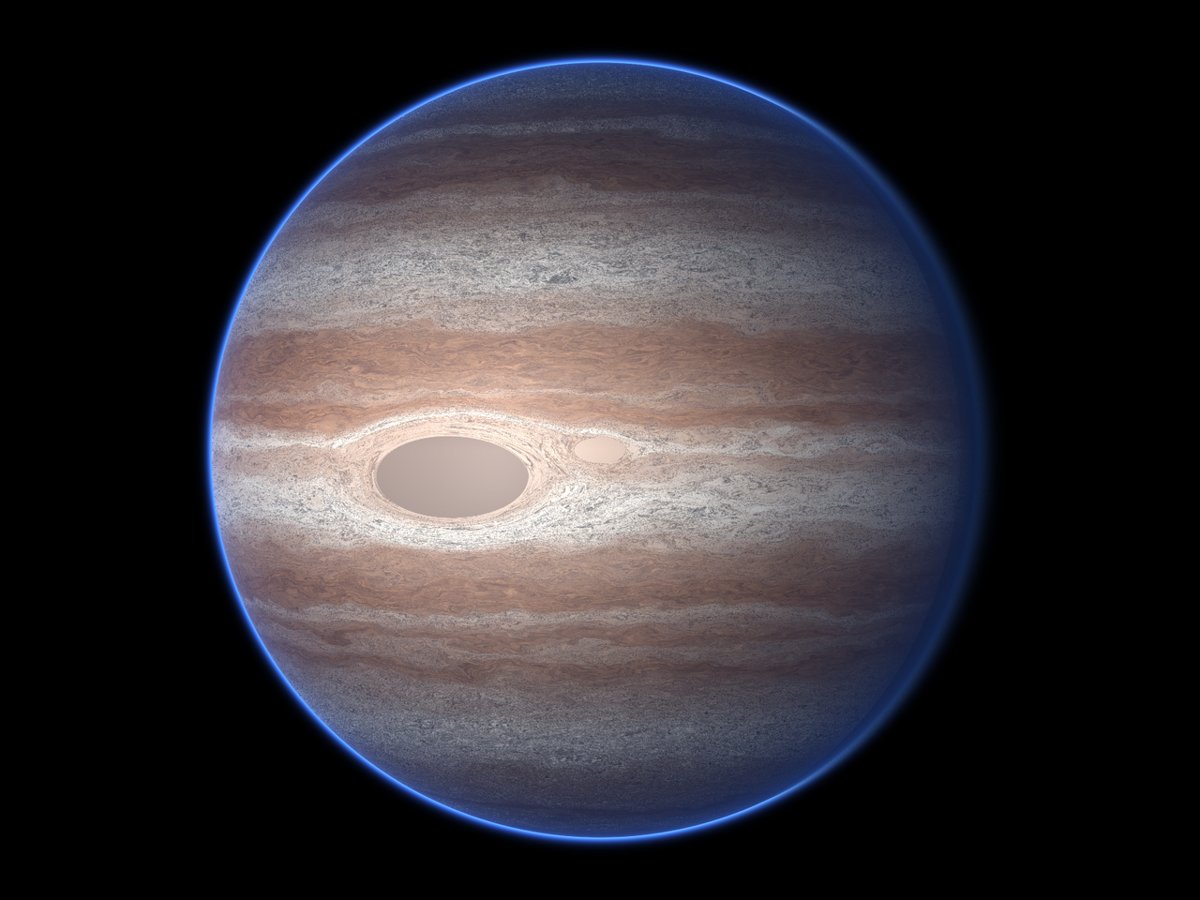
There is no shortage of strange worlds in the exoplanet catalog. Astronomers have documented gas giants completing an orbit in less than a day, tidally locked planets with permanent hemispheres of permanent daylight, and super-dense rocky worlds composed largely of iron. But TOI-791 b and TOI-791 c, a newly confirmed planetary pair orbiting a Sun-like star 1,113 light-years from Earth, occupy a category all their own: the least-dense planets ever placed in the astronomical record.
The discovery, led by George Dansfield of Oxford University's Department of Physics and published in the Monthly Notices of the Royal Astronomical Society in June 2026, draws on 1,122 days of photometric data accumulated across seven years of NASA's Transiting Exoplanet Survey Satellite mission. What that data reveals is a planetary system sitting at—and possibly beyond—the theoretical boundaries of how planets can form and hold themselves together.
The Numbers Behind the Record
TOI-791 b is nearly Jupiter in diameter. It contains just 3.0% of Jupiter's mass. Researchers describe its density as comparable to cotton candy—a comparison that sounds whimsical but captures something precise: this planet, despite being nearly as wide as the largest world in our solar system, has almost no substance to speak of. Its gaseous envelope is extended so far from the planet's gravitational center that the bulk density approaches the lowest values physically plausible for a stable planetary body.
TOI-791 c is, improbably, even larger—exceeding Jupiter in diameter—while containing just 5.9% of Jupiter's mass. Despite holding roughly double the mass fraction of its inner companion, TOI-791 c is geometrically bigger, which means its average density is similarly extreme. Together, the two planets push the known parameter space for planetary inflation into new territory.
Both orbit within a moderately close range of their host star. TOI-791 b completes a full circuit every 139 days; TOI-791 c follows a 232-day orbit. These are not the short-period orbits typical of the hot Jupiter population, where intense stellar irradiation is most often invoked as a driver of atmospheric inflation. The TOI-791 planets receive considerably less energy from their star than a classic hot Jupiter would—which makes their degree of inflation harder to explain through the standard irradiation-driven models the field has relied on.
Seven Years of Photons
TESS detects planets by monitoring stellar brightness for the repeating dips that occur when a planet transits—crosses in front of—its host star. The technique's power depends on accumulating enough transits to rule out false positives and constrain the planet's physical properties with confidence. For TOI-791's slowly orbiting companions, that demanded patience: the team drew on 1,122 days of TESS photometry spanning seven years of mission operations.
That baseline is not incidental to the outcome. Planets with orbital periods measured in months produce only a handful of transit events per observing season. Each individual crossing carries disproportionate statistical weight, and a seven-year accumulation is what transforms a tentative photometric signal into a defensible detection. Without that duration, these planets likely would have remained unconfirmed candidates.
The dataset delivered an additional dividend. Because TOI-791 b and c orbit close enough to interact gravitationally, each planet perturbs the other's orbital timing in a measurable way. These transit timing variations—small but systematic shifts in when each planet crosses the stellar disk relative to a perfectly regular clock—encode information about the perturbing body's mass. Extracting that signal across 1,122 days of data allowed Dansfield's team to constrain the planets' masses with a precision that a shorter observing campaign could not have provided, without needing to rely entirely on time-intensive radial velocity follow-up.
Jon Jenkins, Science Lead at NASA's Science Processing Operations Center at Ames Research Center, and Steve Howell, a research scientist also at Ames, contributed to the analysis. The study's institutional collaboration extended to Université Côte d'Azur, Observatoire de la Côte d'Azur, and the University of Birmingham.
Why It Matters
Planet-formation theory has a working model for how gas giants come to exist: a solid core accumulates from dust and ice in a protoplanetary disk, reaches a critical mass threshold, and triggers runaway accretion of surrounding gas. What that model does not cleanly explain is how a planet can end up with a near-Jupiter diameter while retaining less than 6% of Jupiter's mass—not as a transient post-formation phase, but as an apparently stable configuration persisting for what may be billions of years.
For the hot Jupiter population—planets orbiting their stars in just days—researchers have developed several candidate mechanisms to explain why some gas giants are more inflated than baseline models predict. Stellar irradiation deposits energy into a planet's upper atmosphere, opposing the gravitational contraction that should compress it over time. Tidal dissipation between a planet and its star can generate internal heat. Magnetic coupling between the stellar wind and the planetary atmosphere has been proposed as an additional energy source. These mechanisms are generally strongest at short orbital distances, where stellar flux is highest.
TOI-791 b and c receive substantially less irradiation than hot Jupiters. If the same inflation processes are at work here, they must operate with an efficiency that current models do not account for. Alternatively, the TOI-791 system may require a different mechanism entirely—one tied to the particular formation history of the disk, the mutual gravitational history between the two planets, or some combination of processes that has not yet been satisfactorily formalized.
There is also the question of atmospheric survival. Low-density planets have weak surface gravity, which in principle makes them more susceptible to atmospheric escape: the process by which energetic photons and stellar winds gradually strip gas from the upper atmosphere over geological timescales. Yet TOI-791 b and c have clearly retained enormous gaseous envelopes. Understanding how they maintain that equilibrium has implications beyond this single system. Any model that explains how planets hold diffuse atmospheres under moderate irradiation also informs the broader study of sub-Neptune and super-Earth atmospheres—arguably the most actively contested territory in exoplanet science right now.
For TESS itself, the TOI-791 discovery is an argument for mission longevity. Planets with orbital periods of months are poorly suited to short observing campaigns optimized for detecting tighter-orbiting worlds. The seven-year photometric baseline that made this detection possible required operations well beyond the mission's initial scope—and in doing so, opened access to a population of planets that a truncated mission would have missed entirely. As TESS continues to accumulate data, the accessible parameter space for long-period, low-density planets grows. TOI-791 b and c hold the record for the least-dense planets ever catalogued. Whether that record stands may depend, in no small part, on how much longer the satellite keeps watching the sky.
