
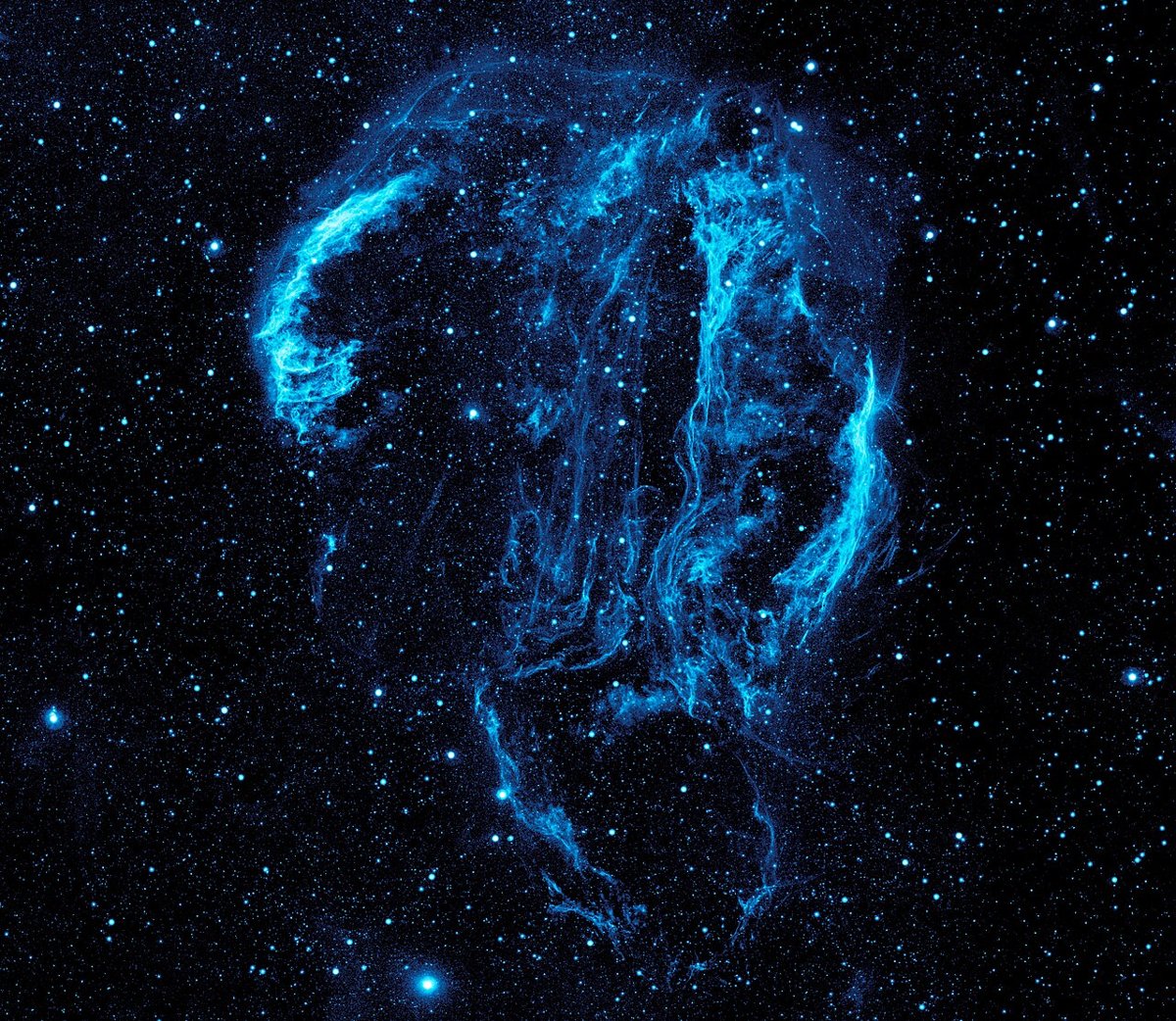
Somewhere around 6,000 light-years away in the constellation Gemini, two ancient explosions left their marks on the interstellar medium. One of them — the Jellyfish Nebula, formally cataloged as IC 443 — has been a favorite target of astronomers for decades, its bright tendrils of shocked gas making it one of the most luminous gamma-ray supernova remnants in the sky. The other, a faint wisp of X-ray emission known only by its catalog entry G189.6+3.3, has languished in relative obscurity since its discovery by the German-led ROSAT mission in 1994.
Now, a team led by Stanford postdoctoral fellow Miltiadis Michailidis has established that these two remnants are almost certainly not just neighbors by coincidence. Using 16 years of accumulated data from NASA's Fermi Gamma-ray Space Telescope, the researchers uncovered a hidden gamma-ray signature from G189.6+3.3 that had been buried beneath the Jellyfish's overwhelming glare — and built a case that both remnants are the aftermath of a single binary star system where both partners met violent ends.
The findings, presented on June 18, 2026, at the 248th meeting of the American Astronomical Society in Pasadena, California, with a paper forthcoming in Nature Communications, represent what may be the first confirmed example of sibling supernova remnants: two shells of debris from two massive stars that once orbited each other, detonated thousands of years apart, and left overlapping scars in the same patch of sky.
Digging a Signal Out of the Glare
The Jellyfish Nebula is not a subtle object. It is among the brightest gamma-ray-emitting supernova remnants known, a status cemented in 2013 when Fermi observations confirmed that the remnant accelerates protons to extreme energies. Those protons slam into surrounding interstellar gas, producing short-lived particles called neutral pions, which immediately decay into pairs of gamma-ray photons — a distinctive spectral fingerprint that Fermi's Large Area Telescope (LAT) is purpose-built to detect.
G189.6+3.3, by contrast, is a ghost. Discovered in an X-ray survey more than three decades ago, it has remained stubbornly faint at most wavelengths. Its proximity to the Jellyfish — the two remnants' explosion centers are separated by roughly 40 light-years as projected onto the plane of the sky — meant that any gamma-ray emission it produced was effectively drowned out.
Michailidis and co-author Marianne Lemoine-Goumard, an astrophysicist at France's National Centre for Scientific Research (CNRS) and the University of Bordeaux, attacked the problem with brute-force statistics. Sixteen years of continuous LAT observations provided enough photon counts to model the Jellyfish's contribution precisely, subtract it, and tease out a residual gamma-ray signal attributable to G189.6+3.3. The detection confirmed that the fainter remnant, too, accelerates cosmic-ray protons into surrounding gas — the same pion-decay mechanism at work in its brighter neighbor.
Two Explosions, One System
Finding gamma rays from both remnants was the necessary first step. The more provocative conclusion required assembling evidence from across the electromagnetic spectrum. In addition to Fermi, the team drew on ultraviolet observations from NASA's Neil Gehrels Swift Observatory and archival infrared data from the now-retired Wide-field Infrared Survey Explorer (WISE).
The combined picture revealed several telling details. Both remnants interact with the same molecular cloud system, cataloged as Sharpless 249 — a sprawling complex of hydrogen gas that lies at approximately the same distance. A bright filament of gas connects the two, marking a region where the shock wave from G189.6+3.3 has plowed into particularly dense material and decelerated sharply. The chemical and physical properties of the two remnants are consistent with a shared environment and, critically, a shared distance from Earth.
But the ages are dramatically different. The Jellyfish Nebula is estimated to be 8,000 to 9,000 years old. G189.6+3.3 is far older — somewhere between 20,000 and 110,000 years, a wide bracket that reflects the difficulty of dating faint, highly evolved remnants. That age gap is the key to the binary hypothesis: the older remnant came first, produced by the more massive star in the pair, and the Jellyfish followed tens of thousands of years later when the surviving companion finally reached the end of its own life.
A Million Simulated Binaries
To test whether this scenario holds up quantitatively, the team ran computer simulations tracking the evolution of one million massive binary star systems. The original stars would each have been at least 20 times the mass of the Sun — with estimates placing the primary at roughly 30 to 40 solar masses and the secondary at 25 to 35. In systems where the stars orbited closely enough to exchange matter, the simulations readily produced dual supernova events with separations and time delays matching the observed properties of IC 443 and G189.6+3.3.
The scenario plays out like this: the more massive star exhausts its fuel first and detonates. The explosion — asymmetric, as supernovae tend to be — unbinds the system and sends the surviving companion hurtling through space at high velocity. That runaway star drifts for anywhere from 20,000 to 100,000 years, covering the roughly 40 light-years of separation, before it too runs out of fuel and explodes. The result is two supernova remnants, slightly offset from each other, expanding into the same interstellar neighborhood.
The team also calculated the probability of a chance alignment — two unrelated remnants happening to sit at the same distance, at the same position on the sky, interacting with the same gas cloud. The answer: less than one percent. With around 300 supernova remnants cataloged across the entire Milky Way, the odds of a coincidental overlap this clean are slim.
Why It Matters
The implications extend well beyond a satisfying cosmic detective story. Astronomers have long understood that most massive stars — the kind that end as supernovae — form in binary or higher-order multiple-star systems. That means dual supernovae should, in principle, be a routine outcome of stellar evolution. Yet no clear-cut example had been identified before now. IC 443 and G189.6+3.3 provide the first observational anchor for a prediction that has floated in theory for decades.
The discovery also has consequences for understanding cosmic-ray acceleration. Both remnants are candidates for classification as PeVatrons — objects capable of accelerating particles to peta-electronvolt energies, roughly a thousand trillion electron volts. It is a fitting connection given the telescope's namesake: physicist Enrico Fermi first proposed the mechanism by which shock waves accelerate charged particles back in 1949. If sibling remnants are more common than currently recognized, their overlapping shock structures could create unusually efficient particle accelerators, compounding the energy available for cosmic-ray production in ways that single-remnant models do not capture.
There is a broader methodological lesson, too. G189.6+3.3 spent three decades hiding in plain sight, its faint signal swamped by a famous neighbor. It took the slow accumulation of 16 years of gamma-ray data — Fermi launched in 2008 and continues to operate — to pry the signal loose. The discovery is a reminder that long-baseline missions produce science that cannot be rushed, and that the sky still harbors structures that only patience and statistics can reveal.
"Fermi's gamma-ray observations of supernova remnants continue to reveal the dynamic lives of stars," said Elizabeth Hays, Fermi project scientist at NASA's Goddard Space Flight Center in Greenbelt, Maryland.
As Michailidis put it: "The evidence we've compiled — including observations across the spectrum, the chemical and physical properties of the remnants, simulations, and more — paints a compelling picture of a dual supernova event."
The Jellyfish, it turns out, was never alone. Its sibling was there all along, waiting for the right instrument and enough time to be seen.
