
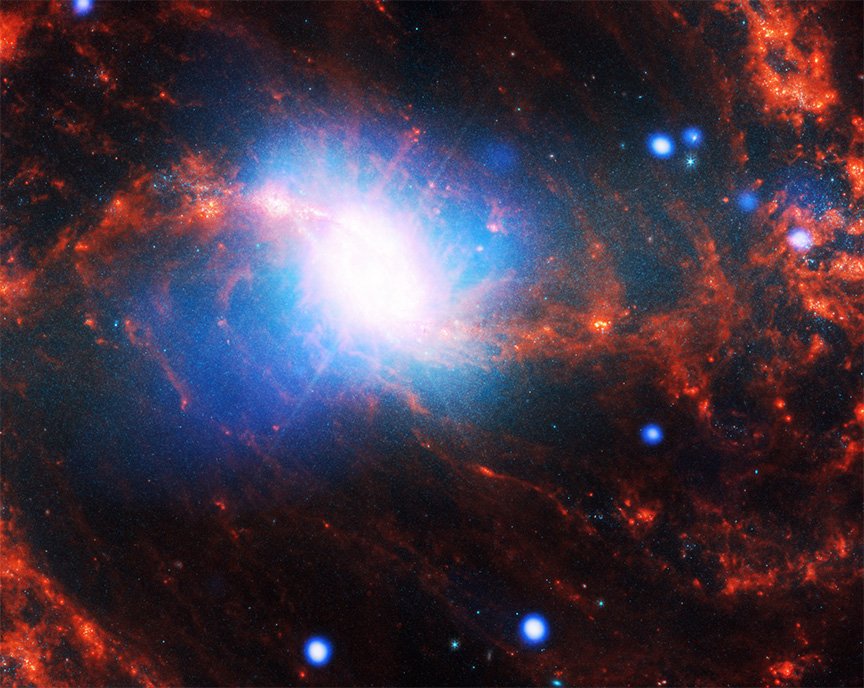
Somewhere in the crowded, chaotic neighborhood surrounding the Milky Way's supermassive black hole, something exploded — and the evidence has been hiding in plain sight across the electromagnetic spectrum. A team led by astronomers at UCLA has used NASA's Chandra X-ray Observatory, along with a suite of other space- and ground-based instruments, to identify what appears to be a previously unrecognized supernova remnant in the Galactic Center region. If confirmed, it would be one of the closest such remnants ever discovered to Sagittarius A*, the four-million-solar-mass black hole anchoring our galaxy.
The finding, published on June 22, 2026, draws on data from five separate observatories spanning radio, optical, infrared, and X-ray wavelengths — a methodical, multi-band approach that underscores just how difficult it is to disentangle genuine stellar debris from the background noise of the galaxy's most extreme real estate.
A Ghost in Five Wavelengths
The candidate remnant emerged from a careful analysis led by Z. Zhu and colleagues at UCLA, who combined observations from Chandra and the European Space Agency's XMM-Newton in the X-ray band, South Africa's MeerKAT radio telescope array, the Panoramic Survey Telescope and Rapid Response System (PanSTARRS) in optical light, and NASA's James Webb Space Telescope in the infrared. Each instrument contributed a different piece of the puzzle.
In the X-ray data from Chandra and XMM-Newton, the object presents as a diffuse, cloudy blue structure — the kind of soft, extended emission that X-ray astronomers associate with hot gas heated by the blast wave of a stellar explosion. That alone would be suggestive but not conclusive; the Galactic Center is full of hot gas for a variety of reasons, from stellar winds to the activity of Sgr A* itself.
The radio view from MeerKAT, however, adds a compelling layer. At radio wavelengths the structure appears as an irregularly shaped red cloud shot through with complex textures — wispy, smoke-like tendrils, tangled networks of faint filamentary veins, and clear streaking lines that hint at organized magnetic-field structures being swept up by an expanding shock front. When the radio and X-ray data are overlaid, the spatial coincidence between the blue and red emission strengthens the case that both are tracing the same physical object: the expanding shell of debris and superheated gas left behind when a massive star reached the end of its fuel supply and detonated.
Optical data from PanSTARRS and infrared observations from JWST round out the portrait. The Galactic Center is notoriously opaque at visible wavelengths — dense curtains of interstellar dust absorb and scatter optical photons, which is precisely why X-ray and radio telescopes are so valuable in this part of the sky. JWST's infrared sensitivity can peer through some of that dust, while PanSTARRS provides a baseline view of the stellar field in which the remnant sits. Together, the five datasets let Zhu's team build a composite picture that no single observatory could deliver on its own.
Why the Galactic Center Makes Everything Harder
Identifying supernova remnants anywhere in the galaxy is a painstaking business. The expanded shells of gas are faint, diffuse, and easily confused with other structures — HII regions ionized by hot young stars, planetary nebulae shed by aging low-mass stars, or simply random density enhancements in the interstellar medium. Astronomers typically look for a combination of signatures: a shell-like morphology, non-thermal radio emission from electrons accelerated in the shock, and elevated X-ray emission from gas heated to millions of degrees.
Near the Galactic Center, all of these diagnostics get muddied. The region is dense with stars, threaded by powerful magnetic fields, bathed in high-energy radiation from Sgr A* and the surrounding cluster of massive stars, and overlaid with complex filamentary radio structures that have no analog elsewhere in the galaxy. Pulling a genuine supernova remnant out of that environment requires exactly the kind of multi-wavelength cross-referencing that Zhu's team performed — and even then, the result is described as a candidate rather than a confirmed detection, reflecting the inherent difficulty of the measurement.
That the candidate remnant sits so close to the central supermassive black hole makes it scientifically notable beyond the mere addition of one more entry to the galactic catalog. The immediate environment of Sgr A* is one of the most intensively studied patches of sky in all of astronomy, yet clearly still has secrets to give up. The region's extreme conditions — high stellar densities, strong tidal fields, intense radiation backgrounds — may also influence how supernova remnants evolve after the initial explosion, potentially altering their morphology and lifetime in ways that differ from remnants in quieter parts of the galaxy.
How Many Remnants Are We Missing?
The discovery also highlights a broader question that has nagged X-ray astronomers for decades: the so-called "missing remnants" problem. Theoretical models of the Milky Way's star-formation rate and the fraction of stars massive enough to explode as supernovae predict that the galaxy should host far more observable remnants than have actually been cataloged. Some of that discrepancy is explained by remnants that have faded below detectability, having expanded and cooled over hundreds of thousands of years until they merge indistinguishably into the general interstellar medium. But some of the gap may simply reflect the difficulty of finding these objects, especially in confused, crowded fields like the Galactic Center.
Every new candidate remnant found in a region where detection is hard serves as a reminder that the current census is incomplete — and that the true rate of stellar death and chemical enrichment in the galaxy may be higher than the observed population suggests.
Why It Matters
Supernova remnants are far more than astronomical curiosities or picturesque nebulae. They are the principal mechanism by which heavy elements forged in the cores and explosions of massive stars are distributed into the interstellar medium. Elements like iron, oxygen, and silicon — critical for the formation of rocky planets and, ultimately, for the chemistry that underpins life — are manufactured inside stars but locked away until a supernova blast wave ejects them into surrounding space. Without that dispersal, the raw materials for Earth-like worlds would remain trapped in stellar corpses.
The expanding shock waves of supernova remnants also compress nearby gas clouds, sometimes triggering new rounds of star formation. In this way, stellar death feeds directly into stellar birth, creating a galactic-scale recycling loop that has been operating for billions of years. Understanding where and how often supernovae occur — and how their remnants interact with the local environment — is fundamental to modeling the chemical and dynamical evolution of the Milky Way.
Finding a candidate remnant this close to Sgr A* adds a data point in one of the galaxy's most extreme and least understood environments. If the object is confirmed through follow-up observations, it will offer a rare laboratory for studying how supernova blast waves behave in the vicinity of a supermassive black hole — a regime where the ambient density, radiation field, and gravitational tides are all dramatically different from the galactic suburbs where most known remnants reside.
The Road to Confirmation
For now, the object retains its "candidate" status. Confirmation will likely require deeper X-ray observations to characterize the spectral properties of the emission — specifically, to determine whether the gas temperatures and elemental abundances are consistent with supernova-heated material rather than some other source of X-ray emission. Radio polarization measurements could also help, since supernova remnants typically produce polarized synchrotron emission as electrons spiral along magnetic-field lines compressed by the shock.
The multi-observatory approach that produced the initial detection — Chandra, XMM-Newton, MeerKAT, PanSTARRS, and JWST — represents the state of the art in modern observational astrophysics, where no single telescope can tell the whole story. Image processing for the composite view was handled by L. Frattare and P. Edmonds, translating raw data from across the spectrum into the layered portrait that made the candidate remnant visible as a coherent structure rather than a collection of unrelated blobs.
If the Galactic Center is hiding one supernova remnant in plain sight, the natural question is how many more are out there, waiting for the right combination of instruments and analysis techniques to pull them out of the noise. For a region of the sky that astronomers have been staring at for decades, that question is both humbling and motivating.
