
NASA's Transiting Exoplanet Survey Satellite has a name that tells you exactly what it was built to do. TESS hunts transits — the faint, periodic dimming that happens when a planet crosses in front of its star from our line of sight. That method works best on worlds packed tightly against their suns, where transits are frequent and geometry cooperates. It is emphatically not the tool you reach for when you want to find a giant planet parked far out on a wide orbit, tens of thousands of light-years away.
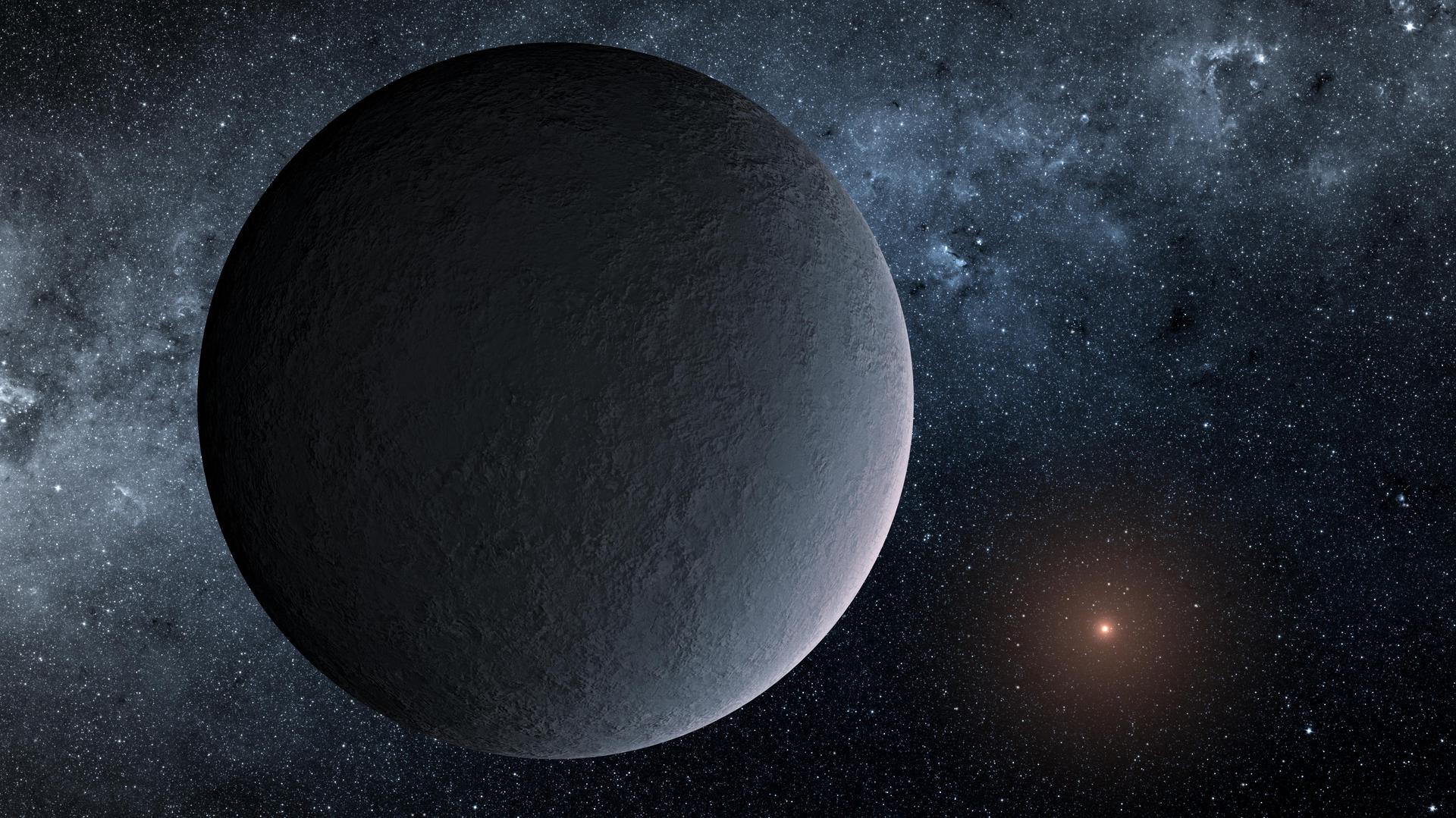
And yet that is precisely the planet TESS has now delivered. In a paper published July 1, 2026 in The Astrophysical Journal Letters, a team led by University of New Mexico PhD candidate Mallory Harris reports the first planet ever detected by TESS through gravitational microlensing rather than a transit. The world, Gaia23bra b, is a super-Jupiter of roughly 1.6 Jupiter masses circling an orange dwarf star at a Jupiter-like distance — and it sits nearly 40,000 light-years from Earth.
A different way to catch a planet
Microlensing has nothing to do with a planet blocking starlight. It exploits the fact that mass bends spacetime. When one star passes almost exactly in front of a more distant background star, the foreground star's gravity acts as a lens, briefly magnifying and brightening the light of the star behind it. If the foreground star hosts a planet, that companion adds its own small gravitational kick, stamping extra wrinkles onto the brightening curve. Read those wrinkles carefully and you can infer the planet's mass and orbital separation.
The technique is powerful in exactly the regime where transits are weakest. It doesn't care whether a planet ever crosses in front of its star, and it is sensitive to wide-orbit giants at enormous distances — the kind of cold, far-flung worlds transit surveys almost never see. The catch is that a microlensing event is a one-time alignment. You don't get a second look, so you need to be watching at the right moment, with good time coverage.
Gaia flagged it; TESS had quietly recorded it
The alignment that produced Gaia23bra b was first spotted not by TESS but by ESA's Gaia telescope, which flagged the microlensing brightening in 2023. Gaia — now retired — was an all-sky survey mission, and its alert system caught the event as the background star flared up.
What the Harris team did next is where the story turns. They went back into TESS's archive to see whether the satellite happened to be staring at the same patch of sky while the event unfolded. It was. TESS's dense, near-continuous time sampling had captured the same brightening — and because its cadence was tighter than Gaia's, the TESS light curve carried additional detail. Those extra features, buried in already-collected photometry, were the fingerprints of the planet. The detection came not from new observations but from cross-checking Gaia's 2023 event against archived TESS data and recognizing what had been sitting there all along.
Why the surprise is warranted
It would be easy to file this under routine archival science. It isn't. TESS's transit-hunting design biases it hard toward close-in planets, and finding a distant, wide-orbit giant through an entirely different physical mechanism was not on anyone's original mission bingo card.
"When TESS launched, no one expected it to ever be capable of finding this kind of planet," said co-author Diana Dragomir of the University of New Mexico. That is not press-release gloss. A transit survey pulling a super-Jupiter out of a microlensing event 40,000 light-years away is a genuine repurposing of the instrument — using its greatest asset, relentless time coverage, for a job it was never specified to do.
The work was a multi-institution effort. Alongside Harris and Dragomir at UNM, the team included co-author Michael Fausnaugh of Texas Tech University. The detection hinged on combining two data streams: Gaia's alert that something was happening, and TESS's high-cadence record of how it happened.
Why It Matters
Every exoplanet survey has blind spots baked into its method. Transit surveys like TESS see close-in worlds well and cold, wide-orbit giants poorly. Demonstrating that the same spacecraft can also register microlensing events — and that its dense sampling can resolve planetary features other telescopes miss — effectively hands astronomers a second detection channel from hardware already in orbit and, in this case, from data already on disk.
That has practical consequences. It means the TESS archive may hold other microlensing planets waiting to be recognized, no new observing time required. It shows the value of pairing missions with complementary strengths: Gaia's all-sky alerting flagged the event, TESS's cadence characterized it, and neither alone would have delivered the planet. And it stretches the population of worlds TESS can contribute to well beyond the hot, tightly bound planets it was built to census — toward the distant, Jupiter-like giants that microlensing is uniquely suited to reveal. For a mission designed around one trick, learning a second one is the kind of milestone that outlives the original spec sheet.
