
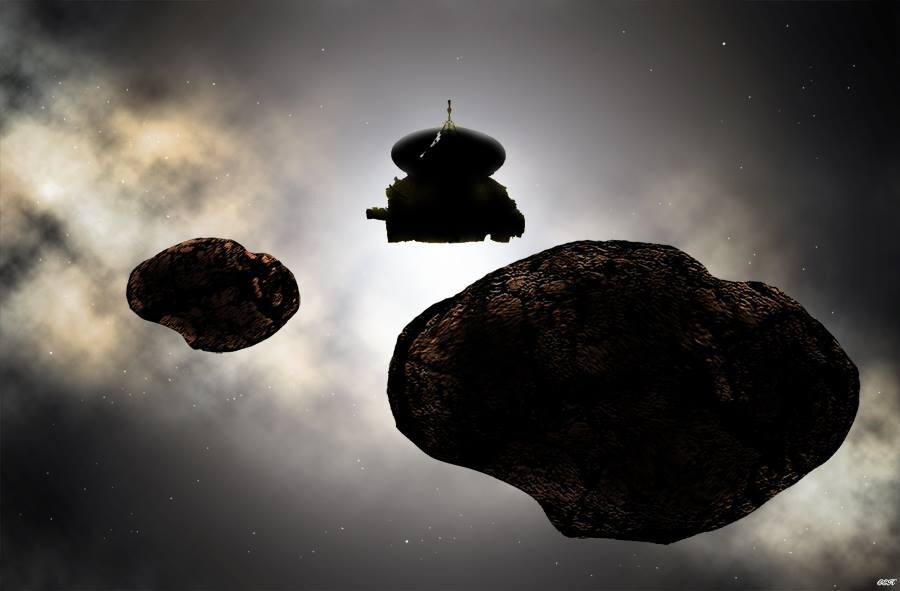
Twenty years and roughly 5.4 billion miles into its journey, NASA's New Horizons spacecraft is no longer chasing icy worlds. It is measuring how the Sun loses its grip on the space around it. On June 29, 2026, a research team led by Heather Elliott of the Southwest Research Institute reported that the solar wind streaming past the probe at 58 astronomical units is measurably slower than the wind near Earth — and that the culprit is a thin haze of atoms drifting in from interstellar space.
Using the Solar Wind Around Pluto (SWAP) instrument, the team clocked the wind's speed across a long stretch of the outer solar system, from 21 AU out to 58 AU. At the far end of that run, the wind is 13 to 15 percent slower than it is at 1 AU, the distance between the Sun and Earth. That is a notable step down from the 5 to 10 percent slowdown the same effect showed earlier, at 30 to 43 AU. The findings appear in a paper titled "The Gradual Slowing of the Solar Wind in the Outer Heliosphere," published in The Astrophysical Journal.
What is actually slowing the wind?
The solar wind is a supersonic outflow of charged particles — mostly protons and electrons — that the Sun blows off in every direction, inflating a vast bubble called the heliosphere. Inside that bubble, the wind rules. But the bubble is not sealed. It sits inside a galaxy that has its own tenuous supply of gas, and neutral atoms from that interstellar medium drift right through the heliosphere's outer defenses because, being electrically neutral, they ignore the Sun's magnetic field.
Those neutral atoms do not stay neutral forever. Through a process called charge exchange, a fast solar-wind proton can steal an electron from a slow interstellar atom. The result is a freshly minted ion — a "pickup ion" — that gets swept up into the wind's flow. Crucially, that new ion adds mass to the wind without adding forward momentum. It is dead weight. As more and more of these atoms are ionized and loaded aboard, the wind has to share its momentum with a growing cargo of hitchhikers, and it slows down. The effect compounds with distance: the farther the wind travels toward the edge, the more interstellar material it has swept up, and the more it decelerates.
That is precisely the trend SWAP has now traced. The slowdown is not an abrupt wall but a gradual braking, and it deepens exactly where the model predicts — steeper at 58 AU than at 43 AU.
Why New Horizons is the right spacecraft for this
The Voyagers famously crossed into interstellar space, and their data remains foundational. But New Horizons brings something distinct to the outer heliosphere: a working solar-wind detector, actively measuring the plasma as the probe pushes outward. Launched in January 2006, the spacecraft flew past Pluto in July 2015 and the Kuiper Belt object Arrokoth on New Year's Day 2019. It is now roughly 66 AU from the Sun in an extended mission, and SWAP is one of the instruments still returning science from that frontier.
Because SWAP can sample the wind's speed continuously across a large range of distances, it fills in the gradient rather than offering snapshots. That continuity is what lets Elliott's team say not just that the wind is slowing, but how the slowdown scales with distance — turning a single-point curiosity into a mapped trend.
Reading the approach to the edge
The larger prize is the boundary itself. Somewhere ahead of New Horizons lies the termination shock, the point where the solar wind abruptly decelerates as it collides with the pressure of interstellar space, and beyond it the heliopause, the true edge of the Sun's bubble. The progressive braking that SWAP is measuring is, in effect, the wind announcing the boundary's approach. Pickup ions load the wind more and more heavily as it nears the shock, so tracking their drag helps scientists chart where and how the transition to interstellar space is unfolding.
It is worth being clear about what the measurement is and is not. This is not New Horizons crossing into interstellar space — it remains well inside the heliosphere. What the team has captured is the slow, cumulative influence of interstellar material reaching in and gradually reshaping the wind long before any boundary is crossed.
Why It Matters
The heliosphere is the Sun's shield — the bubble that deflects a large fraction of the galactic cosmic rays that would otherwise bathe the planets, including Earth. Understanding how the solar wind behaves near the bubble's edge, and how much interstellar matter is bleeding in to slow it, sharpens our picture of how that shield is built and maintained. It also gives modelers a real, measured gradient to test their simulations against, rather than an interpolation between distant data points. And because pickup ions are a direct fingerprint of the interstellar medium leaking inward, tracking them turns New Horizons into a slow-motion probe of the galactic environment the entire solar system is plowing through. With few spacecraft ever built able to make these measurements — and fewer still able to make them this far out — every additional AU of SWAP data is effectively irreplaceable.
