
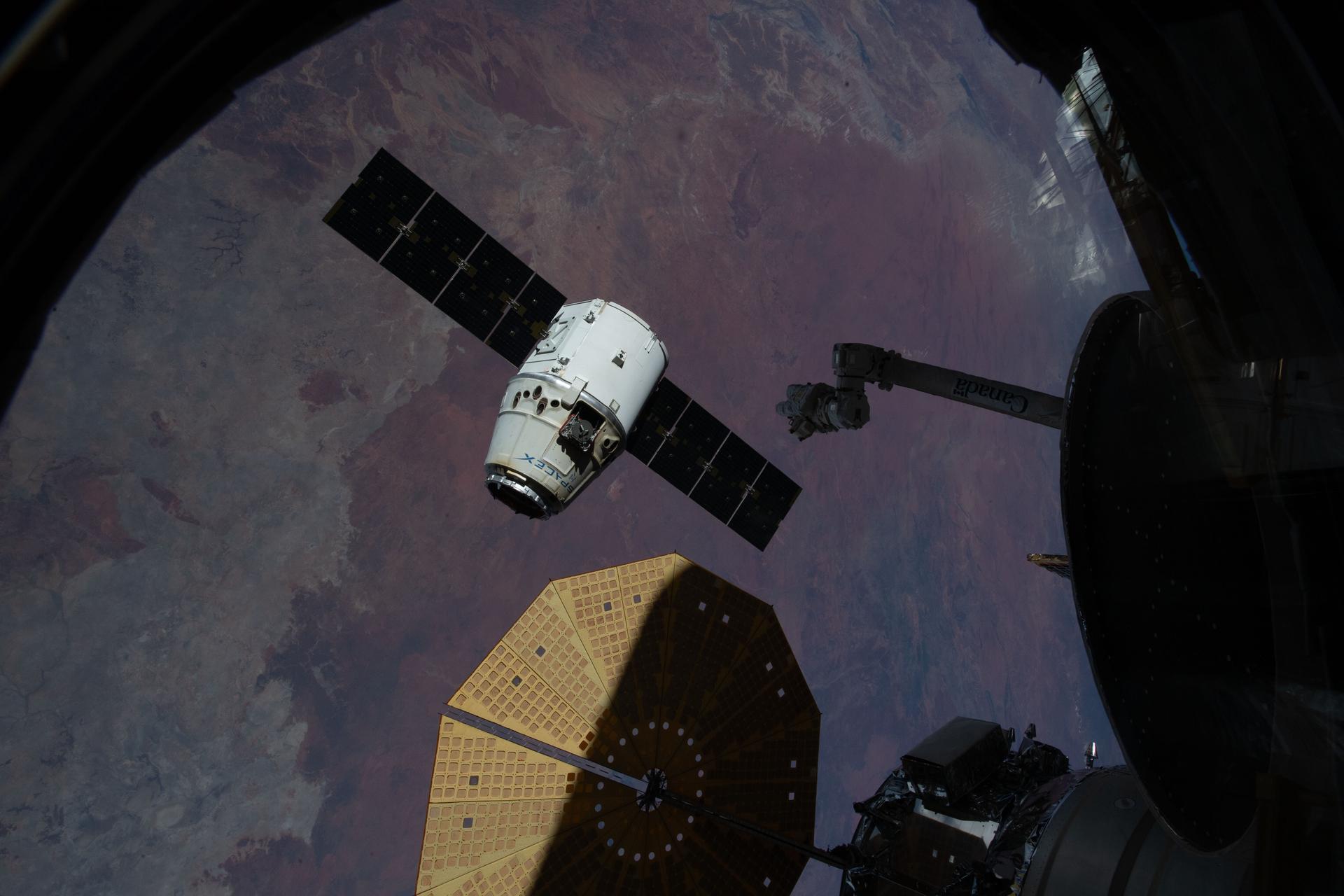
On the morning of June 16, a SpaceX Dragon loaded with the results of months of orbital science backed away from the International Space Station and pointed itself toward home. The CRS-34 cargo capsule undocked at roughly 12:05 p.m. EDT and, after a routine deorbit burn, splashed down off the coast of California at about 5:08 a.m. PDT the next morning. NASA had announced the departure coverage on June 12, but the more interesting story isn't the choreography of the return — it's the manifest.
This Dragon came back heavy. NASA says it returned thousands of pounds of cargo, and the list reads less like a supply run and more like the output log of a working laboratory: bioprinted organ and cartilage tissue, data from a cryogenic fuel-storage experiment, DNA-inspired materials being developed for cancer treatment, an ocular imaging device, an absorbent air-filtration bed, and a waste compartment separator pump. Some of those are hardware coming home for inspection. Others are the actual experimental products — the things the station exists to make.
Why a capsule, and why the ocean?
It's worth pausing on a detail that's easy to take for granted. Of the vehicles that visit the ISS, Dragon is currently the workhorse that can bring a substantial downmass back to Earth intact. Most cargo vehicles are one-way: they're filled with trash and burned up on reentry. Dragon survives reentry, parachutes into the water, and is recovered with its payloads still cold, still pressurized, still viable.
That capability is the whole reason several of these experiments make sense. A bioprinted slice of cartilage or a sample of DNA-inspired cancer material is only useful to researchers if they can get it into a lab freezer and onto a microscope quickly after splashdown. A west-coast splashdown puts the capsule within reach of recovery teams who can hand the time-sensitive samples back to investigators on a tight clock. The "boring" logistics of where and when a capsule lands are, in practice, a hard constraint on what kind of science the station can return.
What's actually in the boxes
Take the items one at a time, because each points at a different reason the orbiting lab is valuable.
Bioprinted organ and cartilage tissue. On Earth, printing soft biological structures runs into a stubborn problem: gravity. Delicate, fluid-like tissue tends to slump or collapse before it can set. In microgravity, structures that would deform under their own weight can hold their shape long enough to mature. Tissue printed and cultured in orbit and then returned for analysis is a way to test whether that theoretical advantage produces a real, measurable difference.
DNA-inspired materials for cancer treatment. NASA describes the returned cargo as including DNA-inspired materials being developed for cancer therapy. Materials that self-assemble — guided by the same base-pairing logic that organizes DNA — can form differently when the convection and sedimentation of normal gravity are removed. Bringing the finished material home lets chemists see what the microgravity environment built.
Cryogenic fuel-storage data. This one isn't biology at all, and it's arguably the most directly consequential for spaceflight itself. Storing super-cold propellants like liquid hydrogen and oxygen for long periods is a major unsolved headache for missions beyond low Earth orbit; the fuels boil off and vent away. Data from a cryogenic storage experiment feeds directly into the architectures that would make long-duration and deep-space missions practical.
The unglamorous hardware. An ocular imaging device, an absorbent air-filtration bed, and a waste compartment separator pump round out the list. None of these will make a headline, but they're the kind of returned hardware that keeps a crewed station survivable — eye health monitoring, air scrubbing, and waste handling are all chronic engineering problems on a vehicle where humans live continuously.
A station running as a factory
String the manifest together and a pattern emerges. The ISS is increasingly being used less as a destination and more as a production facility — a place that takes up raw materials and crew time and returns finished experimental goods. That's the right framing: resupply-and-return is now a steady cadence, not a milestone.
The cadence matters because the science depends on it. A research factory only works if its output gets shipped out reliably. Each Dragon that comes home with a freezer full of samples is the back half of a loop that started weeks or months earlier when those experiments went up.
Why It Matters
The temptation with a story like this is to read it as a press release — another successful resupply, another clean splashdown. The more honest reading is that the value of the International Space Station is concentrated in exactly the part that's easiest to overlook: the return trip. Microgravity research is only as good as a lab's ability to get the results back to Earth intact and on time, and CRS-34's manifest shows how much rides on that pipeline. Bioprinted tissue could inform how we eventually manufacture replacement biological structures. DNA-inspired cancer materials feed a long, uncertain pharmaceutical pathway. Cryogenic fuel data addresses one of the concrete obstacles standing between us and sustained deep-space missions. None of these are finished products, and it would be cheerleading to pretend otherwise. But each represents a measurement you genuinely cannot make on the ground — and every successful capsule recovery is what turns an experiment in orbit into data a researcher can actually use.
