
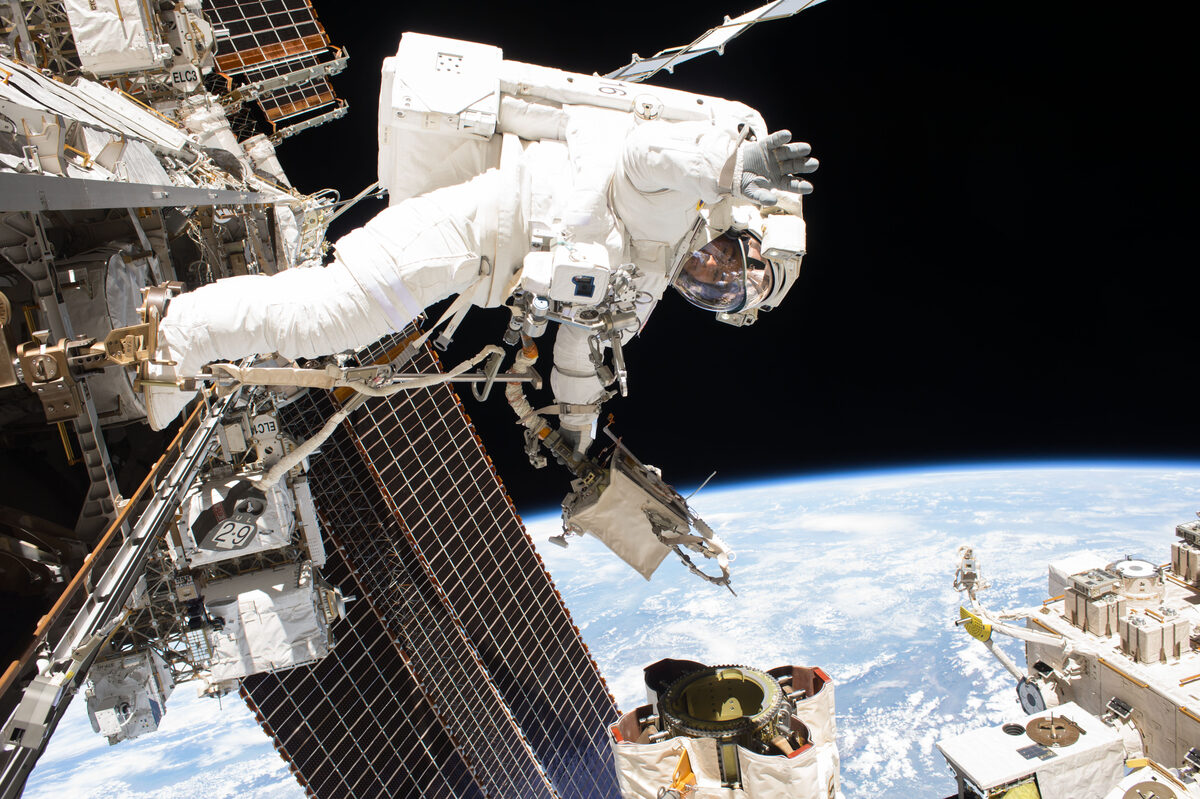
On the morning of Tuesday, June 30, 2026, two NASA astronauts will float out of the International Space Station's Quest airlock with a single, oddly specific mission: replace a wrist. Not a human one, but the robotic kind. The wrist in question belongs to Canadarm2, the station's marquee robotic arm, and it has been refusing to do its job since late May.
The excursion, designated U.S. Spacewalk 95, is scheduled to begin around 8:35 a.m. EDT and run roughly 6.5 hours. Chris Williams and Jessica Meir will handle the repair. For Williams it is only his second time outside the station; for Meir, it is her fifth. By NASA's count, this will be the 280th spacewalk conducted in support of station assembly, maintenance, and upgrades — a tally that underscores just how much hands-on work it takes to keep a two-decade-old orbital laboratory running.
What Actually Broke
The trouble started on May 27, during what NASA describes as normal operations. Canadarm2's wrist joint began drawing elevated motor current and then stopped moving as commanded. In plain terms: the joint was straining harder than it should have, and then it quit responding. That is the kind of behavior that gets a robotic arm benched in a hurry, because an arm that won't move predictably is worse than no arm at all when you're maneuvering hardware around a crewed spacecraft.
The fix is a straight swap. Williams and Meir will remove the failed joint and install a replacement. The component is not small or light by spacewalk standards — it weighs in at roughly 91 kilograms, or about 200 pounds. In microgravity that mass has no weight, but it still has inertia, which means moving it around carefully and getting it bolted into exactly the right place is a deliberate, methodical affair. This is the practical reality behind the 6.5-hour clock: precision work, in a pressurized suit, with a part the size and heft of a large kitchen appliance.
Why a Wrist Matters on a Robotic Arm
Canadarm2 is the station's primary heavy-lifting limb. It berths visiting vehicles — the cargo and crew spacecraft that arrive at the ISS — and it supports external station work, moving payloads and equipment around the outside of the complex. A wrist joint gives the arm's end the rotational freedom it needs to orient grapples and tools correctly. Lose that degree of motion and you lose a meaningful chunk of the arm's usefulness.
That is why this is being framed as a restoration of full arm functionality rather than a cosmetic touch-up. The replacement is meant to bring Canadarm2 back to its complete range of capability, so it can continue catching incoming spacecraft and assisting with the steady drumbeat of exterior maintenance the station depends on.
A Joint Effort, Literally
There's a fitting bit of symbolism in the cross-border nature of this repair. Canadarm2 is Canada's signature contribution to the International Space Station, and the Canadian Space Agency operates the arm. So while NASA astronauts will be the ones outside doing the wrenching, CSA experts have been working alongside NASA to plan the wrist-joint replacement. The two agencies previewed the operation together, with CSA specialists joining NASA at a news conference on June 25 from Johnson Space Center in Houston ahead of the spacewalk.
It is a reminder that the ISS is not a single nation's machine but a stitched-together international project — and that keeping it healthy sometimes means one partner's astronauts repairing another partner's hardware, with both sides at the table for the planning.
Why It Matters
Canadarm2 is not a redundant convenience; it is core infrastructure. The arm is how the station grabs and berths arriving vehicles and how crews handle equipment on the exterior of the complex. A wrist joint pulling abnormal current and locking up is exactly the sort of single-point problem that can quietly constrain station operations until it is fixed. The June 30 spacewalk is a concrete example of the unglamorous but essential maintenance that keeps continuous human presence in low Earth orbit possible — a 91-kilogram part, two astronauts, and a methodical 6.5 hours to make a stubborn joint work again. That it is the 280th such spacewalk says everything about how much sustained, hands-on labor an orbiting laboratory quietly demands.
