
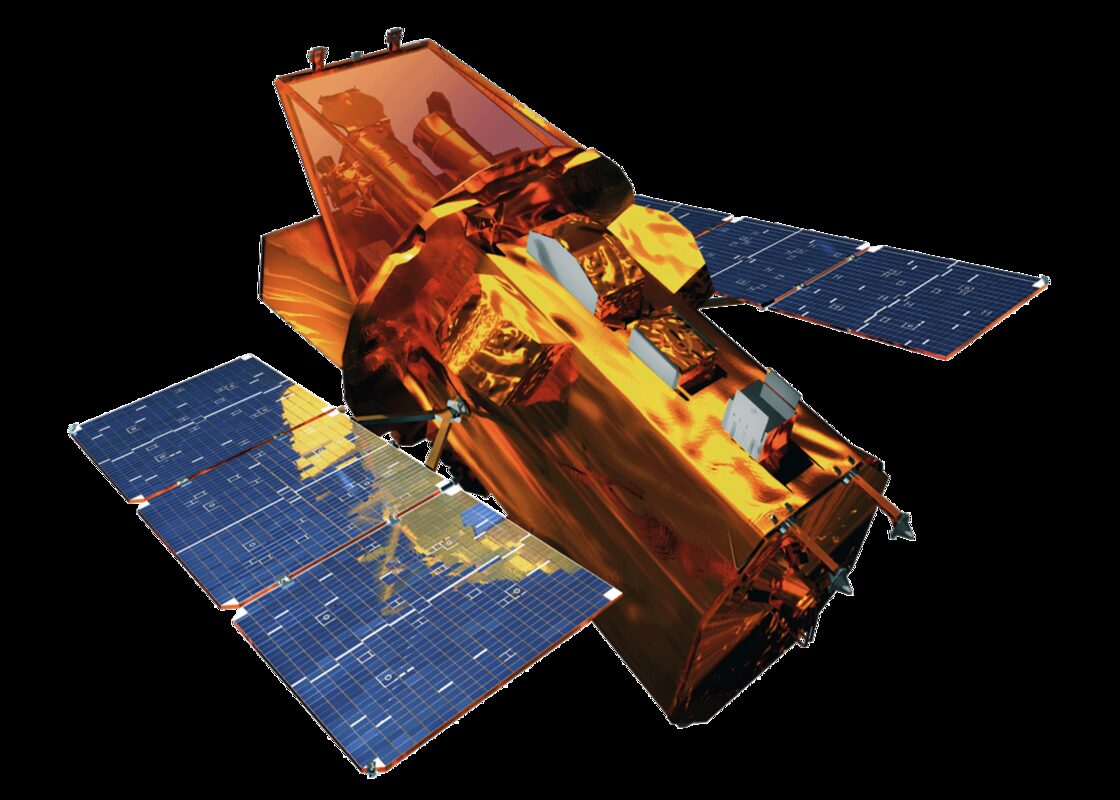
For more than twenty years the Neil Gehrels Swift Observatory has done one thing supremely well: when a gamma-ray burst flares somewhere in the universe, Swift swings to face it within a minute or two, catching the afterglow of a dying massive star or a neutron-star merger before it fades. But Swift has no propulsion of its own, and the thin upper atmosphere has been quietly dragging it down. The observatory has fallen from its original altitude near 600 kilometres to roughly 400, and on its current trajectory it would reenter and burn up in the autumn of 2026.
NASA's answer is unlike anything it has tried before. In September 2025 the agency awarded a contract to Katalyst Space Technologies, a young Arizona firm, to fly up, grab the telescope, and push it back to a safe altitude. Katalyst's servicing spacecraft — named LINK — arrived at NASA's Wallops Flight Facility in Virginia on 5 June for final processing, and NASA is showcasing the mission to media there on 17 June.
Why drop a rocket from a plane?
The most unusual part is how LINK gets to orbit. It will ride a Northrop Grumman Pegasus XL — a winged rocket carried aloft beneath a modified L-1011 jet called Stargazer, released at altitude over Kwajalein Atoll in the Marshall Islands, and ignited in mid-air. The choice looks eccentric until you look at Swift's orbit. The telescope flies at an inclination of only about 21 degrees, deliberately low to keep it out of the South Atlantic Anomaly, a region of trapped radiation that wreaks havoc on electronics. Reaching that shallow orbital plane from Cape Canaveral or Vandenberg would burn an enormous amount of propellant just to bend the trajectory into place. An air-launched rocket can be carried to a release point that does most of that work geographically — the airplane flies to the orbit, so the rocket doesn't have to.
There is a coda here that spaceflight historians will note: this is expected to be the final flight of Pegasus XL, and with it the end of operational air-launch to orbit anywhere in the world. A whole category of launch, pioneered in the 1990s, retires with this mission.
The harder problem is the grab
Swift was never designed to be serviced. It has no docking adapter, no grapple fixture, no cooperative markings — it is, in the language of the field, a non-cooperative target, tumbling slightly and indifferent to its rescuer. LINK has to approach, match its motion, and capture it without damaging the instruments or sending it spinning. Pulling that off would be a milestone for the entire in-orbit servicing industry, which has long promised to refuel, repair, and reposition satellites but has rarely been allowed near a valuable spacecraft that wasn't built for it.
What is being rescued is not a sentimental relic but a working instrument. Swift was built to catch gamma-ray bursts — the brief, blinding flashes that mark the collapse of a massive star into a black hole, or the merger of two neutron stars — and to do it fast, slewing onto a new burst within a minute or two so its X-ray and ultraviolet telescopes can study the afterglow before it fades. That speed made it a linchpin of multi-messenger astronomy, the practice of chasing the same cosmic event across light and gravitational waves at once. Two decades on, it is still among the most responsive eyes in orbit, and there is no like-for-like replacement queued to take its place. Losing it to atmospheric drag would mean losing a capability, not just a spacecraft.
The economics are the real story. Swift cost on the order of a few hundred million dollars and still produces front-line science; replacing it would cost far more and take years. If a comparatively cheap robotic boost can add a decade to its life, it rewrites the default assumption that an ageing satellite in a decaying orbit is simply lost. Multiply that across the thousands of expensive spacecraft now crowding low orbit and the case for a servicing economy stops being theoretical. NASA is, in effect, running a public test of whether the junkyard can become a repair shop. The first patient is a beloved old telescope that isn't ready to come down.
