
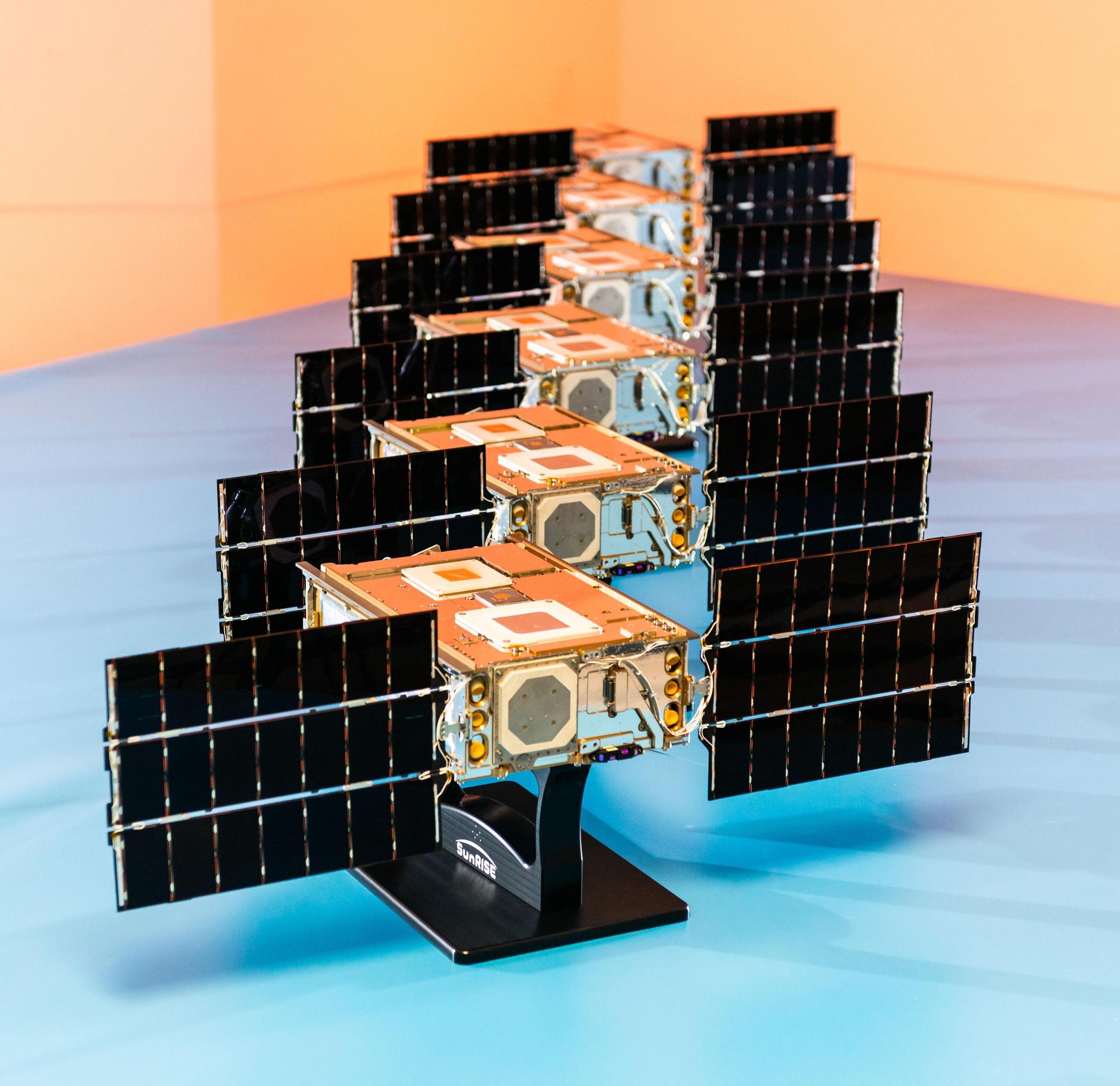
NASA announced on July 13, 2026, that it is switching launch vehicles for SunRISE, a six-satellite constellation designed to give forecasters an early warning system for the Sun's most dangerous outbursts. The mission, previously booked on a ULA Vulcan Centaur, will now fly aboard a SpaceX Falcon Heavy lifting off from Kennedy Space Center. The ride is a rideshare sponsored by the U.S. Space Force's Space Systems Command, and it will carry the spacecraft to an orbit just above geosynchronous altitude — roughly 22,000 miles (35,000 kilometers) up.
It's a logistics change rather than a science change. The mission's instruments, orbit, and goals remain the same; only the rocket underneath it is different. But the swap is a useful reminder of how much modern space science now depends on a healthy, competitive launch market — and how quickly agencies are willing to move between providers when schedules or costs shift.
Six Toasters, One Giant Radio Dish
SunRISE — short for Sun Radio Interferometer Space Experiment — is not a single spacecraft but a formation of six SmallSats, each described by NASA as roughly the size of a toaster oven. Individually, they're unremarkable. Flown together, they become something else: a synthetic-aperture radio telescope with a "dish" as wide as the gaps between the satellites themselves.
According to the University of Michigan's SunRISE mission page, the six CubeSats will fly in a supersynchronous geosynchronous orbit, staying within about 10 kilometers of one another while maintaining roughly 1-meter positional accuracy relative to each other — a tight formation-flying requirement for spacecraft that aren't physically connected. SpaceDaily's independent reporting on the mission describes the resulting virtual aperture as about 6 miles (10 km) across, large enough to resolve low-frequency radio bursts that ground-based telescopes can't see at all, because Earth's ionosphere blocks those wavelengths before they reach the surface.
The spacecraft themselves were assembled and tested at Utah State University's Space Dynamics Laboratory. The mission's science investigation is led by the University of Michigan, with NASA's Jet Propulsion Laboratory managing the project and providing mission operations, and it traces back to a NASA Announcement of Opportunity issued in 2016; the project moved into Phase B — detailed design — in June 2020. In other words, this is a mission nearly a decade in the making, now closing in on its final hurdle: getting off the ground.
What SunRISE Is Actually Listening For
The Sun doesn't just emit visible light and the occasional coronal mass ejection. During major eruptions, it also generates radio bursts — signatures of charged particles being violently accelerated near the solar surface. As NASA's mission blog puts it: "Those bursts are generated by accelerated particles leaving the Sun. The solar radio waves arrive at Earth before the solar energetic particles."
That timing gap is the entire point of the mission. Radio waves travel at the speed of light; the solar energetic particles that follow them do not. By watching for these radio bursts in real time, SunRISE could give space-weather forecasters a heads-up before the particle storm itself arrives — potentially enough warning to protect astronauts, satellites, and power infrastructure from the physical effects of a major solar event.
Once collected, the constellation's data will be relayed to Earth via NASA's Deep Space Network, per SpaceDaily's reporting, rather than through a conventional low-Earth-orbit ground-station network — a consequence of the spacecraft's unusually high, near-geosynchronous perch.
Why the Rocket Swap
Neither NASA's mission update nor the corroborating sources detail the specific reasoning behind the vehicle change, but the shift itself fits a broader pattern that's become common in the small-satellite era: missions booked years in advance on a given rocket sometimes get reassigned as manifests, schedules, or launch-provider availability shift. SunRISE's ride is notable for being a Space Force Space Systems Command-sponsored rideshare — meaning the six SmallSats are hitching alongside a primarily military-driven Falcon Heavy launch rather than flying as NASA's sole payload. That arrangement is itself a cost-saving mechanism: NASA doesn't need to buy a dedicated launch for six toaster-size spacecraft when a rideshare slot to the right orbit becomes available.
The mission is still targeting a 2026 launch window, consistent with earlier reporting, though NASA's July 13 announcement did not specify an exact launch date under the new arrangement.
Why It Matters
Space weather isn't an abstract concern. Solar energetic particle events can degrade or knock out satellite electronics, expose astronauts to elevated radiation doses, disrupt high-frequency radio communications used by aviation and shipping, and — in extreme cases — stress power grids on the ground. Current forecasting relies heavily on a patchwork of single-point observatories that can only see radio bursts from one vantage point at a time, and low-frequency signals are invisible from the ground entirely because of ionospheric blocking.
SunRISE's formation-flying design solves both problems at once: it operates above the ionosphere, where the relevant frequencies actually reach the instruments, and its six-satellite baseline lets scientists triangulate where on the Sun a burst originated and how it's evolving in three dimensions, rather than just detecting that a burst happened. If successful, that could meaningfully extend the warning time available before a solar particle storm hits — time that matters for astronauts on spacewalks, satellite operators bracing for damage, and grid operators watching for geomagnetically induced currents.
The mission also stands as a small case study in how NASA increasingly outsources access to orbit through a mix of competing commercial providers and military rideshare opportunities rather than committing to a single vehicle years out. That flexibility can mean schedule churn for individual missions, but it also means science payloads like SunRISE aren't held hostage to any one rocket's development timeline.
