
Just after midnight Eastern time on July 10, 2026 (04:15 UTC), a 63-meter Long March 10B rocket lifted off from the Hainan Commercial Space Launch Site on China's southern coast. That part — a big rocket climbing off a pad — is routine by now. What happened several minutes later was not: after stage separation, the spent first stage fell back toward the South China Sea, and instead of touching down on legs or splashing into the ocean, it flew directly into a net strung across the deck of a ship.
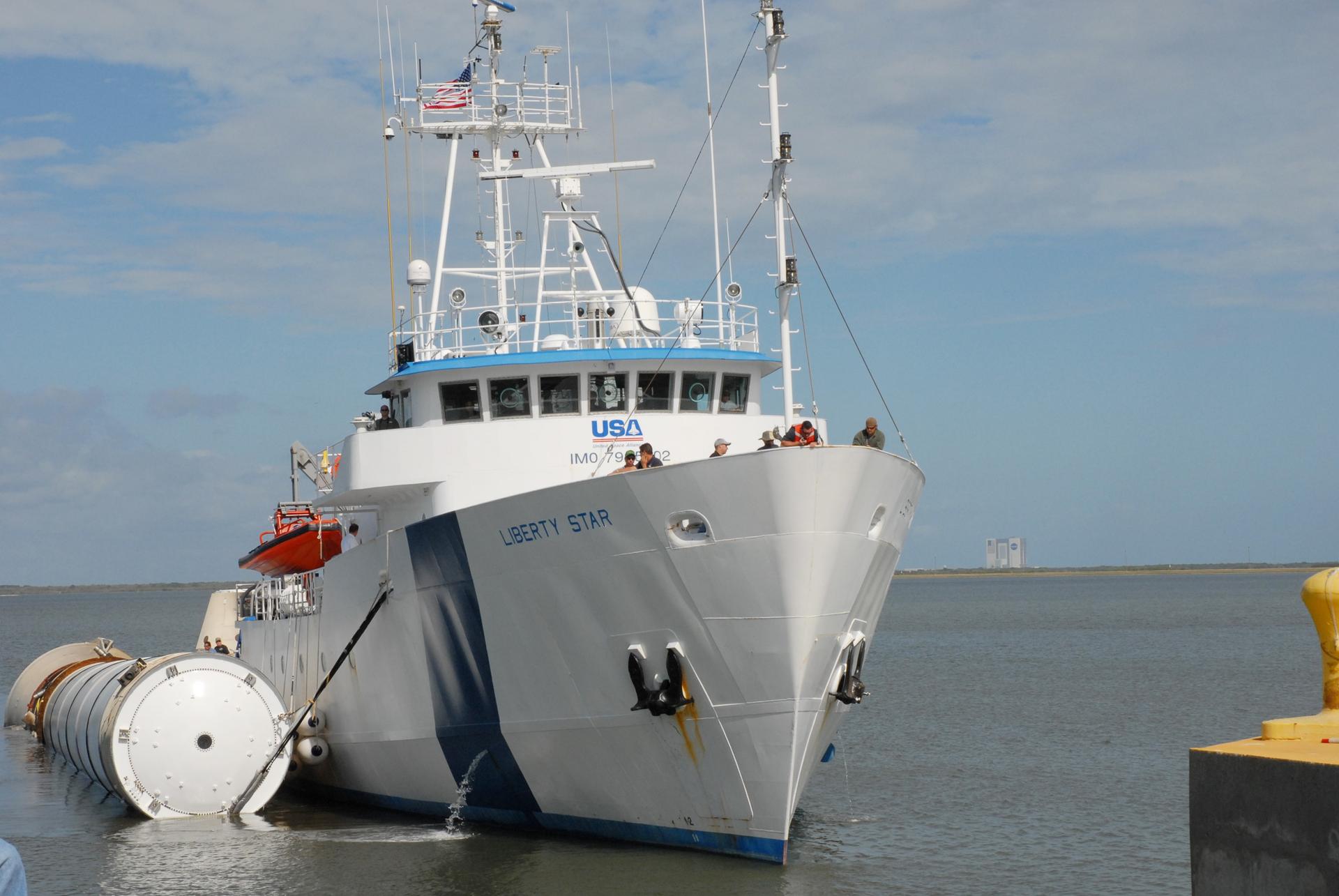
The vessel, named Linghang Zhe ("Navigator"), was stationed downrange in the South China Sea, waiting. According to China's state-run China Aerospace Science and Technology Corporation (CASC), the capture worked exactly as planned, marking what the company describes as the world's first successful net-system capture of a carrier rocket booster. China's State Council Information Office confirmed both the launch and the recovery were completed successfully, calling it the country's first controlled recovery of a rocket's first stage.
It's a genuinely new trick. SpaceX proved a decade ago that a spent booster can fly itself back down and land upright on legs, either on a droneship or back at the launch site. China has now demonstrated a second, mechanically very different way to get the same basic outcome — an intact, reusable first stage — using a net instead of landing gear.
How Net Capture Differs From Landing Legs
SpaceX's approach puts almost all the hard engineering on the rocket itself: extendable landing legs, grid fins, and a guidance system precise enough to bring a multi-story stage down to a soft, vertical touchdown on a small deck or pad. The booster does the work; the ground (or sea) segment just needs to be flat and sturdy.
Net capture, as described in reporting on the Long March 10B flight, flips that division of labor. Rather than building the deceleration and touchdown hardware into the booster, engineers put the catching mechanism on the recovery ship. The falling stage still has to be guided precisely to a target — Linghang Zhe, waiting downrange in the South China Sea — but once it arrives, a net absorbs the impact and holds it, rather than the rocket lowering itself onto legs.
The tradeoff is straightforward: a rocket that doesn't need to carry heavy landing legs, and the structural reinforcement to support a hard landing, can in principle dedicate more of its mass to payload. The cost is that the recovery infrastructure — the ship, the net rig, the tracking and timing systems needed to put a multi-ton falling object into a net at sea — has to be extremely capable in its own right.
The South China Morning Post's writeup goes further, characterizing the net-capture method as giving China a potential technical edge over the SpaceX landing-leg playbook, rather than simply a different way of arriving at the same place. Whether that edge is real will depend on how consistently the technique can be repeated, and on how it eventually scales to the kind of rapid-turnaround reuse SpaceX has achieved with Falcon 9.
That question may get an early answer: CASC says it intends to refly the very booster recovered on July 10 before the end of 2026. A quick reflight would be a strong signal that the recovered hardware needs only modest refurbishment — the same bet SpaceX made, successfully, with Falcon 9.
Why It Matters
Until now, only the United States — via SpaceX and, more recently, Blue Origin — had recovered an orbital-class rocket booster intact. Every other spacefaring nation, China included, has treated first stages as disposable, letting them fall into the ocean or onto land, unrecovered, after every launch. That's a major cost driver: building a new first stage for every flight is expensive, and it's a large part of why SpaceX has been able to undercut competitors on launch price.
The Long March 10B flight makes China the second country to recover an orbital booster intact, and — notably — it did so with a method no one else has successfully used before. That matters for two reasons. First, if net capture proves reliable and scalable, it gives China a reusability path that doesn't require replicating SpaceX's landing-leg approach, potentially sidestepping patents, engineering dead ends, or design constraints that come with the legs-and-grid-fins method. Second, and more broadly, it intensifies what several outlets are now openly calling a US-China race in reusable rocketry — a race that, until this launch, the United States had effectively been running alone.
Long March 10B is also notable because this net capture happened on its maiden flight — the first time the vehicle had ever flown. A successful recovery on a debut launch, rather than after multiple attempts and failures (as SpaceX experienced with its early droneship landings), suggests the underlying targeting and timing problem — getting a falling booster to a precise point in the ocean where a ship and net are waiting — was solved before the rocket ever left the pad.
The real test now is repetition. One successful catch establishes that the concept works; a fast, low-cost reflight of the same booster, as CASC has promised before year's end, would establish that it's economically meaningful. If China can turn this into a routine operation the way SpaceX did with Falcon 9 landings, it would mark the point where reusable-rocket economics stopped being a one-country story.
Sources
- China achieves first-ever controlled rocket recovery in Long March-10B maiden flight — China State Council Information Office
- China becomes second country to recover orbital booster with Long March 10B — SpaceNews
- Long March-10B: China's net-capture rocket joins space race with edge on SpaceX — South China Morning Post
