
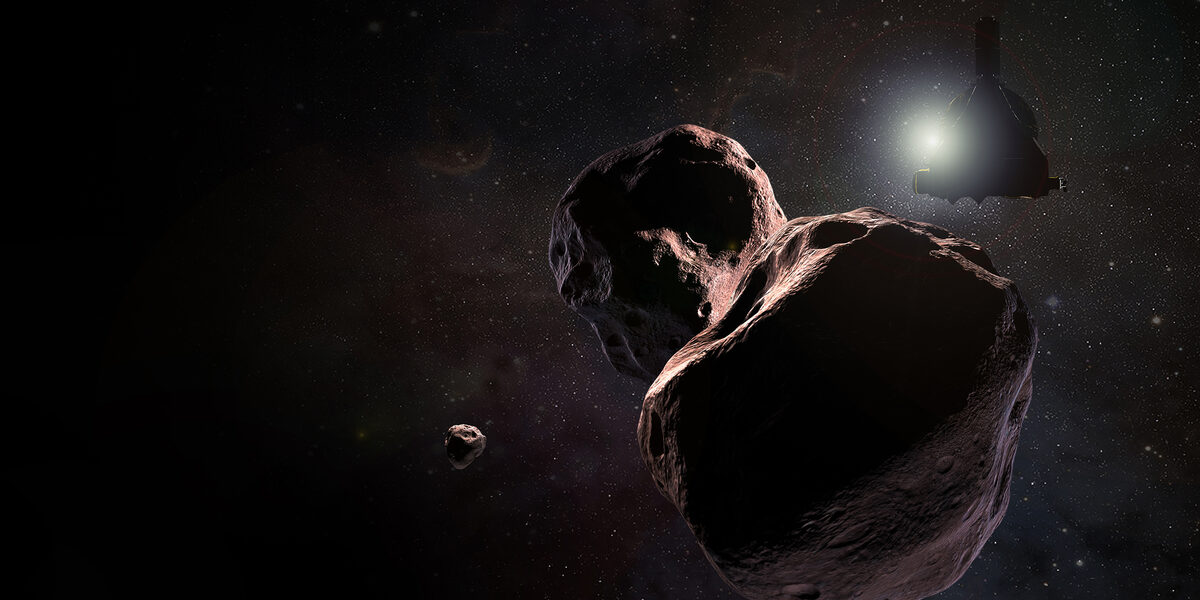
Somewhere past the orbit of Neptune, in the dim scattering of icy bodies known as the Kuiper Belt, a piano-sized spacecraft launched two decades ago has just opened its eyes again. NASA's New Horizons probe confirmed on June 23, 2026 that it had successfully emerged from the longest hibernation period of its entire mission — 321 days of near-total electronic silence — and reported every system healthy from a distance so vast that saying hello and getting an answer back takes nearly 18 hours round trip.
The spacecraft is now 5.9 billion miles (9.5 billion kilometers) from Earth, or roughly 64 astronomical units, according to a July 9, 2026 report from The Register. Only two spacecraft in history have traveled farther and are still operating: Voyager 1, now past 170 AU, and Voyager 2, past 140 AU. That makes New Horizons the third-farthest active NASA mission from the Sun.
A Long Nap, By Design
Hibernation isn't a malfunction; it's a survival strategy. New Horizons entered its latest dormant period on August 7, 2025, and the mission team at Johns Hopkins Applied Physics Laboratory (APL), which built and operates the spacecraft, kept it powered down for 321 days — the longest single stretch of hibernation in the mission's history. During hibernation, the spacecraft doesn't receive commands or transmit data home, though NASA says several instruments kept working the whole time, quietly gathering and storing data around the clock.
"Every status report through this hibernation period was green," said Alice Bowman, New Horizons' Mission Operations Manager at APL, in NASA's July 7, 2026 release announcing the wake-up. That's a notably clean bill of health for a spacecraft that has now been operating far longer, and far farther from the Sun, than its designers originally planned for.
With the spacecraft now roused, APL's team is downlinking full health and status data, followed by the data gathered throughout hibernation by three instruments that never went dark: the Solar Wind at Pluto (SWAP) sensor, which monitors solar wind conditions this far from the Sun; PEPSSI, the Pluto Energetic Particle Spectrometer Science Investigation, which measures energetic particles in the outer heliosphere; and the Venetia Burney Student Dust Counter, which has been quietly logging interplanetary dust impacts since shortly after launch. Alice, the ultraviolet spectrograph that has been central to New Horizons' science return since Pluto, was the one instrument that went fully quiet during hibernation — according to Bowman, it's expected to resume observations of hydrogen gas in the outer heliosphere in about three weeks.
How Far It's Come
New Horizons launched in January 2006 aboard an Atlas V rocket, the fastest launch of a spacecraft from Earth on record. It swung past Jupiter for a gravity assist in February 2007, then spent the better part of a decade crossing the empty gulf to Pluto, arriving for its historic flyby in July 2015 — the first and still only close-up reconnaissance of the dwarf planet and its moons. Four years later, in January 2019, it pulled off an even more distant feat: a flyby of the small Kuiper Belt object Arrokoth, the most distant object ever explored up close.
Since that Arrokoth encounter, the spacecraft has covered another 23.0 AU of empty space, according to The Register's account of the mission's current trajectory. NASA and APL now expect New Horizons to exit the Kuiper Belt entirely sometime between 2028 and 2029, at which point it will be sailing through a region of the solar system where the interplanetary medium thins out and the influence of the Sun's solar wind gives way to interstellar space — the same transition zone the Voyager probes crossed years ago.
Why It Matters
New Horizons is one of only a handful of active spacecraft with a direct vantage point on the outer solar system, and its continued good health after two decades of flight — including a stretch of dormancy nearly as long as a school year — is itself a data point about how well spacecraft electronics and power systems hold up on multi-decade deep-space missions. That matters directly for future outer-planet and interstellar-precursor concepts still on the drawing board.
Scientifically, the instruments now coming fully back online aren't just checking boxes. SWAP and PEPSSI are gathering in-situ measurements of the solar wind and energetic particles at a distance few instruments have ever sampled, contributing to heliophysics models of how the Sun's influence fades into the galactic environment. The Student Dust Counter, still running after two decades, is building one of the longest continuous dust-density records ever collected outside the inner solar system. And with Alice back online, the mission can resume opportunistic observations of the Kuiper Belt environment New Horizons is now flying through — a region so sparsely explored that essentially any data point is new.
There's also the simple matter of longevity. A spacecraft designed in the early 2000s, launched in 2006, and expected to have a limited operational life is instead still reporting "green" status while cruising toward the literal edge of where the Sun's influence gives out. Only Voyager 1 and Voyager 2 have gone farther. New Horizons, by contrast, is coming out of hibernation with its full science payload intact and years of Kuiper Belt cruising still ahead of it.
Sources
- NASA's New Horizons Spacecraft Wakes from Hibernation in Good Health - NASA Science
- New Horizons Pluto probe just woke itself up after 321 days of hibernation - The Register
- NASA's New Horizons probe awakens after long hibernation near Pluto - UPI
- NASA's New Horizons Awakens From Lengthy Kuiper Belt Hibernation - Aviation Week
