
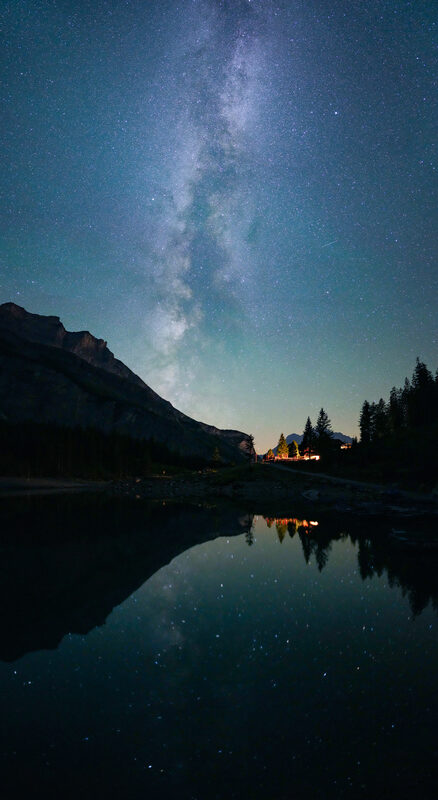
The Milky Way is always overhead. Earth orbits inside it, and the galaxy's disk extends in every direction. What changes with the seasons is which part of the disk we see most clearly on a given night. In winter, the night side of Earth faces the outer fringes of the galaxy — sparse, relatively dim. In summer, the night side faces the galactic center, toward the densest concentration of stars, nebulae, and dust clouds in the entire structure. The summer Milky Way is the bright one, the one photographs show arcing dramatically from horizon to horizon, the one worth going somewhere dark to see. That window is open now.
From mid-northern latitudes, the galactic center culminates — reaches its highest point above the southern horizon — in early August at around local midnight, and in late June at around 2 AM. From June through September, on any clear night away from city lights, the Milky Way is the dominant feature of the sky: a luminous band 10 to 20 degrees wide, running from the northeast horizon through the zenith and down to the south, visibly broadening and brightening toward Scorpius and Sagittarius in the south. Where it broadens is where the galactic center lies, roughly 26,000 light-years away, hidden behind the dust clouds of the inner disk but visible in the cumulative glow of hundreds of billions of stars behind and around that dust.
What you are looking at
The naked-eye Milky Way is not a single coherent structure. It is the integrated light of approximately 100 billion stars, averaged over the disk of the galaxy to a depth of tens of thousands of light-years. The dark rifts that divide it — most prominently the Great Rift running from Cygnus in the north to Centaurus in the south — are not gaps in the stars; they are dense clouds of interstellar dust that block the starlight behind them. The most dramatic of these rifts in the summer sky sits just above the Scorpius-Sagittarius border, where the dark Pipe Nebula and Ophiuchus molecular cloud complex absorb the light from the galactic center region.
Scorpius is the anchor of the summer Milky Way in the southern sky. The constellation contains Antares, a red supergiant roughly 700 times the diameter of the Sun and one of the intrinsically brightest stars in the sky. Near Antares, binoculars or a small telescope will resolve the globular cluster M4, about 7,200 light-years away — a sphere of roughly 100,000 stars held together by gravity, orbiting the galactic center. Sagittarius, just east of Scorpius, is the richest constellation in the Milky Way for globular clusters, emission nebulae, and star clouds. The Sagittarius Star Cloud (M24) is a naked-eye patch of densely packed background stars; the Lagoon Nebula (M8) and Trifid Nebula (M20) are star-forming regions visible with binoculars and stunning through a small telescope.
Finding a dark site
The Milky Way is fatally sensitive to light pollution. Under skies rated 7 or above on the Bortle scale — typical suburban skies — only the brightest core of the summer band is faintly visible, often mistaken for a cloud. For the full structure, with the dark rifts, the color variation, and the star-cloud texture visible to the naked eye, you need a Bortle 4 or better site. These are increasingly rare but still accessible within a few hours of most North American and European cities: dark sky preserves, rural parks, and mountain locations at altitude. The Milky Way Galaxy Core Finder tool and light-pollution maps online show what to expect from a given location.
The Moon is the other factor. Even a half-full Moon washes out the faint Milky Way structure. Plan observations around new Moon: from mid-July 2026, the weeks surrounding July 25 offer dark moonless nights during the peak of Milky Way season. Arrive at your observing site at least 30 minutes before your planned start, allow 15-20 minutes for full dark adaptation, and face south. The brightest part of the galaxy will be there — spread across Sagittarius, brightening where your eyes are aimed toward 26,000 years of accumulated starlight. No equipment required. Just the absence of other light.
Sources
- Galactic Center — Wikipedia (structure, Sagittarius A*, and the central stellar population)
- Milky Way — Wikipedia (galactic structure, naked-eye visibility, and seasonal observing)
- Sagittarius constellation — Wikipedia (Lagoon Nebula, Trifid, M24 star cloud, and deep-sky objects)
- NASA GSFC Imagine the Universe — Our Milky Way galaxy: structure, disk, and galactic center
