
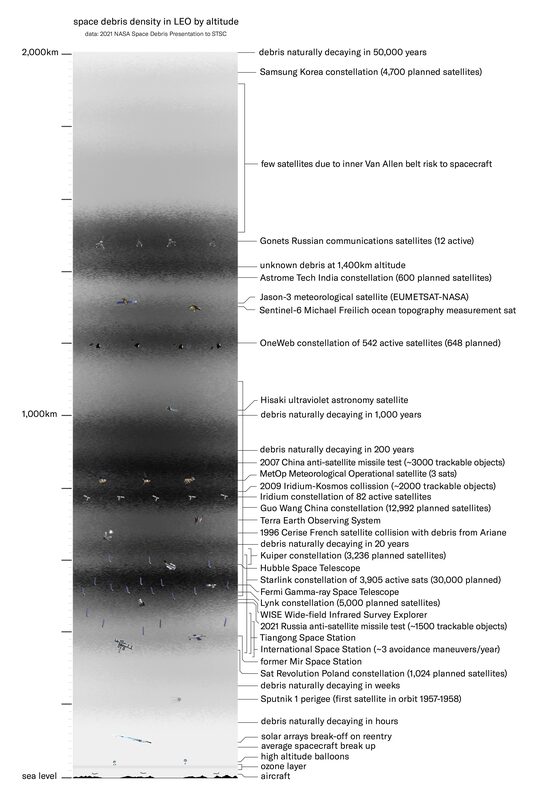
The night sky has acquired a new category of light pollution: satellite trails. A single Starlink satellite, fresh from launch at low altitude before its operational orbit, is visible to the naked eye as a bright point moving steadily across the sky. A train of freshly launched Starlink satellites — several dozen at a time, still at their deployment altitude in a chain — is one of the most striking and controversial sights in modern amateur astronomy: a long string of lights moving in formation, bright enough to interrupt a casual naked-eye observation and bright enough to saturate the detectors of research telescopes. SpaceX has launched more than 6,700 Starlink satellites as of mid-2026, making its constellation the largest single operator's fleet in history, with authorized plans for up to 42,000.
Starlink's business model is straightforward: satellites in low Earth orbit (around 550 kilometers altitude) are far closer to the surface than geostationary satellites (35,786 kilometers), so they can relay internet signals with much lower latency. The coverage model requires hundreds to thousands of satellites to blanket the globe continuously. The economic logic has driven SpaceX to launch aggressively, and the demand for the service — particularly in rural and remote areas without terrestrial broadband — has been strong. More than 3 million subscribers globally were reported in 2024, with the customer base growing fastest in maritime, aviation, and government sectors.
The astronomy problem
The astronomical community's objections are not about the satellites themselves but about their density and brightness. The Vera Rubin Observatory, when fully operational, will scan the entire southern sky every few nights with a 3.2-gigapixel camera, building the most comprehensive astronomical catalog ever assembled. Every exposure lasting more than a few seconds risks capturing a satellite trail as a bright streak across the field of view. With 42,000 Starlink satellites plus competitors' constellations — Amazon's Project Kuiper (up to 3,236 satellites), OneWeb (648), and others — the density of trails in any long exposure approaches the point where significant fractions of the sky survey data are compromised. Automated streak-removal algorithms can recover some of the data, but they cannot recover the underlying sky information in pixels the streak covers.
SpaceX responded to the initial outcry with several mitigations: a "Visorsat" sunshade that reduces reflectivity on newer satellites, operational maneuvering to move away from telescope fields of view on request, and orientation changes to reduce the illuminated cross-section. The mitigations have reduced the brightness of operational Starlink satellites in their final orbits — the FCC-certified operational satellites are typically 2-3 magnitudes fainter than first-generation models — but "fainter" is not the same as "invisible," and the sheer number of satellites means that long exposures still capture trails routinely.
Regulatory gaps
No international regulatory framework specifically governs the impact of commercial satellite constellations on astronomy. The ITU (International Telecommunication Union) manages radio frequency coordination for satellite communications but has no mandate over optical or near-infrared interference with ground-based telescopes. Efforts by the International Astronomical Union to establish voluntary guidelines for satellite operators have produced commitments from some companies, but enforcement is nonexistent. The FCC licenses U.S. operators and has begun asking applicants about astronomy interference mitigation in its approval process, but approval criteria do not yet include quantitative limits. The fundamental tension — between a commercially viable, technically legal service that demonstrably disrupts global scientific infrastructure — remains without institutional resolution, while the number of satellites in orbit continues to grow.
The regulatory picture is evolving slowly. The FCC has begun asking constellation operators about dark-sky mitigation in license applications, and the White House's National Space Policy includes language about minimizing satellite interference with scientific observations. The ITU's Working Party 7D is developing guidelines for satellite luminosity. But the pace of regulatory development has been far slower than the pace of constellation growth, and no binding international standard yet constrains how bright a satellite in low Earth orbit is permitted to be.
