
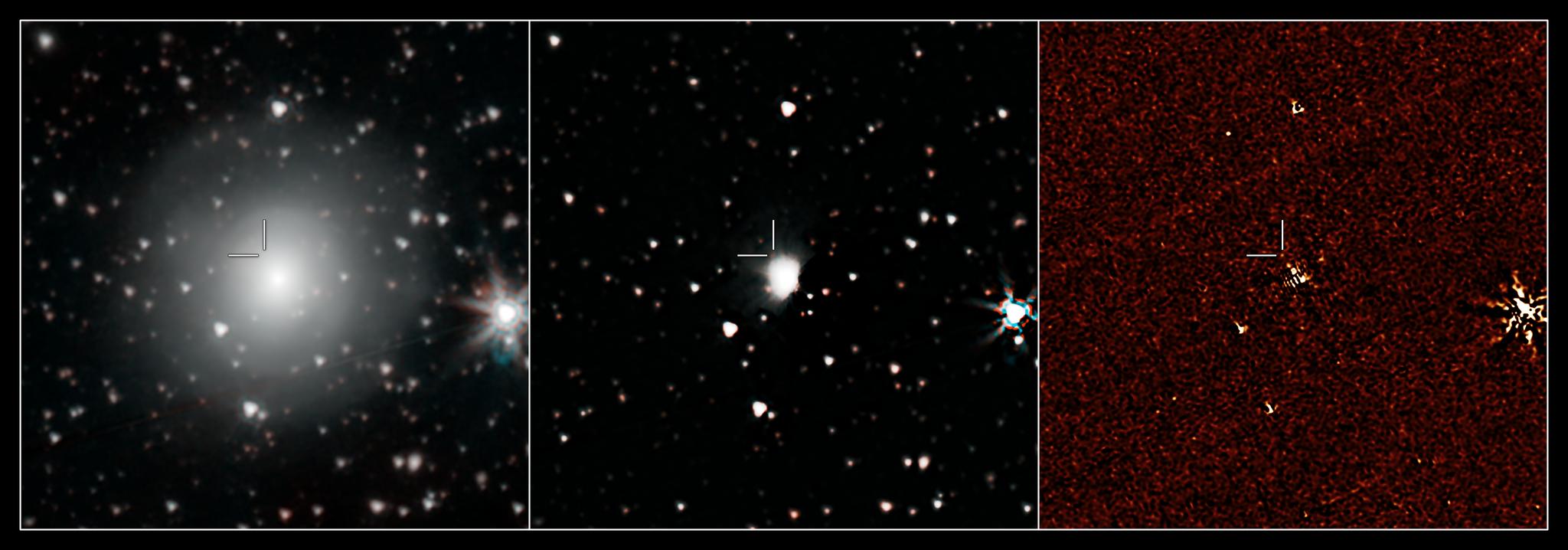
NASA has picked its ride for StarBurst, a small gamma-ray observatory designed to watch for the opening flash of colliding neutron stars. According to the agency's announcement, SpaceX will launch the spacecraft on a Falcon 9 as part of a Bandwagon rideshare mission from Space Launch Complex 40 at Cape Canaveral Space Force Station in Florida. The target date is no earlier than 2028.
That date is a step back. Starlust, reporting on the September 17, 2026 announcement, notes that the launch target has slipped from 2027 to no earlier than 2028. NASA's own release does not dwell on the change. What it does supply is the contract mechanism and the mission's stated purpose, and both are worth unpacking.
The Deal: A Task Order, Not a Dedicated Rocket
StarBurst is not getting a Falcon 9 to itself. It is booked on a Bandwagon rideshare, where a rocket carries several customers' spacecraft. That fits the mission's size: the satellite is a small one, described by Starlust as about washing-machine-sized and by UTIAS Space Flight Laboratory (SFL) as 300 kg.
The launch was purchased as a firm-fixed-price task order under NASA's VADR contract, short for Venture-Class Acquisition of Dedicated and Rideshare. NASA describes VADR as an indefinite-delivery, indefinite-quantity (IDIQ) contract with a 10-year ordering period and a maximum value of $1 billion across all contracts awarded under it. That $1 billion is a ceiling for the whole vehicle, not the price of this launch. NASA's release does not disclose the StarBurst-specific value, so any per-mission figure you may see elsewhere is not something the agency has put on the record.
StarBurst belongs to NASA's Astrophysics Pioneers Program, which funds lower-cost investigations built around small spacecraft and other platforms. Both NASA and SFL identify the program as the mission's funding source. A lower-cost satellite on a shared launch is the design philosophy in miniature.
What StarBurst Actually Does
The mission's goal, in NASA's words, is to investigate neutron star mergers and the origins of short gamma-ray bursts. The spacecraft is built to detect the initial high-energy emission from such events and to feed multimessenger astronomy, in which the same event is studied through more than one kind of signal, including gravitational waves and follow-up telescope observations.
According to Starlust, the instrument uses 12 CsI(Tl) scintillation detectors covering the 30 to 1,000 keV range, and it will operate in low-Earth orbit. NASA says StarBurst will observe the entire portion of the sky not blocked by Earth, searching for brief, powerful explosions called gamma-ray bursts.
The headline figure is sensitivity. NASA says StarBurst's effective area is more than five times that of Fermi GBM, the Gamma-ray Burst Monitor. Starlust puts the comparison as an effective area 500% larger, which read strictly would mean about six times; NASA's "more than five times" is the safer figure to rely on. Effective area is essentially a measure of how much signal the instrument can collect, so a larger number means more chances to catch a faint or distant burst. Both SFL and Starlust say the mission could observe up to 10 neutron star mergers per year.
Who Is Building What
StarBurst is a partnership, and the division of labor is clear from the sources:
- Leadership: The principal investigator is Dr. Daniel Kocevski of NASA's Marshall Space Flight Center.
- Payload: The gamma-ray instrument was developed by the U.S. Naval Research Laboratory.
- Spacecraft bus: SFL is the builder, using its DAUNTLESS platform, a scalable 1 x 1 x 1 m design.
- Other partners: NASA lists the University of Alabama in Huntsville and USRA alongside NRL and SFL.
SFL Director Robert E. Zee says that "our microspace approach to building high-performance, affordable smaller satellites" aligns perfectly with NASA's goal of finding cost-effective new ways to conduct astrophysics research.
The Build History So Far
The launch booking follows hardware milestones that are already under way. NASA reports that the instrument arrived at Marshall on March 4, 2025 for flight vibration and thermal vacuum testing at the center's Sunspot facility, with further work planned in the Stray Light Facility, which helps identify and reduce unwanted light in certain areas of the optical systems. In other words, the science payload went into environmental testing well before a launch was booked. None of our sources explain why the launch target moved from 2027 to no earlier than 2028.
Why It Matters
Short gamma-ray bursts are tied to neutron star mergers, and catching the initial high-energy flash is what lets the multimessenger community combine gamma-ray detections with gravitational-wave measurements and follow-up telescope observations. NASA frames StarBurst's job as detecting exactly that initial emission and handing it to that community. A detector with more than five times Fermi GBM's effective area, watching the full unobstructed sky from low-Earth orbit, is aimed at that need.
The Starlust write-up carries a line that captures the science case: "Neutron star mergers and gamma-ray bursts are nature's laboratories for testing our understanding of the cosmos."
There is also a programmatic point. StarBurst is an example of NASA trying to do astrophysics with small spacecraft on shared rides, using a launch contract, VADR, designed for that purpose. If a roughly 300 kg satellite can deliver up to 10 merger detections a year, as SFL and Starlust say it could, that is a strong return for a Pioneers-class mission. The caveat is the one that applies to every pre-launch projection: "up to 10" is a ceiling, not a guarantee, and the launch itself is still no earlier than 2028.
Sources
- NASA Awards Launch Services for StarBurst Gamma-Ray Detector (NASA)
- Understanding Cosmic Explosions: StarBurst Arrives at NASA for Testing (NASA)
- NASA selects SpaceX to launch StarBurst gamma-ray detector to study neutron star mergers (Starlust)
- StarBurst Gamma-Ray Astrophysics Satellite Mission (UTIAS Space Flight Laboratory)
