
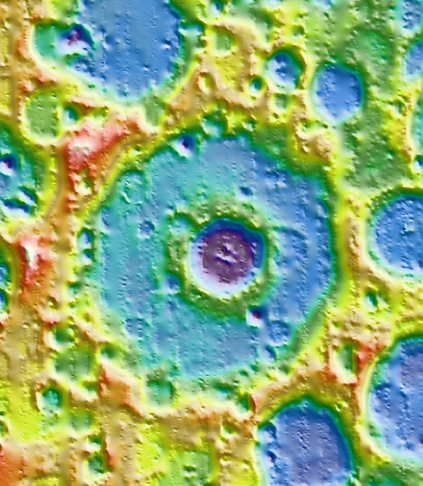
At 6:35 UTC on August 5, 2026 — 1:35 a.m. in Houston, where nobody was watching a launch pad — a four-metric-ton chunk of aerospace hardware that had been drifting dead in space for a year and a half finally ran out of orbit. It hit the Moon.
The object was the second stage of a Falcon 9 rocket, cataloged as 2025-010D, left in a lunar-adjacent trajectory after it did its job delivering Firefly Aerospace's Blue Ghost 1 lander and ispace's Hakuto-R Mission 2 spacecraft toward the Moon on January 15, 2025. About nineteen months later, gravity finished what the launch left undone, sending the 39-foot, 13-foot-wide stage into the lunar surface near Einstein crater on the Moon's western limb at roughly 5,400 mph — about 1.51 miles per second.
Unlike most defunct rocket bodies, which either burn up, drift indefinitely, or crash unnoticed on the Moon's far side, this one had a predictable trajectory well in advance. That gave NASA, international partners, and one of the world's most powerful ground-based telescopes time to point instruments at the impact site before it happened — turning a routine piece of space junk into a brief, unplanned lunar science experiment.
Why It Matters
The Moon has no atmosphere to slow down or vaporize incoming debris, so anything that hits it arrives at full velocity and gouges a fresh scar into the surface. NASA's Marshall Space Flight Center, through its Meteoroid Environments Office, coordinated observation efforts, while the Lunar Reconnaissance Orbiter and South Korea's Danuri spacecraft — carrying the ShadowCam imager — were tasked with capturing before-and-after images of the predicted crash site for comparison. NASA had projected a crater roughly 60 feet wide and 12 feet deep; independent calculations converged on similar figures, in the range of 66 to 98 feet wide, with the impact energy estimated at the equivalent of about 3 tons of TNT.
Every new, dated crater on the Moon is useful data. Planetary scientists use crater counts and impact rates to calibrate the ages of lunar surfaces — a technique that only works if researchers understand exactly how craters of known energy and size form. A rocket stage impact, with its mass, velocity, and impact angle all precisely known in advance, is about as close to a controlled experiment as anyone gets on another world. Nobody planned this particular crash — but plenty of people planned to watch it.
What the VLT Actually Saw
The most striking result didn't come from an orbiter's camera but from a telescope some 239,000 miles away on a mountaintop in Chile. The European Southern Observatory's Very Large Telescope was aimed at the predicted impact site and caught something orbital imagery alone couldn't: a spectroscopic signature of the impact plume itself.
For five to ten minutes after the strike, the VLT detected spectral emission lines from sodium and lithium gas in the debris cloud kicked up by the collision. Sodium is a known, if minor, constituent of lunar regolith, so its presence in the plume likely reflects material blasted out of the Moon's surface. The lithium is a more interesting question mark — researchers consider it plausible that at least some of it originated not from the Moon but from the rocket stage itself, meaning the VLT may have briefly detected the vaporized remains of the spacecraft's own materials mixing with lunar soil in real time.
That's a genuinely unusual data point. Spectroscopy of an impact plume, captured from Earth, of an event whose composition — a known rocket stage hitting known lunar terrain — is unusually well characterized on both sides of the collision, gives scientists a rare calibration case: a laboratory-grade "known input" smashing into the Moon, with its chemical aftermath measured from 239,000 miles away.
A Predictable End for an Unpredictable Piece of Debris
Spent upper stages typically aren't tracked with the rigor of active satellites, and this one had been left adrift after its 2025 delivery job was done — a routine, if not ideal, outcome for the era of aggressive commercial lunar and cislunar launch cadence. What made this impact different wasn't the crash itself so much as the advance warning. Orbital trackers and astronomers had enough lead time to predict the date, time, and approximate location of impact near Einstein and Bell craters well before it happened, giving both NASA's monitoring network and ESO's ground-based instruments a chance to prepare.
That lead time is what separated this event from the routine drumbeat of untracked impacts the Moon absorbs from its own population of micrometeoroids and space debris. Most go completely unrecorded. This one got a spectrum.
What Comes Next
NASA and its partners will now compare the pre-impact and post-impact imagery from LRO and Danuri to pin down the actual crater dimensions and compare them against the pre-impact models — an 18-meter-wide, 4-meter-deep crater, according to NASA's own calculations. Any deviation between predicted and observed crater size will help refine the models scientists use to interpret impacts they didn't get to watch happen.
The VLT's brief sodium-and-lithium spectrum, meanwhile, adds a small but real data point to an ongoing conversation about how much material the Moon's exosphere — its vanishingly thin, transient atmosphere — picks up from impacts large and small. It's not going to rewrite lunar science on its own. But as an accidental scientific bonus from a rocket stage nobody was steering, it's a reminder that even space junk can occasionally do something useful on its way out.
