
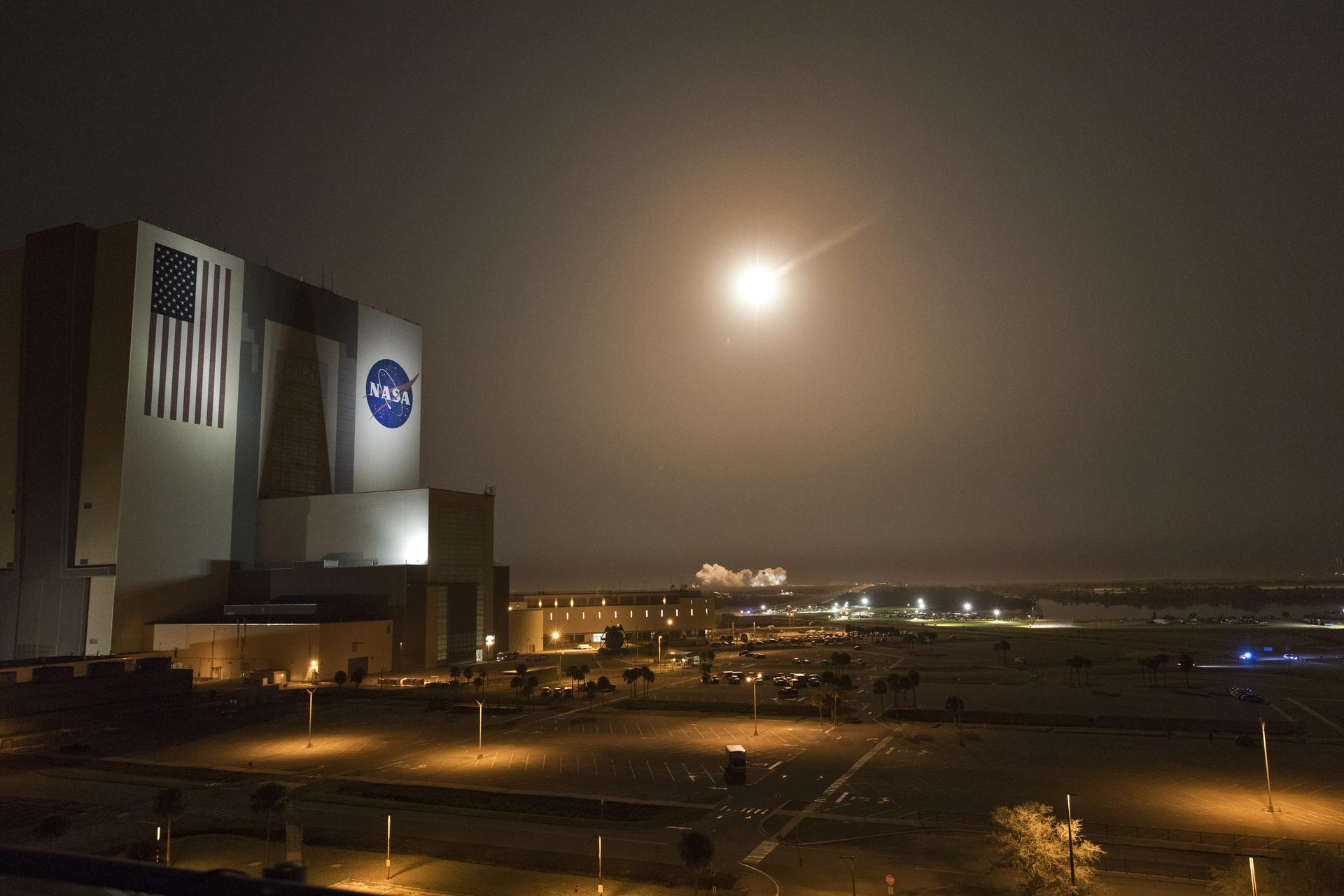
In a 38-minute, 30-second window on Saturday night, SpaceX launched two Falcon 9 rockets from opposite coasts — one climbing out of Florida, the other arcing over the Pacific from California. It's the tightest gap the company has ever managed between separate launches.
The first rocket lifted off at 9:12 p.m. EDT from Space Launch Complex-40 at Cape Canaveral Space Force Station, carrying a batch of eight replacement satellites for Globalstar's Big LEO mobile satellite system. Eight minutes later, its first stage — booster B1090, flying for the 14th time — settled onto Landing Zone-40 a few miles from the pad. The launch was the 52nd orbital mission out of Florida's Space Coast so far in 2026, according to Spaceflight Now's live coverage of the flight.
Thirty-eight and a half minutes after that first liftoff, a second Falcon 9 left Space Launch Complex-4E at Vandenberg Space Force Base in California at 9:50 p.m. EDT, carrying the classified USSF-366 payload for the U.S. Space Force. That booster, B1088, flew its 18th mission and landed on the droneship Of Course I Still Love You in the Pacific — the 650th successful Falcon booster landing SpaceX has logged to date.
Two Coasts, One Rocket Family, No Room for Error
Pulling off launches this close together isn't just a matter of having two rockets ready on two pads at the same time. Each mission runs its own independent countdown, range clearance, weather call, and recovery operation — and SpaceX's launch teams, tracking stations, and Mission Control in Hawthorne have to manage both without either one bleeding into the other's operational window.
The Vandenberg launch had a comparatively generous window to work with — 2:52 p.m. to 6:52 p.m. Pacific time on Saturday, with a backup opportunity Sunday at 2:38 p.m. PT, according to the Lompoc Record's report on the mission ahead of launch. The Cape Canaveral flight, by contrast, needed to thread a much narrower needle: land in a specific slot that would put its liftoff within striking distance of Vandenberg's window, close enough to set a record but far enough apart that neither range's safety and tracking operations would collide with the other.
What Flew, and Why It's Classified
The Globalstar mission is the more straightforward of the two. It's a replenishment flight for the company's Big LEO constellation, which provides satellite phone, data, and messaging services.
USSF-366 is a different animal. The Space Force has disclosed almost nothing about the payload beyond confirming it involves classified satellites destined for low Earth orbit on behalf of a U.S. government entity, per the Lompoc Record. What is known is the booster's résumé: B1088 had already flown 17 previous missions before Saturday, including NROL-126, Transporter-12, the SPHEREx astrophysics observatory, NROL-57, and 13 separate Starlink deployments — a flight history dominated by Starlink deployments but rounded out by national security payloads, commercial rideshare, and NASA science.
The Vandenberg launch also came with a physical side effect for people living nearby: the Space Force warned residents of Santa Barbara, San Luis Obispo, and Ventura counties that they might hear sonic booms as the booster came back down for its droneship landing.
Why It Matters
A 38.5-minute gap between two independent orbital launches from opposite coasts is a small number with a large amount of infrastructure behind it. It requires two flight-proven boosters ready to fly on the same day, two separate ground crews executing countdowns in parallel, and a scheduling system precise enough to line up two very different customers — a commercial satellite operator and the Space Force's classified satellite program — into windows that nearly touch.
That kind of cadence is the practical payoff of reusability. Boosters that have already flown 14 and 18 times, respectively, are no longer novelties for SpaceX; they're workhorses being turned around fast enough that the company can treat "launch two rockets from two coasts in the same evening" as a schedule to hit rather than a stunt to plan around. The 650th booster landing logged on the same night underscores how routine that part of the operation has become, even as the missions riding on top of it — from constellation maintenance to national security payloads — stay as varied as ever.
For the Space Coast, the Globalstar flight also pushed Florida's 2026 orbital launch tally to 52 — a pace that, if sustained, points to another record year for the region's spaceports.
