
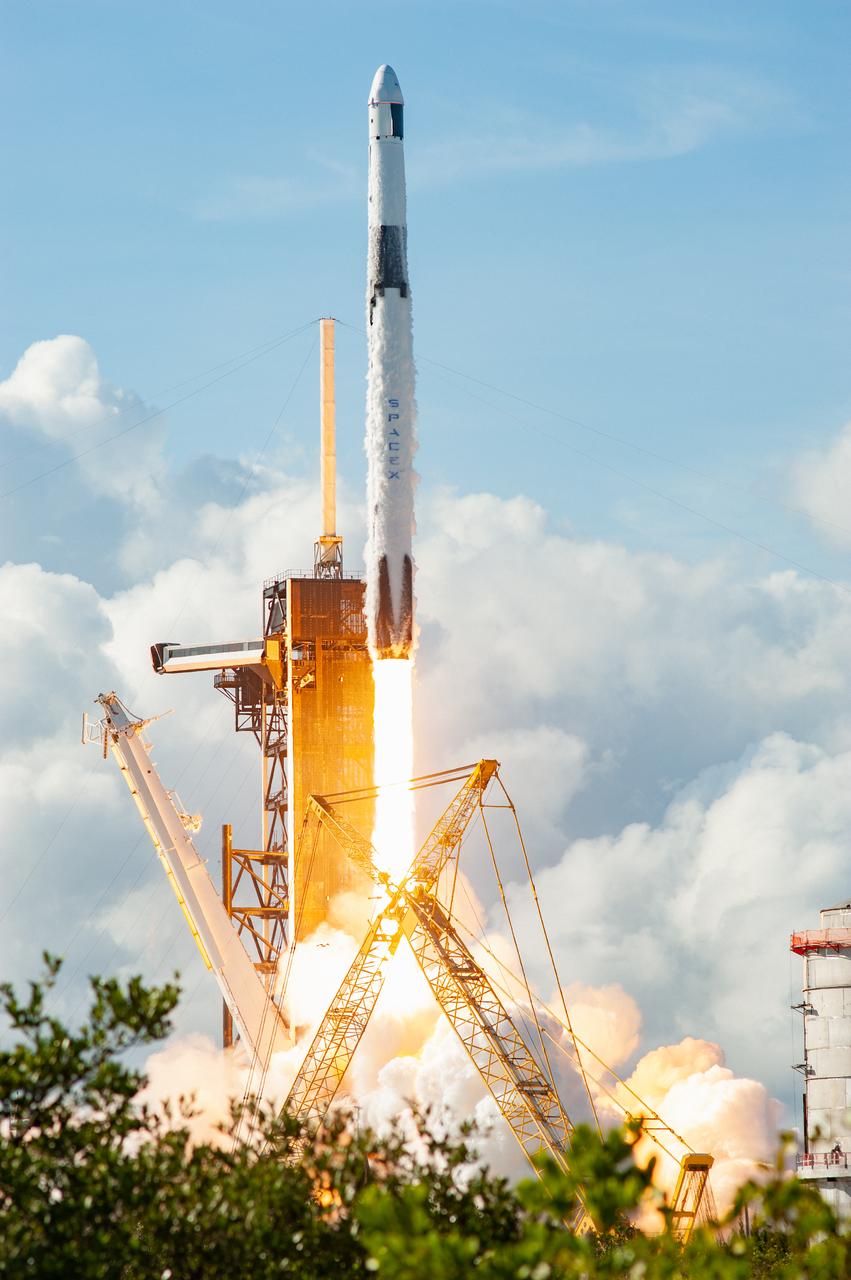
On the morning of June 16, as the International Space Station passed over the Pacific Ocean at 12:25 p.m. EDT, the SpaceX Dragon cargo capsule released its grip on the Harmony module and began its departure burn. After 30 days in microgravity, the spacecraft was now homebound with thousands of pounds of research that represents some of the most scientifically dense cargo ever returned from low Earth orbit. The splashdown, scheduled for June 17 at 5:08 a.m. PDT off the California coast, would mark the culmination of CRS-34—a mission whose manifest reads less like a routine resupply operation and more like a comprehensive survey of the current state of space-based research.
The centerpiece of the cargo manifests are bioprinted organ and cartilage tissues. These aren't samples passively exposed to the microgravity environment; they're products of active manufacturing conducted aboard the ISS. Tissue bioprinting in space exploits a fundamental advantage of weightlessness: the absence of gravitational effects on fluid dynamics and cell settling. On Earth, cellular constructs tend to collapse under their own weight or segregate based on density. In microgravity, cells can organize into three-dimensional structures that more closely approximate native tissue architecture. The tissues returning aboard Dragon represent proof-of-concept demonstrations that functional, complex biological structures can be fabricated in space—work that has immediate applications for regenerative medicine and pharmaceutical testing.
Alongside the tissue samples are DNA-inspired cancer treatment materials, compounds developed through experiments in the station's specialized life sciences modules. The phrase "DNA-inspired" suggests a biomimetic approach: researchers may have extracted design principles from genetic structures and translated them into therapeutic molecules. These compounds are being returned with an ocular imaging device—suggesting that efficacy testing or cellular response monitoring relies on visual documentation. Whether these materials represent entirely novel cancer therapies or optimized versions of existing approaches remains unclear, but their presence aboard a high-priority return mission indicates that early laboratory results warranted resource-intensive microgravity validation.
Perhaps the most time-critical cargo aboard Dragon are the blood stem-cell samples. Unlike tissue constructs that can be preserved for extended periods, stem cells are metabolically active and degrade in transit. The notation that these samples require "prompt ground analysis" is understatement: stem cell viability degrades measurably within hours of harvest. This constraint has shaped Dragon's entire return profile. The 20-hour transit time from ISS to Pacific Ocean splashdown has been engineered to keep delay minimal. Once recovered, the samples will be transported via helicopter or rapid ground vehicle to specialized facilities where cryopreservation or immediate culturing can begin. This logistical choreography—invisible to outside observers—represents the hidden complexity of operating a flying laboratory.
The mission also includes datasets and physical samples from space agriculture and stem cell expansion studies. These dual categories of cargo reflect divergent research agendas: agriculture focuses on scaling food production for deep-space missions, while stem cell expansion targets terrestrial applications in regenerative medicine and pharmaceutical development. A single 30-day mission can advance both simultaneously, an efficiency gain that has made the ISS increasingly valuable to commercial research partners.
Supporting this science is a suite of station hardware, including a sorbent air filtration system and waste compartment separator pump. These components may lack the scientific cachet of bioprinted tissues, but they're equally essential: the ISS's habitability depends on continuous maintenance of environmental systems. The replacement of these components aboard Dragon illustrates how commercial resupply missions have become heterogeneous operations, blending cutting-edge research with routine hardware replacement.
Why It Matters
The Dragon manifest encapsulates a fundamental shift in how space infrastructure is utilized. The ISS was originally conceived as a research facility for fundamental science—microgravity materials science, fluid dynamics, combustion studies. It remains that, but increasingly it's also becoming a biomanufacturing facility. Companies are investing in ISS research not for curiosity, but for competitive advantage. Bioprinted tissues that self-organize without gravity's distortion could yield insights that accelerate tissue engineering. Cancer compounds derived from DNA-inspired design principles might offer novel mechanisms of action that bypass resistance pathways that limit existing therapies.
This commercialization has been enabled by reliable cargo return capacity. For decades, only Soyuz spacecraft provided routine return capability, and launching anything to the ISS meant committing it to months of detention awaiting a Soyuz departure. SpaceX's Dragon has shattered that constraint. With cargo return happening on regular schedules—measured in weeks, not months—the ISS has become practically accessible to time-sensitive research. Stem cells, living tissues, active biological experiments: all can now be conducted in space and brought home for analysis on timescales that permit iterative research.
The blood stem-cell samples exemplify this shift. Stem cell research is advancing rapidly on Earth, but microgravity offers unique conditions: reduced cellular stress from settling, altered mechanical signaling, exposure to different osmotic environments. If stem cells expanded in microgravity exhibit superior expansion rates, reduced differentiation, or enhanced therapeutic potency, the implications for regenerative medicine could be transformative. A discovery today—validated aboard CRS-34—could reach clinical trials years ahead of alternative development timelines.
The cancer compounds represent another frontier: space-based drug discovery. If the ISS environment permits testing of novel therapeutic mechanisms in ways that Earth-based labs cannot, then space becomes part of the R&D pipeline. This is not theoretical. Pharmaceutical companies have already filed payloads aboard the station for exactly this purpose. The ocular imaging device returned alongside the DNA-inspired compounds suggests that live efficacy monitoring—watching how cancer cells respond to treatment in real time, visualizing the mechanism of action—occurred aboard the station. That data, combined with returned samples, may compress years of preclinical development into months.
Finally, Dragon's return highlights the economic sustainability of ISS operations. National space agencies have historically justified the station on grounds of fundamental science and international cooperation. Those arguments remain valid. But they're increasingly supplemented by economic data: commercial companies are willing to pay for access, willing to invest in research that the ISS uniquely enables, willing to treat the facility as a profit center rather than a cost center. Each successful mission—each return of valuable samples—strengthens the argument that sustained ISS operations are not a budgetary burden but an investment in competitive advantage.
As Dragon's parachutes deploy over the Pacific on June 17, teams will spring into action: helicopter recoveries, rapid transport to cryogenic facilities, high-priority analysis queues, data pipelines feeding back to researchers in dozens of institutions. The 20-hour journey home will end in focused intensity, every hour spent analyzing what microgravity made possible.
