
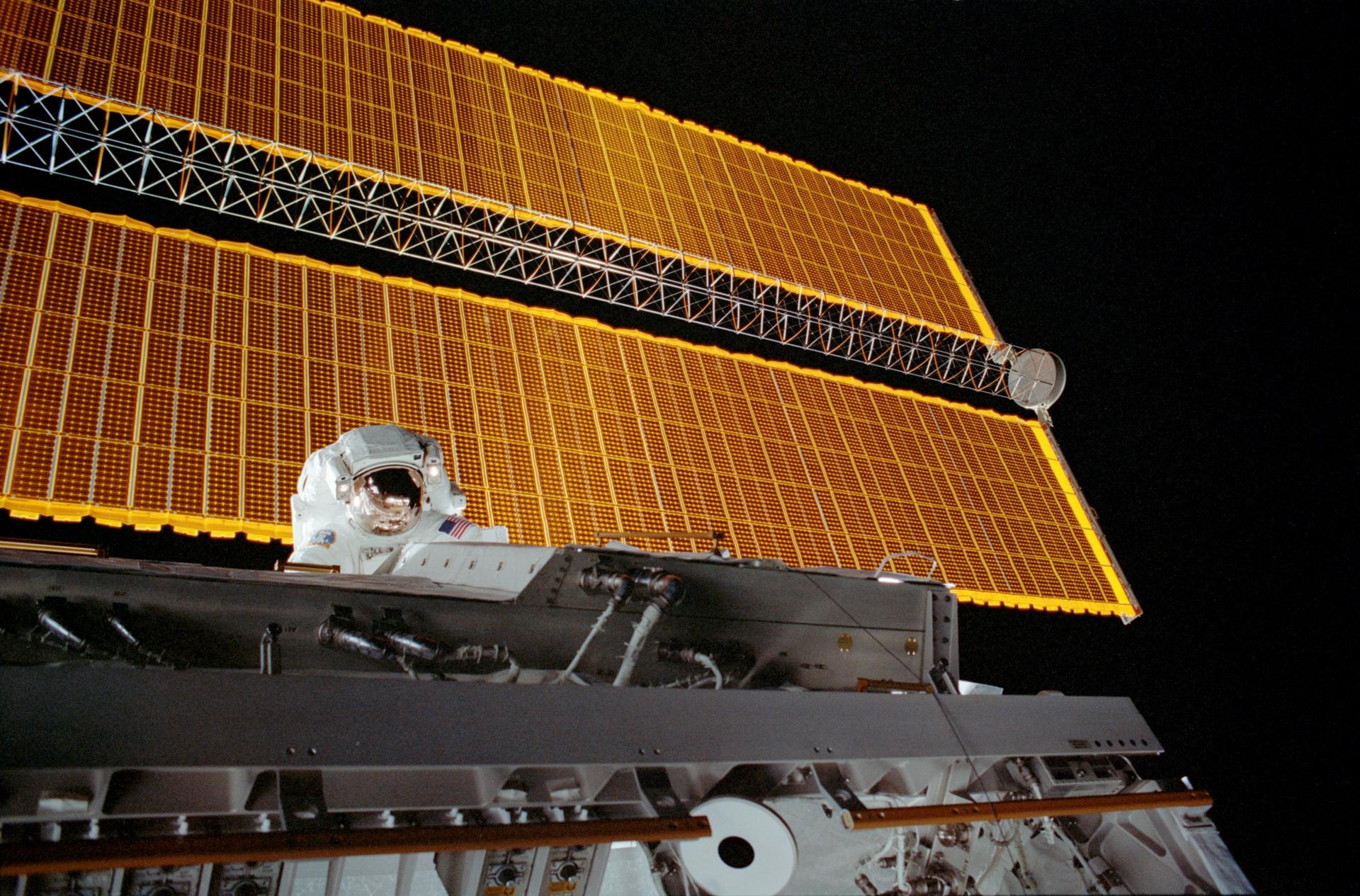
NASA is sending astronauts outside the International Space Station three times this August, tackling a punch list that ranges from rewiring a power channel to replacing a communications antenna that keeps the station talking to the ground. The agency laid out the schedule during a news conference held July 30, 2026, at 2 p.m. EDT from Johnson Space Center in Houston.
None of the three excursions is glamorous by spacewalk standards — there's no new module to bolt on, no telescope to service. But together they illustrate something easy to forget about a research outpost that has spent decades in continuous operation: keeping the station habitable and functional is itself a continuous, physically demanding engineering project, one that increasingly involves prepping infrastructure for equipment that hasn't launched yet.
What's on the Schedule
The first outing, designated U.S. Spacewalk 96, is set for August 6. According to NASA's release, astronauts Jessica Meir and Anil Menon will modify the station's 3B power channel — one of the power channels that distribute electricity collected by the station's solar arrays to its systems — and lay groundwork for a future installation of an ISS Roll-Out Solar Array, or IROSA. The station has been fitting IROSA panels over its older, degrading arrays in stages for several years; this spacewalk doesn't install a new array itself but sets up the channel and mounting hardware for one to come later.
For Meir, it will be her sixth spacewalk. For Menon, it will be his first time outside the station — a debut that NASA's release flagged specifically, the kind of milestone that gets a mention even in an otherwise routine maintenance announcement.
Spacewalk 97 follows a week later, on August 13, with a narrower and more self-contained objective: replacing a Space-to-Ground antenna. According to NASA, this antenna is critical communication hardware used to transmit data and high-speed communication between Mission Control in Houston and the space station. Swapping it out before it can fail is standard practice for a spacecraft that can't exactly pull into a service bay.
The third and final spacewalk of the month, U.S. Spacewalk 98 on August 25, is the most varied of the three. Crew members will connect power-channel cables and data-relay system connections, and separately swap out a navigational aid at the forward port of the station's Harmony module. Harmony is one of the station's connecting modules, and the navigational aid being replaced there assists visiting spacecraft during docking.
Why It Matters
It's tempting to read three spacewalks announced back-to-back as a sign something is wrong on the station. NASA's release and the corroborating coverage don't frame it that way, and the tasks described — a power channel modification, an antenna swap, cable connections — read as scheduled maintenance and upgrade prep rather than emergency repair.
But the cadence itself is worth noting. Three U.S. spacewalks in a single month is a heavy schedule for the ISS program, and each one carries real risk: astronauts working in bulky pressurized suits, tethered outside a spacecraft in orbit, handling cabling and hardware that has to be disconnected and reconnected without a single misstep. NASA doesn't commit to that kind of workload lightly.
The power-channel work in particular points to where the station's infrastructure priorities sit heading into the back half of this decade. The IROSA rollout has been a multi-year effort to compensate for solar arrays that have been generating power since the station's earliest modules went up, and every spacewalk that preps a channel for a future array installation is quietly extending the vehicle's operational runway. Meanwhile, the antenna replacement and the Harmony navigational-aid swap are the kind of unglamorous fixes that keep the station reachable and dockable — the plumbing, essentially, that a laboratory in low Earth orbit depends on just as much as any experiment running inside it.
There's also a crew-development angle worth flagging: Anil Menon's first spacewalk on August 6 means NASA is continuing to build spacewalk experience across its active astronaut corps, not just relying on veterans. Jessica Meir, by contrast, brings six spacewalks of experience into that same excursion — a pairing of a newcomer with a veteran that reflects a common structure for EVA crews, spreading institutional knowledge rather than concentrating it.
What to Watch For
NASA typically provides live coverage of station spacewalks, and additional details — exact start times, spacewalk duration, and any changes to the task list — tend to firm up in the days immediately preceding each excursion. Spacewalk 96 on August 6 is the one to watch first, both for the power-channel work itself and for how Menon's debut EVA goes. The two subsequent spacewalks, on August 13 and August 25, round out what amounts to a full month of station upkeep before any of the year's other major ISS milestones come into view.
