
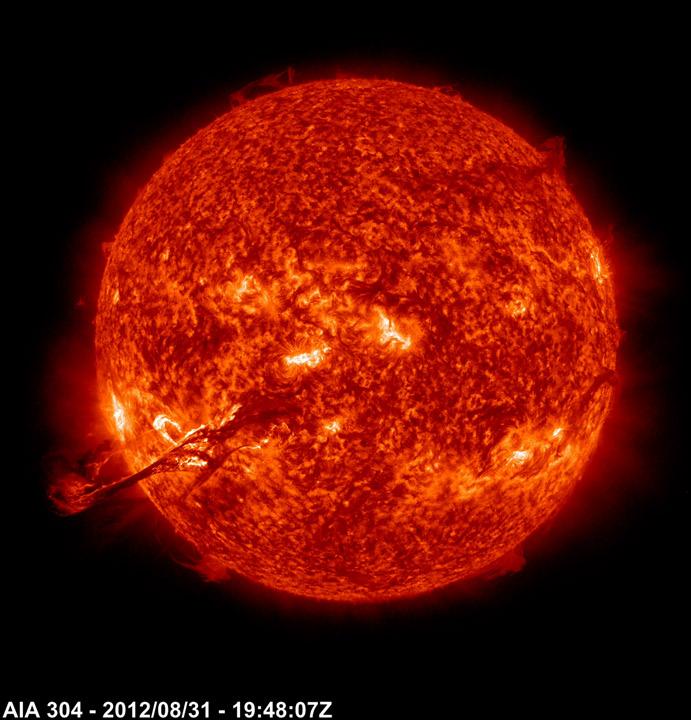
On Aug. 14, 2026, a long, arching filament of magnetized plasma tore free from the Sun's atmosphere and hurled a coronal mass ejection (CME) into space, roughly in Earth's direction. Three days later, forecasters are watching the sky for the result: a glancing solar punch that probably won't knock out satellites or power grids, but might just paint the night sky green for skywatchers who don't usually get the chance.
EarthSky describes the eruption as a "rope" of solar material and magnetic fields now en route to Earth, while Spaceweather.com and NOAA's Space Weather Prediction Center are tracking it as a glancing blow. NOAA's Space Weather Prediction Center — the U.S. government's official forecasting authority for events like this — is hosting the 3-day geomagnetic forecast that other outlets are citing, and confirms the Sun is currently active enough to be producing R1 (minor) radio blackout effects on top of the incoming CME.
What's Actually Coming
A filament eruption is different from a flare, though the two often happen together. Filaments are long strands of relatively cool, dense plasma suspended above the Sun's surface by magnetic fields; when those fields become unstable, the filament can erupt outward, frequently taking a CME — a bubble of magnetized solar wind plasma — with it. That's what happened on Aug. 14.
According to EarthSky's tracking, forecasters expect the CME to reach Earth late on Aug. 17, though EarthSky notes forecasting centers still disagree on the timing, with some models pushing the encounter as late as Aug. 19. Spaceweather.com reports that NOAA's models point to a glancing blow rather than a direct hit, with the CME expected to clip Earth's magnetic field on Aug. 17.
That geometry matters for how strong the resulting geomagnetic storm will be. EarthSky's forecast calls G1 (minor) storming likely, with G2 (moderate) storming possible if the CME's embedded magnetic field happens to tip southward when it arrives — a southward-pointing field couples more efficiently with Earth's own magnetosphere and tends to produce stronger, longer-lasting storms.
Spaceweather.com's numbers, current as of Aug. 16, put the odds in more granular terms: for the 0–24 hour window on Aug. 17, the site's storm-probability table gives mid-latitude locations a 15% chance of "active" conditions, a 5% chance of minor storming, and a 1% chance of severe storming. As of that same reading, the solar wind was still moving at an unremarkable 298.6 km/sec and the planetary K-index sat at 0.67 — solidly in "quiet" territory, meaning the disturbed conditions from Aug. 14's eruption hadn't yet arrived. Spaceweather.com also logged a recent C8-class X-ray flare, a modest event on the flare intensity scale but a sign the active region responsible is still capable of throwing off material.
Who Might See Aurora
If the glancing blow performs as forecast, EarthSky's aurora visibility map extends further than the usual high-Arctic fringe. In North America, that includes Alaska and most of Canada, plus a swath of the northern U.S. running from Washington and Montana across North Dakota to northern Michigan and Maine. Across the Atlantic, Scotland, northern England, and Northern Ireland are in the potential viewing zone. In the Southern Hemisphere, southern New Zealand and Tasmania made the list as well — a reminder that geomagnetic storms light up both poles simultaneously, just with mirrored geography.
None of this is guaranteed. Aurora forecasting is probabilistic by nature, and the actual visibility on any given night depends on cloud cover, light pollution, and the precise timing and orientation of the CME's magnetic field when it sweeps past Earth — details that are essentially unmeasurable until the plasma is already here. That's why NOAA's own forecast is framed as a rolling 3-day outlook rather than a fixed prediction, and why EarthSky hedges the arrival window by two full days.
Why It Matters
G1 and G2 geomagnetic storms sit at the low end of NOAA's five-step storm scale, and by themselves they're not disruptive events — you won't see satellite outages or grid failures at these levels, though NOAA's confirmation of ongoing R1 radio blackout activity is a reminder that the same active region driving this eruption is capable of interfering with high-frequency radio communications used by aviation and maritime operators. For most people, the practical significance of a storm this size is entirely about visibility: it's one of the more reliable ways for skywatchers well outside the Arctic Circle to catch aurora without traveling. Events that push the aurora oval down into the northern U.S., southern Canada, the UK's northern fringes, and equivalent latitudes in the Southern Hemisphere don't happen on every solar cycle, so a forecast G1 with a shot at G2 is enough to be worth setting an alarm for, even though the exact odds — Spaceweather.com's own numbers put severe storming at just 1% for the Aug. 17 window — mean most of the drama is riding on the CME's magnetic orientation rather than its raw size.
For now, the numbers on the ground are unremarkable: quiet solar wind, a low K-index, nothing happening yet. That's expected — the CME hasn't arrived. Skywatchers in the potential viewing zones should keep an eye on NOAA's real-time aurora forecast late on Aug. 17 and be ready to step outside on short notice, since the actual window of visibility, if it happens at all, is likely to be measured in hours.
