
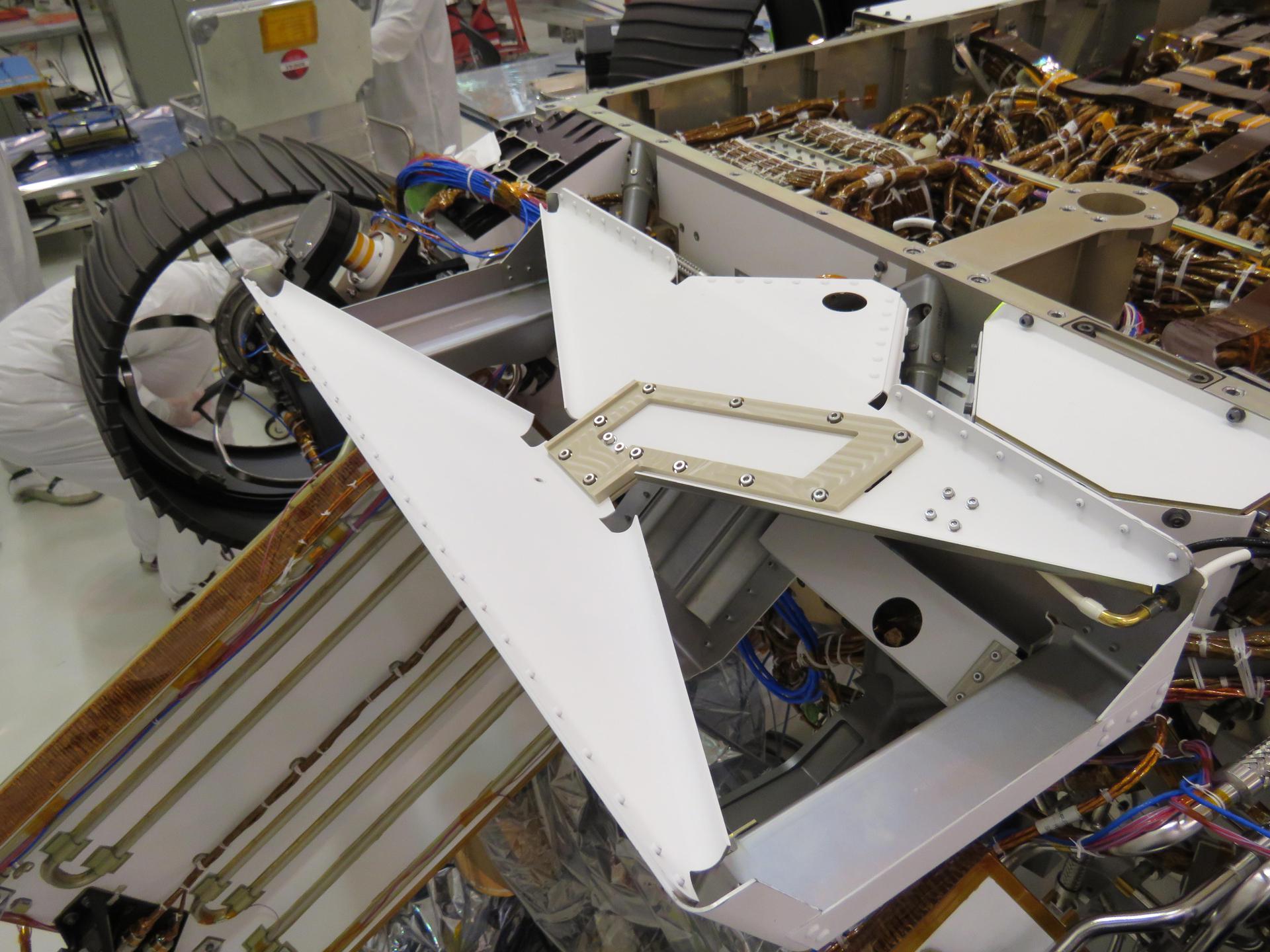
Three helicopters. One fission-powered spacecraft. And a radar antenna light enough to hold in one hand that has to survive dozens of jarring touchdowns on the surface of another planet. NASA's Jet Propulsion Laboratory says that antenna just passed its toughest test yet, absorbing 200 simulated Mars landings — more than double what the mission actually requires — without losing any measurable performance.
The hardware belongs to SkyFall, a follow-on to the Ingenuity helicopter concept that trades a single scout chopper for a fleet of three, each one built to hunt for buried water ice rather than simply prove that powered flight in Mars's thin atmosphere is possible. If the antenna's showing holds up through the rest of qualification testing, it removes one of the more delicate unknowns standing between the mission and its late-2028 launch window.
A radar antenna built from fabric, not metal
The component JPL put through its paces is a Vivaldi-style antenna — a flared, tapered shape borrowed from radio engineering — built not out of metal but out of a flexible fabric blend of polyester and Vectran, the same high-strength synthetic fiber used in the airbags that cushioned NASA's Spirit and Opportunity rovers when they landed on Mars. The finished antenna weighs about 5 ounces (150 grams) and operates across a 500 to 2,500 MHz band, corresponding to wavelengths of roughly 5 to 24 inches (12 to 60 cm).
That wavelength range is not arbitrary. It is what lets the instrument function as ground-penetrating radar (GPR), sending signals into the Martian subsurface and reading back the echoes to map what lies beneath the dust. According to NASA's mission page for SkyFall, each of the three helicopters will carry this kind of radar, capable of detecting ice deposits between roughly 1.6 and 10 feet (0.5 to 3.0 meters) below the surface — shallow enough to matter for future astronauts who would need to dig it up, but too deep to see with a camera alone.
Because the antenna has to fold, fly, and land repeatedly rather than sit fixed on a lander, JPL's test regime was built around mechanical fatigue as much as electronics. Engineers cycled the prototype through temperature swings of 170°F (94°C) to reproduce the extremes of a Martian day-night cycle, paired with repeated flexing meant to mimic the shock of landing. Two hundred cycles later, JPL reports, the antenna's performance held steady.
Why three helicopters instead of one
Ingenuity, which flew as a bonus payload strapped to the Perseverance rover, proved that a small rotorcraft could get off the ground in Mars's thin atmosphere. SkyFall is a different kind of mission by design. Rather than a single demonstrator dependent on a rover for communications relay, NASA's mission page describes three rotorcraft working as a team, each able to transmit its findings directly to Mars orbiters overhead — no rover relay required.
The job description has also changed. Where Ingenuity's flights were largely proof-of-concept hops, SkyFall's helicopters are tasked with mapping subsurface ice, scouting terrain hazards, and identifying candidate landing sites for a future human mission to Mars. A NASA program executive quoted by The Brighter Side of News framed the goal in blunt terms: finding out not just whether water ice is present at a given spot, but how large the deposit is, how deep it sits, and what its physical characteristics are — the kind of granular data an actual crewed landing and surface stay would depend on.
Riding a nuclear reactor to Mars
The helicopters don't travel alone. Their ride is Space Reactor-1 Freedom, described by NASA as humanity's first fission-powered interplanetary spacecraft. Rather than parachuting the helicopters down after a conventional landing, Freedom releases them mid-air during atmospheric descent — a more aggressive delivery method than Ingenuity's ride-along under Perseverance's belly, and one that puts extra emphasis on making sure hardware like the radar antenna can take a hard landing without flinching.
The mission timeline is tight but specific. Space Reactor-1 Freedom is slated to launch in late 2028, according to both JPL and NASA's mission page. The Brighter Side of News reports a launch date of December 2028 with arrival roughly a year later; NASA's own mission page puts landing in fall 2030, following a second approach to Mars. The two accounts are consistent with a roughly two-year cruise and approach profile rather than a direct one-year transit.
Why It Matters
Water ice is the resource that turns "visiting Mars" into "staying on Mars." It can be split into breathable oxygen and rocket-propellant hydrogen, and it removes the need to haul every drop of water astronauts would need across the vast distance separating Earth and Mars. But knowing ice exists somewhere on Mars, in a general sense, is not the same as knowing where it sits in usable quantity near a viable landing site — and that is precisely the gap SkyFall's radar-equipped helicopters are meant to close.
The antenna itself matters beyond this one mission. A GPR instrument light enough to fly on a helicopter, tough enough to survive dozens of landings, and simple enough to be made from woven fabric rather than rigid metal is a small but genuine advance in planetary instrument design — the kind of component that could reappear on future landers, rovers, or airborne platforms anywhere engineers need radar without the mass penalty. For a mission still more than two years from launch, a prototype that shrugs off 200 simulated landings is exactly the unglamorous, load-bearing kind of progress that keeps a 2028 launch date credible.
