
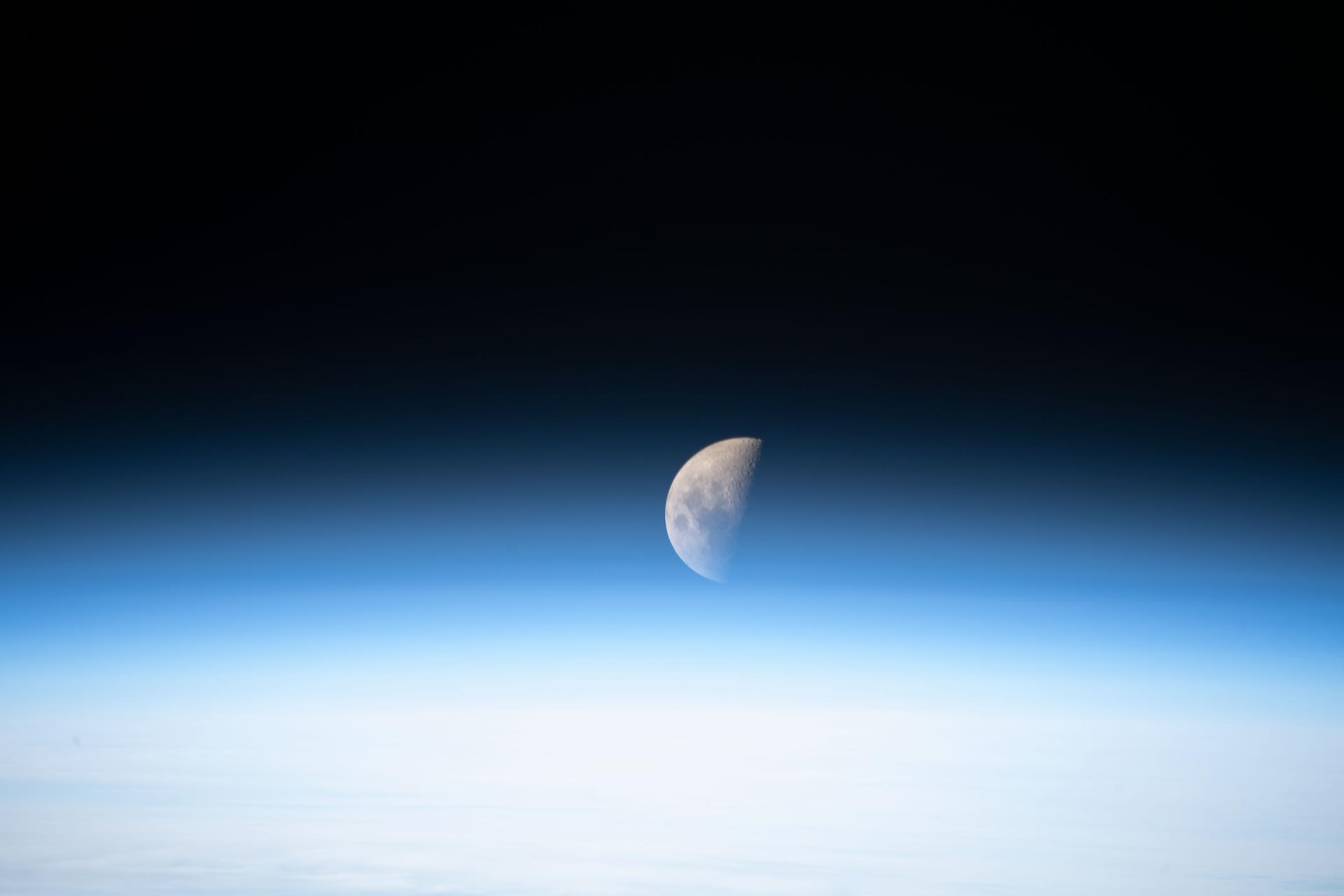
Mid-November rarely offers this much in one week. Between Nov. 17 and Nov. 20 the Moon reaches first quarter, the Leonid meteor shower peaks, the growing Moon passes Saturn, and Jupiter and Mars stay close together in Leo just after their closest pairing. NOAA's space weather forecasters have also flagged a chance of minor geomagnetic storming in the same stretch. None of these events is dramatic by itself. Together they make a good week to step outside, and the timing works out well: the Moon is up in the evening and gone before the darkest part of the morning.
The Moon Sets the Schedule
According to EarthSky's November sky guide, the Moon reaches first quarter at 11:48 UTC on Nov. 17, which is 5:48 a.m. CST. A first-quarter Moon rides high in the evening sky and sets around the middle of the night, and that is what matters most this week. In the evening the Moon is the brightest thing up there. After it sets, the sky gets dark enough for meteors.
Each night after that the Moon grows fuller and sets later. The end point arrives a week out: NASA's November skywatching guide notes a supermoon on Nov. 24. For anyone hoping to see faint objects, this week's pre-dawn hours are the best dark-sky chance before that bright full Moon takes over.
Leonids: Wait for Moonset
EarthSky and NASA agree on the Leonids' timing. The shower peaks on the mornings of Nov. 17 and 18, and NASA's guidance is to watch in the early morning hours after the Moon has set. NASA puts the rate at up to around 15 meteors per hour under ideal conditions.
That number needs some context. "Ideal conditions" means a dark site well away from city lights, a clear sky, and eyes that have had time to adjust. Most people watching from a suburban backyard will see fewer. Fifteen an hour works out to roughly one every four minutes on average, and meteors tend to come in clusters with quiet gaps between them. Settle in for a while instead of glancing up for five minutes.
The practical advice is simple:
- Go out after moonset. With a first-quarter Moon, the hours before dawn will be the darkest of the night.
- Give it time. Plan on at least 30 to 45 minutes with your back to any nearby lights.
- Look broadly. Meteors can appear anywhere in the sky, so take in as much sky as you can instead of staring at one spot.
The Moon Visits Saturn
Once the Leonids have peaked, the evening sky has the next event. EarthSky reports that the waxing gibbous Moon will appear near Saturn on the evenings of Nov. 19 and 20, with the pair setting several hours after the middle of the night. The Moon will be past first quarter by then and heading toward full, so it will be the obvious marker in the sky. Saturn is the steady, golden point of light nearby.
EarthSky describes Saturn as this month's lone evening planet. It shines in the east as darkness falls and stays visible until after midnight. If you have never knowingly seen Saturn, this is an easy way to find it: locate the Moon, and the brightest star-like object close to it is the planet. The pairing should look good to the naked eye, and a telescope will show more detail.
Jupiter and Mars, Still Paired in Leo
The two other bright planets are morning objects. NASA and Space.com both reported that Mars and Jupiter appeared just over a degree apart in the constellation Leo overnight Nov. 15-16. NASA gives the separation as about 1.2 degrees on the mornings of Nov. 15 and 16, and EarthSky says they will still be 1.2 degrees apart on the morning of Nov. 17. Space.com notes that the pair rises around midnight, with Leo's brightest star, Regulus, below them.
The closest approach has passed by the start of this week, but the planets separate slowly, and they will still be noticeably close together during the Leonid mornings. Space.com points out that the two planets will not be this close again until July 2029, which makes it worth a look while you are already outside for meteors.
Leo matters here for a second reason. The Leonids take their name from the constellation, because their meteors appear to radiate from it. Anyone looking toward Leo before dawn on Nov. 17 or 18 will have Jupiter, Mars and Regulus in view while waiting for meteors.
A Possible Bonus: Aurora
NOAA's Space Weather Prediction Center issued a three-day forecast at 12:30 UTC on Nov. 16 that calls isolated G1 conditions likely on Nov. 17-18. G1 is the lowest level on NOAA's geomagnetic storm scale. Forecasters expect a high-speed solar wind stream from a coronal hole to move into a geoeffective position, and a coronal mass ejection that left the Sun on Nov. 14 may arrive late in the period. The maximum Kp index expected for Nov. 16-18 is 4.67.
Keep expectations low. A Kp near 4.67 usually means aurora is mainly a possibility for observers at higher latitudes, and SWPC's own wording on the CME is "possible arrival," not a confirmed hit. These are also the same nights as the Leonid peak, so anyone already up before dawn in the north should check the northern horizon now and then. Phone cameras often pick up a faint auroral glow that eyes miss.
Also on the Calendar
NASA's November guide also lists a "Shine Bright for Voyager" light-day activation on Nov. 17, the same date as first quarter and the start of the Leonid peak.
Why It Matters
This week is a good example of how much the Moon's phase decides what you can see. A first-quarter Moon is bright in the evening and gone by the small hours. That split lets the Leonids, a modest shower at up to about 15 per hour, get a dark sky, while the Saturn pairing gets the evening. The Jupiter and Mars pairing, which Space.com says won't be matched until July 2029, overlaps the meteor mornings in the same constellation. Seeing several events in one outing makes the cold worth it. And with a supermoon coming on Nov. 24, the pre-dawn hours of Nov. 17 and 18 are this month's best dark-sky window. NOAA's G1 forecast adds a small chance of something more.
