
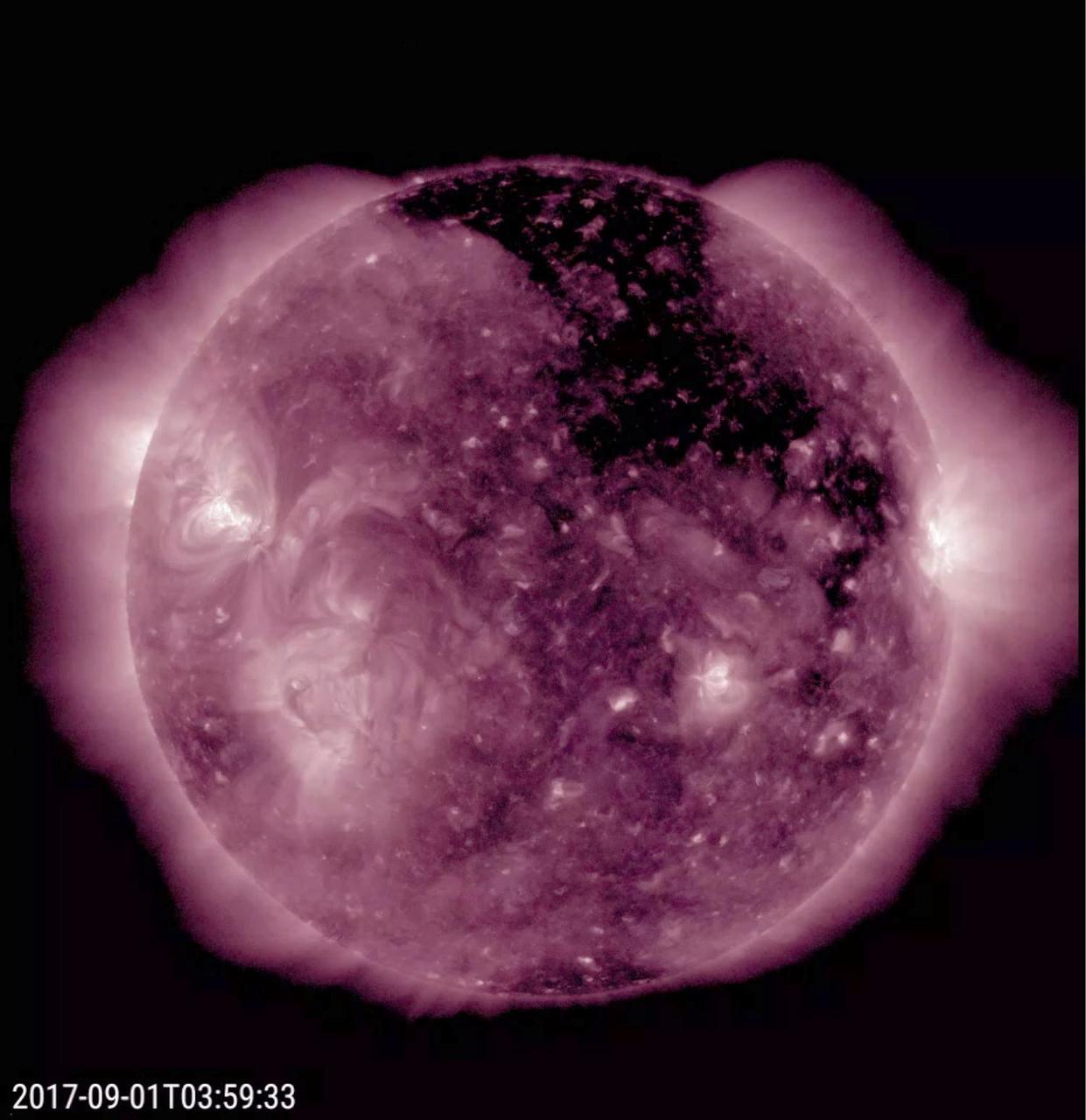
The sun has been fairly quiet this week, and that's about to change a little. NOAA's Space Weather Prediction Center (SWPC) expects G1, or minor, geomagnetic storm conditions on Nov. 17 and 18. Two things are behind it: a stream of fast solar wind from a coronal hole, and a coronal mass ejection (CME) that may give Earth a glancing blow. Nobody expects a big show. A G1 storm usually means aurora at high latitudes, and for observers in the right places it can be worth staying up for.
Here is what the forecasters are saying, where the numbers come from, and what you can realistically expect if you go outside.
The forecast in numbers
SWPC's 3-day forecast, issued at 00:30 UTC on Nov. 16, puts the highest expected 3-hour Kp index for the period at 4.67. That is the G1 threshold. The peak falls in the 03:00-06:00 UT block on Nov. 17. The forecast tops out at Kp 3.67 on Nov. 16 and again on Nov. 18, which is unsettled but below storm level. The agency's reasoning is short: "G1 (Minor) geomagnetic storms are likely on 17-18 Nov due to the anticipated influence of the combined effects of a coronal hole and glancing CME."
For anyone hoping to see something, the Met Office, covered below, expects the visible aurora to stay largely at high latitudes, well north of most of the contiguous United States and most of Europe.
Things started from a very quiet baseline. The highest Kp observed in the 24 hours before the forecast was only 2. EarthSky's Nov. 15 update also called conditions quiet, with Kp at 0-2 and a normal solar wind.
Two sources, overlapping
The storm forecast rests on two separate solar features that may affect Earth at the same time.
The coronal hole. EarthSky reports that a positive-polarity coronal hole stream is expected to arrive, preceded by a solar sector boundary crossing. Coronal holes are regions where the sun's magnetic field opens out into space, so the solar wind can escape faster than usual. When that faster wind reaches Earth, it can push the magnetosphere into unsettled or active conditions without any eruption. The UK Met Office expects the faster wind to arrive later on Nov. 16 (UTC) or on Nov. 17.
The glancing CME. The second ingredient is less certain. EarthSky notes that one CME model run shows a glancing arrival at 15:58 UTC. "Glancing" means the main body of the ejection is expected to miss Earth, with only its flank brushing past. A flank hit like that can add a modest boost on top of conditions already stirred up by fast wind. The Met Office says the potential for glancing CME influence keeps a slight chance of activity going into Nov. 18.
The CME arrival time comes from a single model run, and the SWPC peak is set hours earlier, in the 03:00-06:00 UT window on Nov. 17. Treat both as estimates. Arrival times for glancing CMEs are notoriously uncertain, and how strongly the geomagnetic field responds depends a lot on the orientation of the magnetic field the solar wind carries, which can't be measured until the material is almost here.
What the sun has been doing
The overall picture is a sun at low activity that still has some potential. EarthSky's Nov. 15 report counted six flares in the previous 24 hours, four C-class and two B-class, with no M-class or X-class flares. SWPC's forecast gives a 25% chance of R1-R2 (minor to moderate) radio blackouts on each day from Nov. 16 to 18, which tracks with a chance of M-class flares, and a 5% chance of R3 or greater. EarthSky gives a similar outlook for M-class flares over Nov. 15-17, naming AR4576 and AR4579 as the regions to watch.
The past few days had a couple of notable events. EarthSky reports that a large new sunspot region rotating onto the sun's northeast limb, now numbered AR4579, fired a C5.5 flare that peaked at 18:21 UTC on Nov. 13. Meanwhile, AR4566, the star of the previous two weeks, has been rotating off the western edge of the sun, out of Earth's view.
On the radiation side, SWPC puts the chance of an S1 solar radiation storm at only 5% on each day of the forecast period, and says no significant active region activity favorable for radiation storm production is forecast.
Where you might actually see aurora
The forecasters agree on the answer, and it's a modest one.
EarthSky's day-by-day outlook calls for unsettled conditions with isolated active periods (Kp 3-4) on Nov. 16, active conditions with isolated G1 periods (Kp 4-5) on Nov. 17, and unsettled conditions with a slight chance of G1 on Nov. 18. It says auroras could briefly reach northern Scotland and similar latitudes, as well as far southern New Zealand.
The UK Met Office is more cautious. It says significant auroral enhancements are unlikely and that visibility will be largely limited to high latitudes. It allows that aurora could become visible from northern Scotland and places at similar latitudes for a short time once the faster wind arrives, and it gives the same outlook for the Southern Hemisphere, naming far southern New Zealand. When it was checked, the Met Office had no active space weather notifications.
In practice:
- High-latitude observers, those who already live under or near the auroral oval, have a good chance of seeing more activity than usual, especially around the SWPC peak window early on Nov. 17 UT.
- Northern Scotland and far southern New Zealand are at the edge. Expect brief, low-on-the-horizon displays at best, and possibly nothing you can see with your eyes. Look toward the poleward horizon (north in Scotland, south in New Zealand) from a dark site away from town lights.
- Mid-latitude observers shouldn't expect much from this event unless conditions turn out stronger than forecast.
Phone and camera sensors often pick up faint auroral glow the eye can't, so a long exposure aimed at the right horizon is worth a try even if the sky looks empty.
Why It Matters
A G1 storm won't make headlines, and that's a reason to pay attention to it. Most of the aurora people actually see comes from modest, recurring events like this one, not from the rare severe storms. Coronal holes are especially good to know about because they can persist for several solar rotations, so a hole facing Earth now may face Earth again in about four weeks.
The event also shows how much uncertainty is built into space weather forecasting. Two respected forecasters, SWPC and the Met Office, are working from the same physics and arrive at slightly different tones. SWPC calls G1 storms "likely." The Met Office says significant enhancements are "unlikely" outside high latitudes. Those statements don't contradict each other: a minor storm can be likely while a widespread aurora is not. Knowing the difference helps you decide whether to set an alarm for 3 a.m. or simply check the sky before bed.
Finally, the sun hasn't settled down. A large sunspot region, AR4579, has recently rotated into view, and M-class flares stay on the table through Nov. 18. Conditions could change faster than any 3-day forecast can capture, so check the official sources before you go out.
