
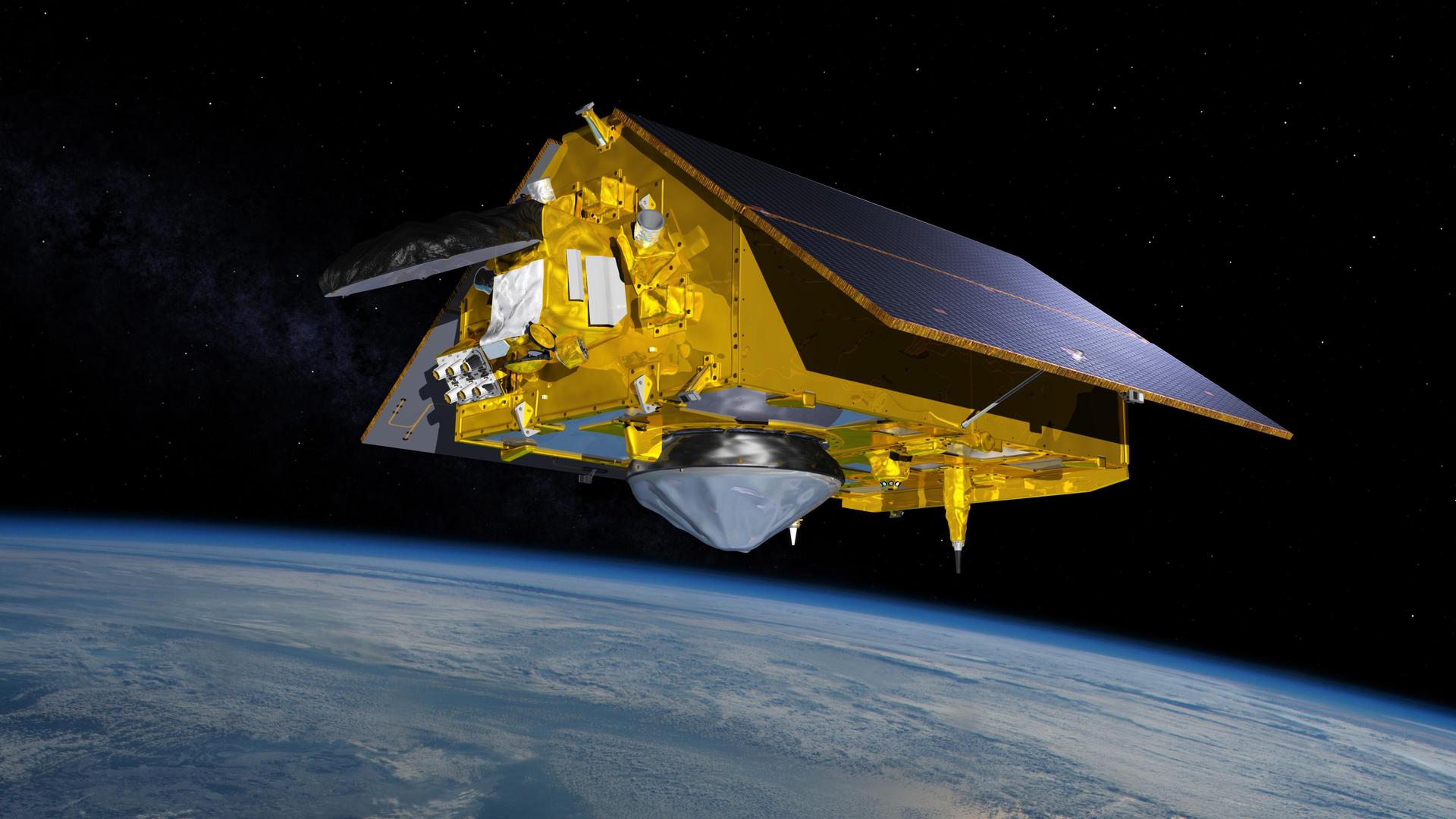
The Molniya orbit is a piece of Cold War cleverness that has been sitting in plain sight for sixty years. Tilt a satellite's orbit to 63.4 degrees, stretch it into a long ellipse, and physics does something useful: the orbit stops precessing, the spacecraft crawls near apogee, and it loiters for hours over the high latitudes the Soviets could never reach from geostationary orbit. NASA's Earth Observatory orbit catalog lays out the geometry plainly — a Molniya orbit "combines high inclination (63.4°) with high eccentricity (0.722)," takes twelve hours to go around, and "spends about two-thirds of that time over one hemisphere."
China appears to have taken that recipe and rotated it. Instead of parking the slow, high end of the ellipse over the Arctic, the Shijian-31 satellite hangs its apogee just south of the equator — above the geostationary belt, where nearly every high-value communications, early-warning and signals satellite on Earth lives.
The finding comes from commercial trackers, not governments. Integrity ISR published the orbital analysis on June 26, 2026, and it reached a wider audience on July 22 when SpaceNews reported the work alongside independent assessment from space situational awareness firm ComSpOC. Both frame the same conclusion: SJ-31 is positioned to look down on GEO, methodically, one longitude band at a time.
The orbit, in numbers
Shijian-31 — NORAD ID 69570 — launched June 16, 2026 on a Long March 3B from the Xichang spaceport. Gunter's Space Page lists the same date and site and the CZ-3B/G2 variant, and describes SJ-31 simply as a Chinese experimental satellite of unknown purpose placed into a highly eccentric Molniya orbit.
The orbital elements are where it gets interesting. Inclination sits at roughly 63.4 degrees — 63.46 by SpaceNews's figure — the same frozen inclination the Soviets used, chosen because it cancels the rotation of the orbit's apsides. Eccentricity, per Integrity ISR, is 0.69, slightly less extreme than the classical Molniya's 0.722. Perigee falls just under 2,000 kilometers; apogee reaches about 39,900 kilometers. Argument of perigee is around 171 degrees, which is the single number that gives the game away: Integrity ISR notes it places "apogee just south of the equator as the satellite approaches its ascending node," swinging the slow end of the ellipse down out of the northern high latitudes.
Geostationary satellites orbit at 42,164 kilometers from Earth's center, or roughly 36,000 kilometers above the surface. Integrity ISR pegs the practical standoff at 2,000 to 2,500 kilometers above the GEO satellites SJ-31 passes over — close enough to watch, far enough to stay clear of the traffic.
Then there is the period. A textbook Molniya orbit runs twelve hours, which locks its ground track to two fixed apogee longitudes. SJ-31 runs 12.5 hours. That half-hour of deliberate mismatch means the satellite never returns to the same spot. Its ground track walks about 15.7 degrees of longitude per cycle, and the apogee marches steadily eastward until it has completed a full 360-degree circuit of the geostationary belt in roughly 23 days. Sweeping past the belt once on each 12.5-hour revolution, it works its way around the ring like a lighthouse beam run in slow motion.
What it can actually see
It is worth resisting the temptation to describe this as a spy satellite peering into the lens caps of Western hardware. Integrity ISR is explicit that the observation distance limits SJ-31 to "unresolved detection" — it can find things, track them, and characterize their motion, but at 2,000-plus kilometers it is not returning imagery of solar panel hinges. That is a meaningfully different capability from what Integrity ISR calls "typical GEO inspectors like the US GSSAP vehicles," which operate in the belt itself.
What a top-down sweep does provide is custody. GEO is crowded, and satellites there are usually tracked from the ground, through atmosphere, at ranges of 36,000 kilometers and up, with weather and daylight getting in the way. A platform sitting above the belt, moving through it on a predictable 23-day cadence, offers a persistent overhead vantage on who is where and who has moved — precisely the kind of information that matters if a satellite quietly changes station.
The China Aerospace Science and Technology Corporation's official designation for the mission is "space environment exploration" — CASC says the satellite is "mainly used" for that. Analysts are not buying it as the whole story, but they are also careful not to overclaim. SpaceNews frames the plausible roles in terms of space domain awareness and inspector-satellite work rather than any single declared mission. Integrity ISR, for its part, notes that China has already synchronized the orbits of SY-10 01 with TJS-13 and SY-10 02 with TJS-21 to provide "dual ball" missile warning coverage over the Northern Hemisphere — a reminder that highly elliptical Chinese platforms have served warning as well as surveillance ends.
That ambiguity is the real story, and SpaceNews's account brings in Victoria Samson of the Secure World Foundation on exactly that problem. She calls the mission "pretty unusual" and "hard to characterize with limited information," while placing it in what she describes as a "larger trend toward inspector satellites and an increased interest in having strong situational awareness of activities and hardware in GEO." A sensor that watches the geostationary belt looks much the same from the outside whether it exists to warn of a launch or to keep a catalog of foreign spacecraft.
Not a one-off
SJ-31 is China's fifth satellite of this general highly elliptical class, joining SY-10 01, SY-10 02, TJS-13 and TJS-21 — the other four of which, Integrity ISR notes, keep their apogees in the traditional northern-hemisphere position. The comparable systems abroad are familiar: the U.S. GSSAP inspectors and Russia's Luch 2, both cited by SpaceNews in the same space-situational-awareness context. What distinguishes SJ-31 is not the existence of a GEO-watching satellite but the orbit chosen to do it from — an equatorially oriented Molniya variant that Integrity ISR describes as a novel operational approach among documented Chinese space systems.
Integrity ISR's own summary is the line worth keeping: "With SJ-31, Chinese space operators have displayed orbital mechanics mastery and more than a little creativity."
Why It Matters
Three things follow from this, and none of them require assuming the worst about Chinese intentions.
First, it is a demonstration of orbital fluency. Repurposing a sixty-year-old orbit by rotating its apsides and detuning its period by thirty minutes is not an expensive engineering achievement — it is a conceptual one, and it produces a surveillance pattern that would otherwise take a constellation to replicate. One satellite now covers the entire geostationary belt on a roughly three-week cycle.
Second, it changes the observation problem in both directions. Operators of geostationary satellites are accustomed to being watched from the ground and, increasingly, from within the belt. Being watched from above, persistently and on a schedule, is a different condition — and one that other space powers will now have to account for in how they maneuver and when.
Third, and most consequentially, this is another data point in a trend where the same hardware credibly serves more than one end. A missile-warning sensor and a space-surveillance sensor can be indistinguishable at the level of published orbital elements, which is precisely why analysts hedge as carefully as Samson does. Norms and arms-control conversations have no good answer for that yet, and satellites like SJ-31 keep arriving faster than the answers do.
It is also a reminder of who is doing the disclosing. None of this came from a government release. A commercial tracking firm published the elements, a second SSA company corroborated the interpretation, and the trade press carried it. The transparency layer over orbital activity is now largely privately owned — which is its own story, for another day.
Sources
- China's Shijian-31 satellite is sweeping GEO using a unique orbit — SpaceNews (Andrew Jones, July 22, 2026)
- China's SJ-31 Satellite In Position to Monitor GEO from an Unusual Highly Elliptical Orbit (HEO) — Integrity ISR (June 26, 2026)
- Catalog of Earth Satellite Orbits — NASA Earth Observatory
- Shi Jian 31 (SJ 31) — Gunter's Space Page
